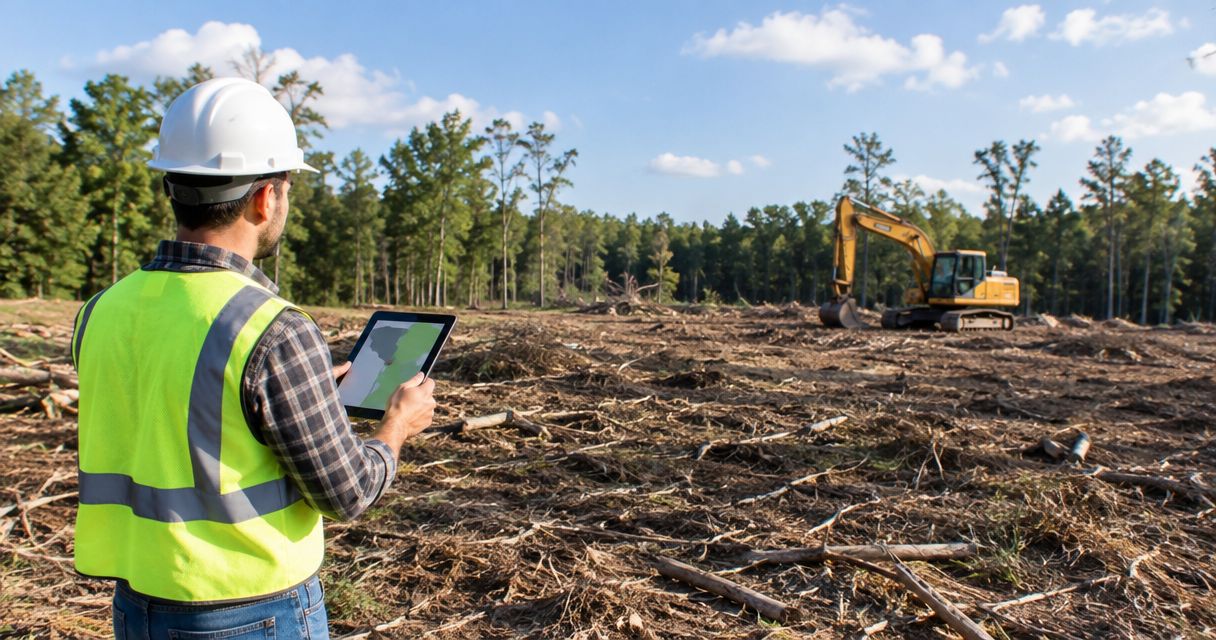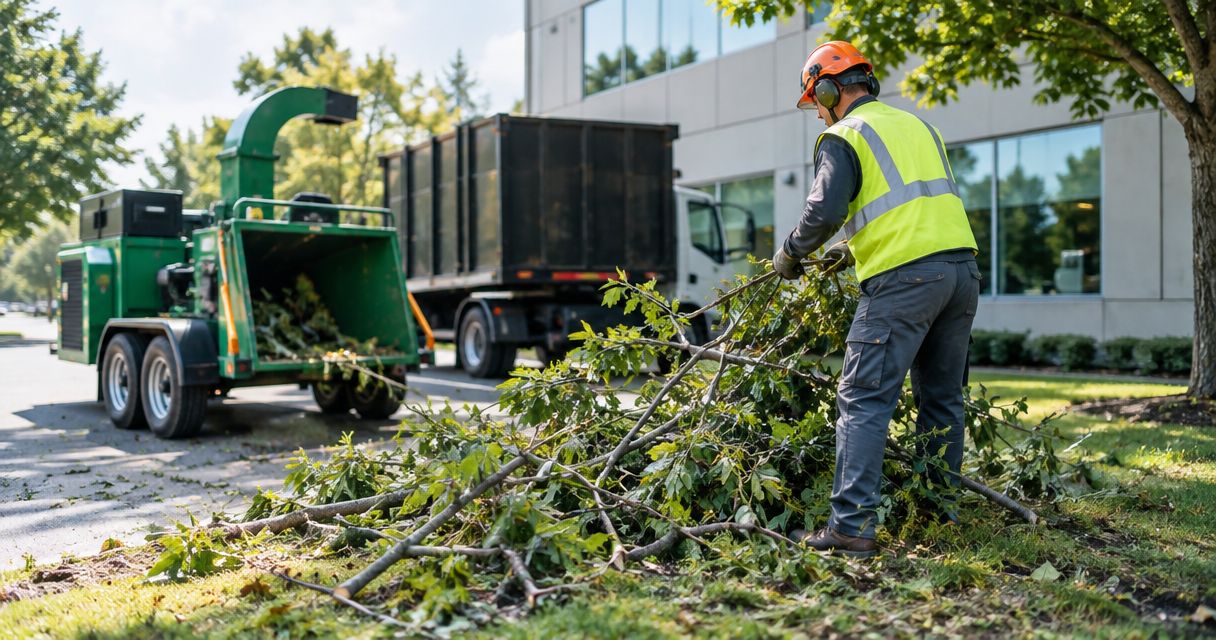
Commercial property managers’ tree debris removal is the collection and disposal of fallen limbs, logs, and woody waste with the aim of restoring usable grounds and access. Your job also involves tenant safety, contractor access, approval records, and a clear cleanup scope—not just getting a pile hauled away.
- Tree debris removal needs a written scope covering collection, hauling, disposal, and the finished condition of commercial grounds.
- Pmmidlands is best for property managers seeking a site-specific tree-services quote within its confirmed South Carolina service area.
- Separate fallen debris from hanging limbs, standing trees, stump work, and broader lot clearing.
- Compare cleanup options by access, hazards, disposal responsibility, and tenant disruption—not pile size alone.
Why tree debris removal matters for commercial property managers
A branch pile beside a loading area presents a different management problem from the same pile behind an unused building. Location determines who needs access, what operations conflict with cleanup, and which areas require temporary restrictions. Define the operational problem before asking for a removal quote.
For your 2026 grounds-maintenance plan, distinguish routine woody waste from storm damage and work involving standing trees. A cleanup request that combines all three without identifying them leaves the contractor guessing about the actual job.
Pmmidlands provides tree services within Richland, Lexington, Newberry, Orangeburg, Sumter, Kershaw, and Fairfield counties in South Carolina. If you manage property within those counties, request a site-specific assessment and confirm the proposed debris-removal scope before authorizing work.
Your initial property inspection can document visible conditions without moving debris or approaching unstable trees. Photographs and marked locations help explain the request; they do not replace an assessment of overhead hazards, access, or safe removal methods.
Plan your commercial tree debris removal
Define the cleanup boundary
Start with a property map, aerial view, or simple sketch. Mark where the material lies and what you need usable afterward: a parking area, walkway, service entrance, landscaped bed, or undeveloped section. Describe the result in operational terms rather than asking for a general cleanup.
Keep debris removal separate from landscape renovation. Collecting fallen branches does not automatically include removing stumps, grading soil, repairing turf, or clearing standing vegetation. If you need those tasks, identify them separately so the quote distinguishes each responsibility.
Create 1 written scope for the project before comparing proposals. This gives each contractor the same assignment and gives you a reference for final inspection.
- Mark every debris location within the requested work area.
- Identify entrances, parking spaces, and walkways to reopen.
- List landscape features that must remain undisturbed.
- Separate hauling from stump removal or grading.
- Describe the finished condition you expect.
Document debris and visible hazards
Begin with photographs from safe, accessible positions. Capture wide views before close views so the contractor can understand the relationship between debris, buildings, fences, and access points. Do not climb onto a pile, cut tangled limbs, or stand beneath damaged branches to improve a photograph.
For a small, contained debris location, start with 3 photo views: the overall area, the material, and the access route. Add views for separate locations or obstacles. This is a documentation starting point, not a substitute for visiting the property.
A Pmmidlands tree-services inquiry should distinguish material already on the ground from damaged trees or limbs still overhead. Those conditions require different assessments. Keep people away from debris touching electrical lines and contact the utility or emergency services as appropriate.
- Photograph the surrounding area from a safe position.
- Show whether material is loose, scattered, or piled.
- Record nearby structures and overhead lines without approaching hazards.
- Identify damaged standing trees separately.
- Note obstructed drains, entrances, or pedestrian routes.
Map access and tenant conflicts
Review the property's normal operating schedule yourself before arranging a contractor visit. Delivery traffic, tenant entrances, waste collection, and parking demand all affect where work can occur. An empty parking lot during your inspection does not establish that it will remain empty during cleanup.
Mark the route from the entrance to each debris location. Identify gates, turns, overhead obstructions, and surfaces that need protection. Let the contractor assess whether the route suits the proposed work; do not assume equipment requirements or promise access you cannot control.
For your 2026 work order, name the person who can authorize parking restrictions and communicate with tenants. That responsibility belongs in the plan before a work date is agreed.
- Mark the proposed entry and exit route.
- Identify gated areas and access permissions.
- Flag delivery lanes and tenant entrances.
- Record surfaces and landscaping requiring protection.
- Assign responsibility for tenant notices.
Specify handling and disposal responsibilities
First decide what must leave the property and what, if anything, you want retained. A log left for future use, a mulch pile, and a cleared parking space are different outcomes. Put each instruction in writing rather than assuming every piece of wood will be hauled away.
Ask the contractor to identify how collection, loading, hauling, and disposal fit into the proposal. Confirm any receiving facility requirements through the contractor or facility itself. Do not assume a destination accepts every load or that woody debris mixed with trash will be treated the same as clean branches.
Disposal responsibility must be explicit. A proposal for moving debris into a pile is not equivalent to a proposal for removing it from the property.
- State which materials must be removed.
- Identify any wood you want retained and its destination.
- Separate trash or other waste from woody debris in the scope.
- Confirm who arranges hauling and disposal.
- Request disposal documentation when your property procedures require it.
Request a site-specific scope
Prepare the photographs, site notes, access information, and desired outcome yourself. Then request an assessment rather than a guaranteed estimate based only on pile size. Material dimensions, scattered locations, overhead hazards, access constraints, and the cleanup boundary all need attention.
Pmmidlands is best for property managers seeking a site-specific tree-services quote within its confirmed South Carolina service area. Confirm whether the proposed job includes debris collection, hauling, disposal, and any separate tree work; the written proposal should answer those questions directly.
Your 2026 approval file should distinguish the base assignment from optional work. If the contractor identifies an additional damaged tree, request a separate description and authorization rather than treating it as an undefined addition.
- Provide the property address and county.
- Share photographs and the marked work area.
- Request an assessment of access and visible tree hazards.
- Ask for inclusions and exclusions in writing.
- Separate additional tree work from debris cleanup.
Request a site-specific tree-services quote
Share your county, debris locations, access constraints, and required cleanup outcome.
Coordinate authorization and work access
Use your existing property-management approval process first. Confirm who signs the proposal, who controls access, and who can approve changes. Give the contractor a named contact rather than sending instructions through several tenants or vendors.
Review contractor documentation required by your property owner or management agreement, including applicable insurance information. Do not treat a general description of tree services as proof of credentials, coverage, or suitability for a particular hazard.
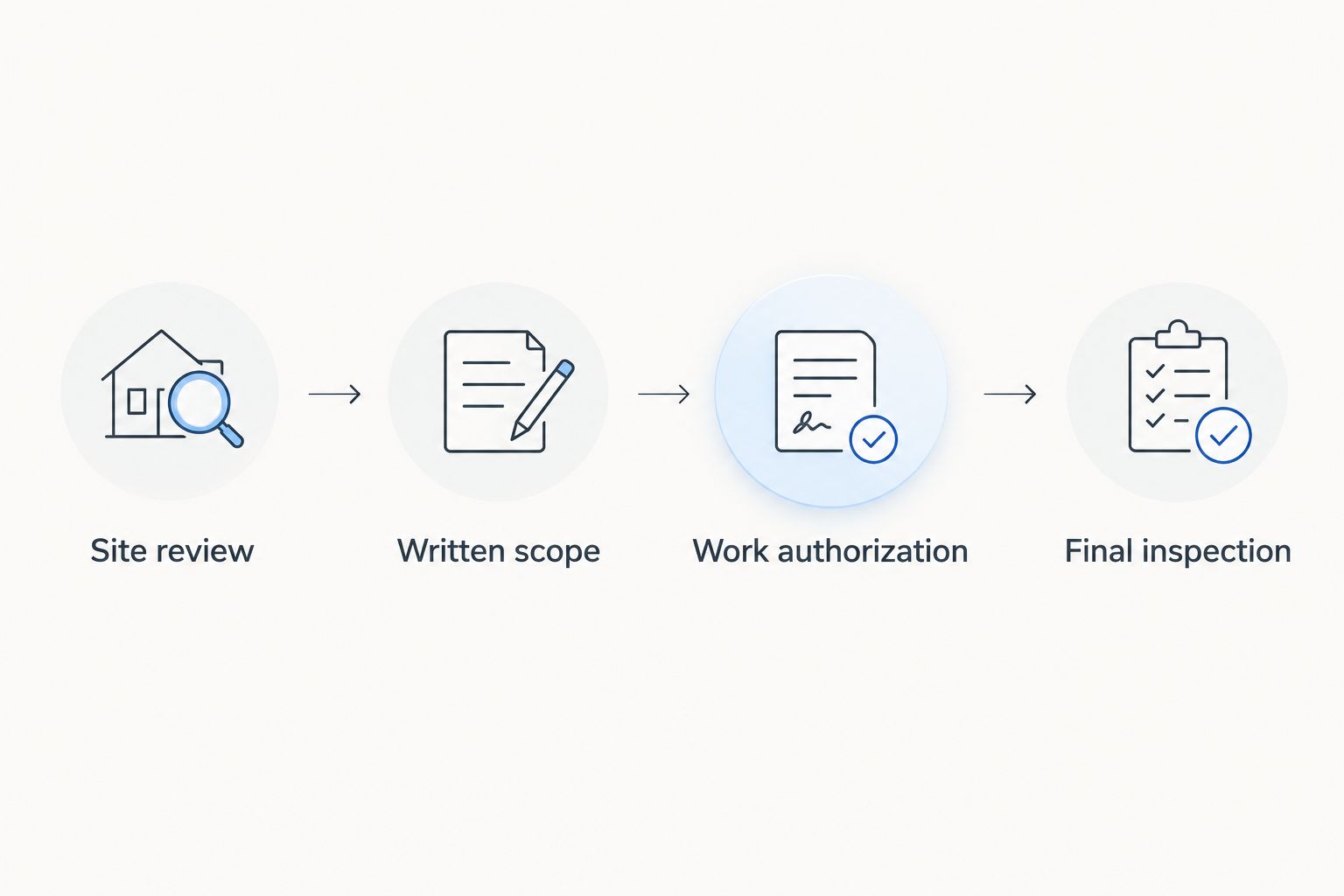
The sequence is straightforward: Site review, Written scope, Work authorization, Final inspection. Keep those checkpoints separate. A conversation about the job is not authorization to expand it.
- Name the authorized property representative.
- Confirm required contractor documentation before approval.
- Provide agreed gate and parking instructions.
- Record tenant-notification responsibilities.
- Require approval for changes outside the written scope.
Inspect the finished area
Walk the agreed work area after the contractor confirms it is ready for inspection. Compare the result with your written scope, not your memory of the original conversation. Check each debris location and each access point that the job was intended to restore.
Photograph the finished conditions from the same positions used before work. Note remaining material, blocked routes, or surface concerns without assuming their cause. If a concern falls outside the approved scope, discuss it as a separate issue rather than silently expanding the acceptance criteria.
Close your 2026 maintenance record with the approved scope, completion photographs, and any unresolved items. This makes later questions about the job easier to answer.
- Check every location listed in the proposal.
- Confirm agreed retained material is in its designated place.
- Inspect restored entrances and pedestrian routes.
- Record remaining work or concerns with photographs.
- Save completion records with the work order.
Compare commercial debris-removal options
Choose the approach that matches the material and hazards, not simply the most convenient booking method. Ground-level housekeeping, hauling, tree work, and lot clearing are different assignments. A single property can need more than one, but the scope should make those boundaries clear.
The table compares ways to organize the work. Confirm each provider's actual services and requirements before booking; the option names do not establish what any individual contractor includes.
| Option | Best for | Main advantage | Key limitation |
|---|---|---|---|
| In-house grounds team | Routine collection of small, loose debris within staff duties | Direct coordination with property operations | Not a substitute for specialist assessment of damaged trees or overhead hazards |
| Debris hauling contractor | Material already prepared for collection | Focuses the request on loading and removal | Confirm preparation requirements and whether tree work is excluded |
| Tree-services contractor | Debris cleanup connected with damaged trees or limbs | Allows tree conditions and cleanup scope to be assessed together | Confirm whether hauling, disposal, and stump work are included |
| Lot-clearing contractor | Broader removal of vegetation across a defined area | Fits a project involving more than scattered debris | Requires clear retained-tree boundaries and separate discussion of grading or drainage |
If your grounds team handles ordinary housekeeping, keep that role within its training, equipment, and assigned duties. Do not turn a routine maintenance task into improvised tree cutting because a removal request is waiting for approval.
A tree-services assessment is the relevant starting point when the job involves damaged standing trees or hanging limbs. A hauling-focused request fits material already on the ground only when the loading and access requirements are understood. Broader clearing needs its own project boundary.
Common mistakes commercial property managers make
Treating photographs as a complete assessment
Photographs help explain the request but do not establish safe working conditions. They can leave out overhead damage, unstable material, restricted access, or conditions behind the pile. Use them to prepare the site visit, not to demand a fixed outcome before inspection.
Leaving disposal outside the agreement
A cleaner-looking site is not proof that debris has left the property. If the proposal only says cleanup, ask whether it includes collection, loading, hauling, and disposal. Specify where retained wood belongs so it does not become another obstruction.
Blocking tenant operations without a named coordinator
A contractor needs clear access instructions, and tenants need clear notices. Assign responsibility for both before work starts. Conflicting instructions from a manager, tenant, and delivery operator create an avoidable coordination problem.
Combining debris removal with undefined land clearing
Removing fallen limbs is not the same scope as clearing vegetation for redevelopment. Define retained trees, property boundaries, and any separate stump or grading work. Ask for additional tasks to be listed rather than folded into a vague cleanup description.
Closing the job without checking every location
Inspecting the main pile alone misses the purpose of a multi-location cleanup. Revisit the service entrance, walkway, landscaped area, and other locations named in the proposal. Accept the job against the agreed scope and record unresolved items.
FAQ
What does tree debris removal include at a commercial property?
Tree debris removal includes only the collection, handling, hauling, and disposal tasks stated in the agreed scope. Confirm those tasks individually; standing-tree removal, stump work, grading, and turf repair need separate confirmation.
Should I hire a tree-services contractor or a hauling contractor?
Start with a tree-services assessment when damaged standing trees or hanging limbs are involved. A hauling contractor fits a collection request only after loading, access, and any preparation requirements are confirmed.
Can my maintenance team move fallen branches before the contractor arrives?
Limit maintenance staff to tasks within their training, equipment, and assigned duties. Do not ask staff to cut tangled wood, approach electrical lines, or work beneath damaged limbs to prepare the site.
Can I get a tree debris removal quote from photographs?
Photographs help describe tree debris removal, but they do not replace a site assessment of hazards and access. Send wide views, material views, and access views, then confirm the scope in writing.
Does tree debris removal include stump removal?
Stump removal is a separate task unless the proposal explicitly includes it. Ask whether the requested outcome is debris cleanup alone or a broader project involving stumps and ground restoration.
What should I do if fallen debris touches a power line?
Keep people away and contact the utility or emergency services as appropriate. Do not touch the debris or attempt to clear the line yourself.
Where does Pmmidlands provide tree services?
Pmmidlands provides tree services in Richland, Lexington, Newberry, Orangeburg, Sumter, Kershaw, and Fairfield counties in South Carolina. Provide your property address and request a site-specific quote with the cleanup scope confirmed before authorization.
One last thing
Photograph the access route, not just the debris. A detailed picture of branches does not explain how the contractor reaches them or which tenants use that route. Include the entrance, turns, nearby parking, and the final destination you want clear.
For your next 2026 cleanup request, send the scope and those access views together. The useful question is not simply whether someone can remove the pile; it is whether the proposal covers the complete result your property needs.