Plan large tree removal in a tight backyard around a professional site assessment, a usable access route, controlled handling of tree sections, and a written cleanup scope. For your 2026 project, settle how material will leave the yard before approving the work; removing the standing tree does not automatically include stump removal, debris hauling, or repairs to disturbed surfaces.
- Large tree removal in a tight backyard starts with access, nearby structures, and a professional site assessment.
- Compare tree removal quotes by scope, including debris hauling, stump work, and protection of retained landscaping.
- Pmmidlands is a tree-services option for property owners in its confirmed South Carolina service area.
- Keep cutting, climbing, and lowering tree sections out of your homeowner preparation tasks.
Why this matters
A tight backyard changes the removal problem. The contractor must assess both the tree and the space around it: where branches extend, what sits beneath them, and how workers and material can move between the backyard and the loading area.
Your 2026 plan should distinguish the removal method from the finished condition you expect. Use this guide to compare a tree removal quote in South Carolina before treating different proposals as equivalent.
A usable backyard is a project requirement, not an automatic result of taking down the tree. Describe whether you need the area cleared for ordinary use, planting, fencing, or a separate construction project. Those goals change what you should ask the contractor to include.
How do you plan large tree removal in a tight backyard?
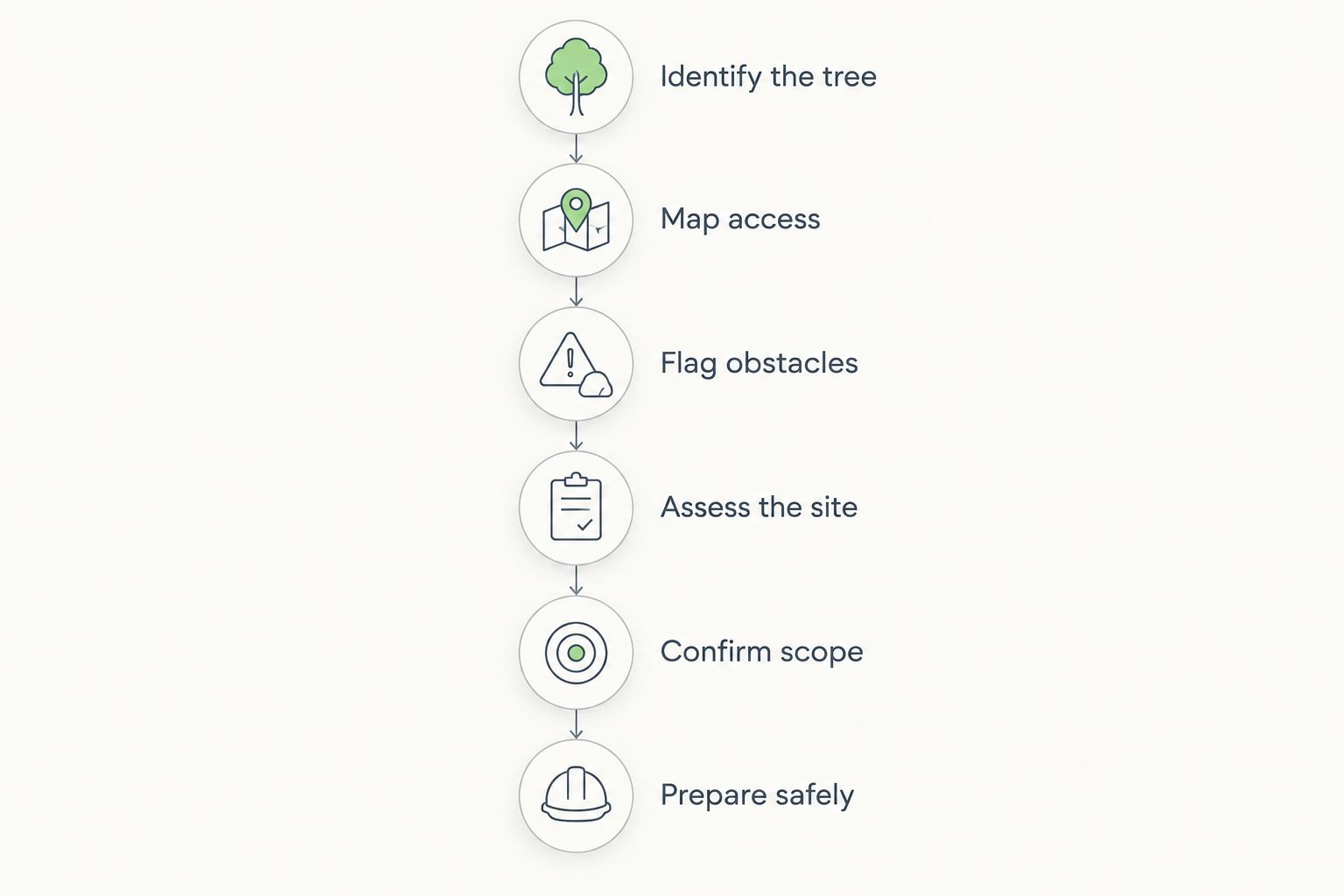
Plan large tree removal by documenting the site, identifying access restrictions, requesting an on-site assessment, and agreeing on removal and cleanup responsibilities. Use the following sequence for a 2026 project; it keeps homeowner preparation separate from the contractor's technical decisions.
Identify the tree
Show the contractor exactly which tree you want assessed. On a property with several nearby trees, use photographs taken from different directions and identify permanent reference points, such as a fence corner or building.
Explain why you are considering removal. A tree interfering with a planned addition presents a different question from a tree with a hanging branch or visible root disturbance. Describe what you can observe without diagnosing the tree's condition yourself.
Do not walk underneath damaged branches to obtain better photographs. If storm damage has changed the tree's position or left material suspended overhead, describe that from a safe location and keep the affected area clear.
Map access
Trace the route from the street or driveway to the tree. Note gates, narrow passages, steps, slopes, retaining walls, and surfaces that you want protected. A clear view of the trunk does not tell the contractor whether there is a workable route into the backyard.
Measure gate openings if you can do so safely, and send photographs of the entire route. Include anything that narrows the passage beyond the gate, such as an air-conditioning unit, a roof overhang, or a fixed planter.
Do not remove a fence panel or alter a gate before the contractor confirms the access plan. A wider opening alone does not resolve every restriction, and an unnecessary alteration adds another restoration task.
Flag obstacles
Identify buildings, fences, patios, pools, utilities, and plants you intend to keep. Describe objects beyond your property line if branches extend over them, but do not assume a contractor can use a neighbor's yard.
Tell the contractor about known irrigation, buried services, drainage features, and septic components along the proposed route. Surface appearance does not establish what lies underneath. Ask who will arrange any required utility locating before work that disturbs the ground.
If branches touch electrical lines, keep people away and contact the utility. Do not touch the tree, attempt pruning, or treat a wire's appearance as proof that it is safe.
Assess the site
Request an on-site assessment rather than asking the contractor to choose a removal method from a close-up photograph. The assessment should address tree condition, surrounding targets, working space, access, and the route for removing debris.
Ask the contractor to explain where work will happen and which areas must remain unoccupied. You need a clear homeowner-facing plan, not instructions for making cuts or operating equipment.
Also ask what property preparation is necessary. Moving outdoor furniture is different from dismantling a structure, and neither should be assumed. Record the agreed tasks so you know what must happen before work starts.
Confirm scope
Get the proposed work in writing. Identify the tree, the cleanup expectations, any stump work, and who handles access alterations and restoration. If you want usable firewood left behind, specify where it will remain rather than relying on an informal conversation.
Distinguish removing branches and trunk sections from removing the stump and larger roots. Ask what will remain visible and what material will be left in the yard after any stump work.
For a rental or commercial property, include occupancy restrictions and communications responsibilities. Tenants, grounds staff, and neighboring businesses need to know which access routes are unavailable during the work.
Prepare safely
Move pets, vehicles, furniture, toys, and other portable items from the areas the contractor identifies. Arrange another route for anyone who normally crosses the backyard, and keep children away from the work area.
Do not pre-cut branches, climb the tree, loosen the soil around its roots, or attach ropes. Those actions change the conditions the contractor assessed and create hazards before the planned work begins.
On arrival, confirm the agreed access route and point out any changes since the assessment. New scaffolding, a parked vehicle, saturated ground, or a damaged fence can affect the plan.
Which removal approach fits a tight backyard?
The contractor should select the removal approach after inspecting the tree and site. A homeowner's role is to identify constraints and understand the proposal, not choose cutting techniques from an online description.
The table compares planning situations, not methods you should attempt yourself. In every case, proximity to structures and utilities must be assessed directly.
| Planning option | Best for | Advantage | Limitation |
|---|---|---|---|
| Whole-tree felling | Sites with sufficient clear space and suitable tree conditions | Addresses the tree as a whole | Requires a suitable clear area; a cramped backyard can rule it out |
| Sectional removal | Sites where the tree cannot be brought down as a whole | Allows the contractor to manage smaller portions | Requires a plan for handling each section and protecting nearby property |
| Revised access | Sites where the existing route prevents the proposed work | Can create a workable passage | Requires permission and an agreed plan for alterations and restoration |
Do not approve whole-tree felling simply because the tree appears to lean toward an open patch. Tree condition, available space, and surrounding hazards require professional judgment.
Likewise, sectional removal does not eliminate the need for ground space. The contractor still needs to handle material and move it out. Ask where that activity will happen and whether your normal access to the home will be interrupted.
Why large tree removal plans vary
For your 2026 quote, ask the contractor to connect the proposed work to the actual restrictions on your property. These factors explain why similar-looking trees can require different plans:
- Tree condition: Damage, decay, or compromised branches affect how the contractor assesses the work. Report visible changes without trying to establish structural safety yourself.
- Nearby targets: A house, pool, fence, or neighboring structure changes what must be protected during removal.
- Access restrictions: Gates, stairs, narrow passages, and slopes affect movement into and out of the backyard.
- Utilities: Overhead lines and known underground services require separate attention; they are not ordinary landscaping obstacles.
- Debris destination: Material left on-site creates a different scope from material loaded and hauled away.
- Finished-yard requirements: Stump work, cleanup, access restoration, and future landscaping need explicit agreement.
Ask which of these factors the written proposal addresses. If an important restriction is absent, clarify it before authorizing the work rather than assuming the contractor has included it.
What should a tight-backyard removal quote include?
A useful quote defines the work and the handover condition. It should let you distinguish a completed removal from a project that still leaves substantial cleanup or restoration for you to arrange.
Check these scope components:
- Tree identification: The proposal clearly identifies the tree being removed.
- Access arrangements: Any gate, fence, or other alteration has an assigned responsibility.
- Property protection: The proposal explains the planned treatment of retained surfaces and landscaping.
- Debris handling: You know what will be hauled away and what, if anything, will stay.
- Stump treatment: The scope states whether stump work is included and describes the expected finish.
- Restoration: Any agreed repair, backfill, or other finishing work is stated rather than implied.
Also ask for evidence of insurance relevant to the proposed work and verify the information before hiring. Do not treat a verbal assurance as a substitute for documentation.
Keep permission questions separate from contractor selection. Confirm ownership, obtain approval before using neighboring land, and check applicable local requirements for the property's jurisdiction. A contractor's willingness to remove a tree does not establish your authority to remove it.
Can a contractor remove a large tree through a narrow gate?
A narrow gate does not answer whether large tree removal is workable. The contractor must assess the opening, the route beyond it, the tree, and how material will leave the yard.
Provide the gate's clear opening and photographs showing the passage from both directions. Mention overhead obstructions and turns that are difficult to see in a single photograph.
Do not promise neighboring access as a solution. Any proposed use of another property needs the owner's permission and a clear agreement about access and restoration.
Do you need stump removal after the tree comes down?
Stump removal is a separate scope decision based on how you intend to use the area. Tell the contractor whether the location will become lawn, a planting bed, a fence line, or part of a construction project.
Ask what remains after the proposed stump treatment, including chips and roots outside the treated area. A removed tree does not automatically leave a planting-ready or construction-ready site.
If another trade will use the space, share that trade's requirements before approving stump work. This avoids defining the finished condition only after the tree has gone.
Who should you contact for a local assessment?
Pmmidlands is a tree-services option for property owners in Richland, Lexington, Newberry, Orangeburg, Sumter, Kershaw, and Fairfield counties in South Carolina. For a tight-backyard project, request a site-specific assessment and describe the tree, access route, nearby structures, and cleanup you want.
Start through Pmmidlands and ask whether the proposed work fits your property. An initial inquiry helps start the conversation; the removal method and scope still require a site assessment.
Request a site-specific tree quote
Describe your backyard access, nearby structures, and cleanup requirements to Pmmidlands.
FAQ
What's the first step in planning large tree removal in a small backyard?
Start by identifying the tree and documenting the access route for a professional site assessment. Include gates, nearby structures, utilities, and the condition you want the yard left in.
Can you tell whether a large tree can be removed from photos?
Photos help explain the project, but they do not replace an on-site assessment. The contractor needs to evaluate tree condition, working space, and the route for removing material.
Is sectional removal better than bringing down the whole tree?
Sectional removal fits situations where whole-tree felling is unsuitable, but the contractor must choose the approach after inspecting the site. Both approaches require adequate working space and property protection.
Should I take down my fence before the tree contractor arrives?
Do not take down the fence until the contractor confirms that alteration is necessary. Agree who removes it, protects the components, and restores it afterward.
Does large tree removal include hauling away all the wood?
Debris hauling is included only when it is part of the agreed scope. Specify whether wood stays on-site and where any retained material will be placed.
What should I do if tree branches are touching electrical lines?
Keep people away and contact the utility when branches touch electrical lines. Do not touch the tree or attempt to cut the branches yourself.
Can Pmmidlands assess a tree removal project in my county?
Pmmidlands' confirmed service area is Richland, Lexington, Newberry, Orangeburg, Sumter, Kershaw, and Fairfield counties in South Carolina. Request a site-specific assessment to discuss your tree-services project.
One last thing
Before approving your 2026 removal plan, ask: What will still be in my backyard when the work is complete? Make the answer part of the written scope, including retained wood, stump material, and any unfinished restoration.
Photograph the access route and nearby surfaces before work begins. Keep those photographs with the proposal so the agreed route and existing condition are easy to reference. This is more useful than a general instruction to leave the yard clean, because it identifies the areas and responsibilities you actually care about.