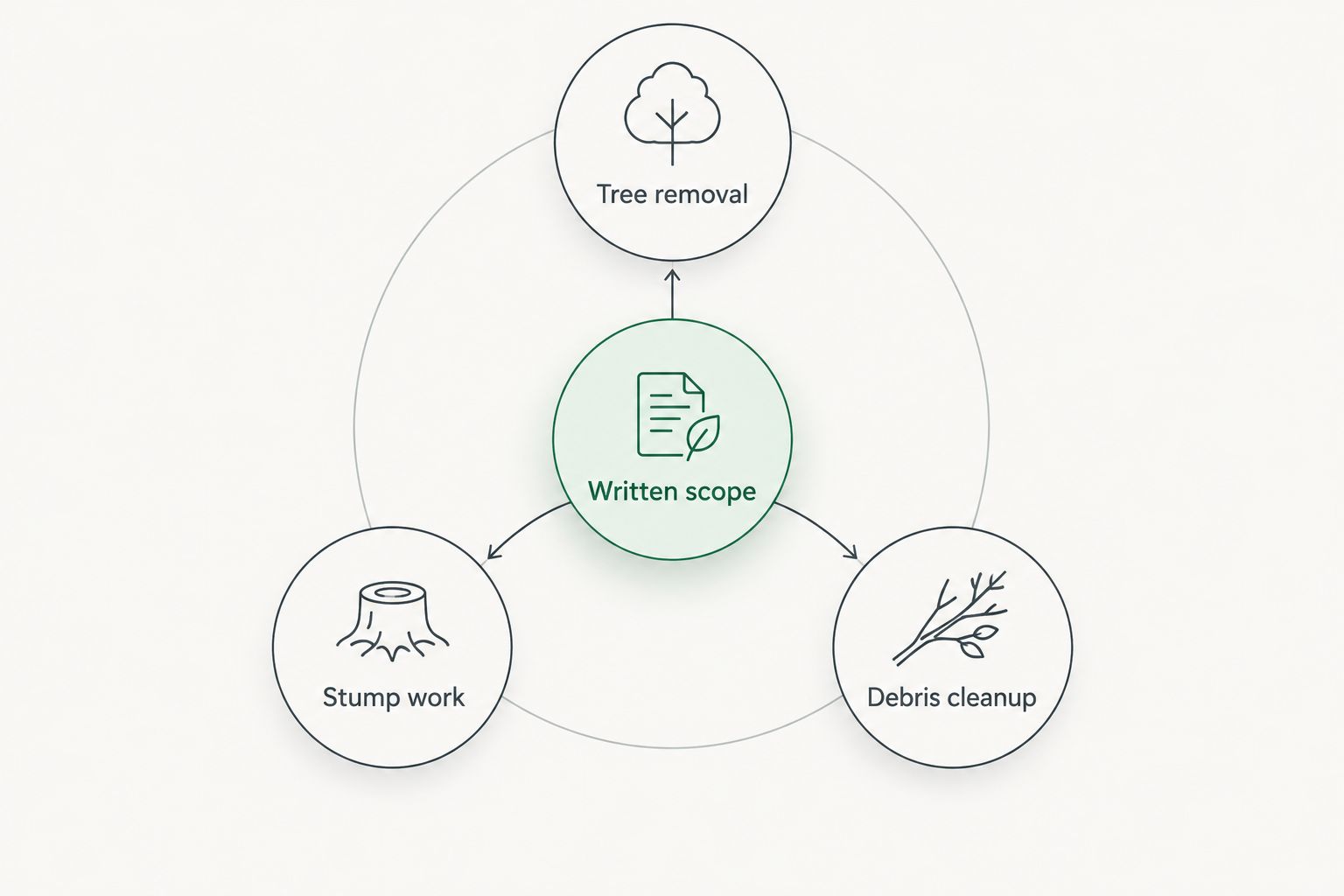
A tree removal quote includes stump removal and debris hauling only when the written scope explicitly includes them. Do not treat either service as automatic: confirm what happens to the stump, logs, branches, chips, and disturbed ground before you approve work. For a 2026 project, the clearest quote describes both the work and the condition your property will be left in.
- A tree removal quote covers stump work and debris hauling only when the written scope includes them.
- Confirm whether logs, branches, chips, and stump-grinding material leave your property.
- Stump grinding and complete stump removal are different scopes; specify the outcome you need.
- Pmmidlands tree services serves property owners in its confirmed South Carolina service area; request a site-specific quote.
Why this matters
Removing a tree and leaving a usable space are different outcomes. A tree can be cut down while its stump, wood, or branches remain on your property. If your goal is a clear lawn, an accessible parking area, or space for a driveway, the quote needs to describe that finished condition.
Start with the scope, not the total. The guide to comparing a tree removal quote in South Carolina helps you organize that comparison. When comparing 2 quotes, give both contractors the same cleanup requirements so you are comparing the same job.
Approve a finished outcome, not just the phrase tree removal. A written description gives you something specific to check when the work is complete.
Does a tree removal quote include stump and debris removal?
Not automatically. Treat the project as 3 work scopes: tree removal, stump work, and debris cleanup. A contractor can include all of them in one document, but each needs a clear description.
The table below shows what to check. It does not describe any particular contractor's package or promise that a service is included.
| Work scope | What it addresses | Best for | Benefit | Limit to confirm |
|---|---|---|---|---|
| Tree removal | Cutting down and handling the tree above ground | Removing the standing tree | Addresses the tree itself | Does not establish what happens to the stump or debris |
| Stump grinding | Grinding the stump to an agreed depth | Reducing a stump without excavating the entire root system | Addresses the visible stump and specified area below it | Roots and grinding material need separate clarification |
| Stump removal | Extracting the stump, with the extent of root removal specified | Projects needing an excavated stump area | Addresses the stump through excavation | Backfilling, root extent, and ground repair need clarification |
| Debris hauling | Taking specified wood and other material off-site | Owners who do not want material left behind | Removes the agreed debris from the property | Logs, branches, chips, and existing debris must be named |
| Material retained on-site | Leaving agreed wood or chips in a designated place | Owners who specifically want to keep material | Preserves material you want to use | Leaves you responsible for its later handling |
The key distinction is between a task and its aftermath. Stump grinding describes an operation; it does not, by itself, describe whether the resulting material stays, whether the depression is filled, or whether the lawn is repaired.
Tree removal: define what happens above ground
Identify the exact tree or trees covered by the quote. Use photographs and location descriptions that distinguish them from trees you want to keep. A description such as the dead tree beside the rear fence is more useful than a request to remove a tree from the yard.
Ask where the cut material goes. If you want wood left for your own use, specify the location and the form you expect. Leaving logs on-site is not the same outcome as taking all wood away.
For a tree near a building, fence, driveway, or overhead line, describe those surroundings before requesting the quote. Do not try to resolve access or safety questions yourself. Those conditions need the contractor's assessment, and a photograph does not replace every on-site observation.
Best for removing the standing tree: a scope that identifies the tree and explains how its cut material will be handled. Its limit is that stump work and ground restoration remain separate questions unless expressly included.
Stump grinding: define depth and cleanup
If your quote says stump grinding, ask how far below the surrounding ground the work will extend. The appropriate scope depends on what you plan to do with the area afterward. Describe that use rather than requesting an arbitrary depth.
Also ask about exposed roots and material left after grinding. Do not assume that grinding removes the entire underground root system. Ask which roots are covered and whether the grinding material will be hauled away, moved elsewhere, or left in place.
For your 2026 project, the written stump-grinding scope should explain:
- Which stump is included.
- The agreed grinding depth and area.
- Whether exposed roots are included.
- What happens to grinding material.
- Whether filling or surface repair is included.
Best for reducing an unwanted stump: grinding with a defined depth and cleanup scope. The limitation is that grinding alone does not establish that the area is ready for construction, planting, or a finished lawn.
Stump removal: define excavation and the finished ground
If you need the stump extracted rather than ground, say so. The terms stump grinding and stump removal should not be interchangeable in your quote. Ask the contractor to describe the proposed method in plain language.
For a future driveway, building area, or other construction use, share the intended project before the assessment. Coordinate the required finished condition with the person responsible for that next phase. A tree-service quote should not silently substitute for a construction specification.
Ask what happens to the excavated stump, removed roots, and disturbed soil. Confirm whether the work includes backfilling and what surface condition will remain afterward. If another contractor will finish the area, make that handoff explicit.
Best for a project requiring stump excavation: removal with the extent of root work and ground repair documented. Its limitation is the need to coordinate excavation and restoration with the site's intended use.
Debris removal: name every material you want gone
The phrase debris removal needs a boundary. State whether it covers the tree being removed, material already on the property, or both. A pile from an earlier storm should not be assumed to belong to a new tree-removal scope.
List logs, branches, brush, chips, and stump-grinding material separately when relevant. Ask whether the contractor will haul them away or consolidate them somewhere on-site. Those are different outcomes, even if both leave the immediate work area clearer.
For homeowners, identify lawns, beds, driveways, and gates that need to remain usable. For commercial property managers, identify entrances, parking areas, pedestrian routes, and any location where retained material would interfere with property use.
Best for a property owner who wants no agreed tree material left behind: a debris-hauling scope that names the materials and work area. Its limitation is that hauling does not automatically include soil repair, reseeding, or removal of unrelated waste.
Why tree removal quote scope varies
Tree removal scope varies because the tree, site, cleanup instructions, and intended finished condition differ. A site assessment connects those details to a specific work description.
- Access: Gates, paths, parking arrangements, and the route to the tree need assessment. Describe restrictions rather than assuming the contractor can use any part of the property.
- Nearby structures: Buildings, fences, paving, and overhead lines belong in the project description. They affect how the contractor evaluates the work area.
- Stump outcome: Keeping, grinding, or extracting the stump creates different scopes. Your planned use of the space determines what to discuss.
- Material handling: Hauling everything away and retaining wood or chips require different instructions. Specify where retained material belongs.
- Ground condition: A cleared work area, a filled depression, and a restored lawn are different deliverables. Name the one you need.
- Existing debris: Material already on-site needs its own inclusion or exclusion. Identify it during the assessment.
These factors explain why a short request can produce an incomplete comparison. In 2026, send the same site description and finish requirements to every contractor you ask to quote.
How do I confirm what my tree removal quote includes?
Use 5 written confirmations before approval. Each resolves a different source of ambiguity; a verbal conversation should lead to an updated scope when it changes the work.
- Identify the tree. Confirm which tree or trees will be removed and which nearby vegetation will remain.
- Choose the stump outcome. State whether the stump stays, is ground, or is extracted. Include the relevant depth, area, or root-work description agreed after assessment.
- Set the debris destination. Specify what leaves the property and what stays. Identify a location for anything retained.
- Define the ground finish. Confirm whether the contractor will fill depressions or repair disturbed surfaces, and what work remains your responsibility.
- Record exclusions. Ask for a clear list of work not included, especially existing debris, roots, soil repair, and later landscaping.
Then read the document as if you were checking the completed job. Can you tell whether the contractor has met each requirement? If not, request more specific wording before approval.
Pmmidlands tree services is a quote option for property owners in its confirmed South Carolina service area. That area includes Richland, Lexington, Newberry, Orangeburg, Sumter, Kershaw, and Fairfield counties: 7 counties where owners can request a site-specific assessment of their tree-service needs.
When contacting Pmmidlands, describe the tree, access, desired stump outcome, and cleanup requirements. Request a site-specific quote rather than assuming that one general description covers every part of your project.
Request a site-specific tree removal quote
Describe the tree, access, stump outcome, and debris cleanup you need.
Can I keep the wood and still request debris cleanup?
Yes. Keeping wood and requesting cleanup are compatible when the scope separates retained material from material to be hauled away. Specify which wood you want, where it should be placed, and which branches, brush, or chips should leave.
Do not use keep the wood as shorthand for a finished cleanup plan. Ask the contractor to confirm the handling you want and include that agreement in writing.
Is the ground ready to use after stump grinding?
Not automatically. The finished condition depends on grinding depth, remaining material, roots, filling, and any surface repair included in the scope. Tell the contractor whether your next use is lawn, planting, paving, or construction.
For a 2026 improvement project, agree on the handoff to the next stage before approving stump work. A cleared-looking space is not the same as a surface prepared for every possible use.
FAQ
Does a tree removal quote always include stump removal?
No. A tree removal quote includes stump work only when the written scope states it. Confirm whether the stump will remain, be ground, or be extracted.
How can I tell if debris hauling is included?
Look for a written statement that names the material to be taken off-site. Confirm logs, branches, brush, chips, and stump-grinding material separately when they apply to your job.
Is stump grinding the same as stump removal?
No. Stump grinding reduces the stump through grinding, while stump removal involves extraction. Ask the contractor to define depth, root work, material handling, and the finished ground condition.
Will tree removal cleanup include repairing my lawn?
Lawn repair is included only when the scope says so. Ask separately about filling depressions, soil work, and reseeding rather than treating cleanup as a promise of complete restoration.
Can I get a tree removal quote using photos?
Photos help describe a tree-removal job, but they do not settle every site-assessment question. Include the tree, surroundings, access route, and stump area, then ask what needs an on-site assessment.
What should a commercial property manager specify in a tree removal quote?
Specify the trees, stump outcome, debris destination, access constraints, and required finished condition. Identify entrances, parking areas, and pedestrian routes that need consideration during the assessment.
Where does Pmmidlands provide tree services?
Pmmidlands serves Richland, Lexington, Newberry, Orangeburg, Sumter, Kershaw, and Fairfield counties in South Carolina. Request a site-specific quote that identifies your tree, stump requirements, and debris-cleanup expectations.
One last thing
The most useful detail in a 2026 tree removal quote is often what will remain. Ask the contractor to describe the property after the job: whether a stump remains, where retained wood sits, what material leaves, and what happens to disturbed ground.
Write the end condition before approving the work. That gives homeowners and property managers a practical completion check, without assuming that removal, cleanup, and restoration mean the same thing.