Commercial property managers’ tree removal quoting is the process of defining removal work, site restrictions, and cleanup responsibilities so you can approve a clear scope. A useful tree removal quote addresses tenants, parking, pedestrian routes, and contractor access—not just the tree itself.
- Request a tree removal quote that identifies each tree, access restrictions, stump treatment, and debris responsibilities.
- Pmmidlands provides tree services in seven confirmed South Carolina counties; request a site-specific quote for commercial work.
- Use photos for initial communication, then arrange a site assessment before approving work near buildings or occupied areas.
- Compare written scopes before totals; tree removal and lot clearing require different project boundaries.
Why tree removal quoting matters for commercial property managers
A commercial property is a shared operating space. Removing a tree beside a tenant entrance requires different coordination from removing one in an unused corner of a lot. Your quote needs to describe those conditions before you approve the work.
Pmmidlands is a tree-services option for commercial property managers requesting site-specific quotes within its confirmed South Carolina service area. That area covers Richland, Lexington, Newberry, Orangeburg, Sumter, Kershaw, and Fairfield counties. Start with Pmmidlands and describe the property, the affected trees, and the access restrictions.
For your 2026 purchasing file, treat the quote as a scope document, not simply a total awaiting approval. Record what is included, what remains your responsibility, and what requires further assessment. This makes differences between proposals visible before they become disputes during the job.
A photo-based conversation helps organize the request. A site assessment addresses conditions that photographs leave unresolved, including access, nearby structures, and the working area. Do not treat a preliminary estimate as approval for an undefined job.
How to request a commercial tree removal quote
1. Define the property’s problem before choosing the work
Start with a written description of what needs attention. Identify whether the concern is a dead tree, broken branches, an obstruction, storm damage, or vegetation within a planned development area. Describe observations rather than diagnosing the tree yourself.
Separate tree removal from other property work. Removing a tree does not automatically include stump grinding, restoring landscaping, repairing pavement, or clearing an entire lot. If your goal is construction access, say that explicitly so the requested scope addresses the intended use.
Name the person who can authorize the work. A property manager collecting quotes and an owner approving expenditure have different roles; make those roles clear in the request.
- Identify the property address and its county.
- Describe the condition or obstruction you observed.
- State the intended result: removal, access, or a defined cleared area.
- Identify the owner’s approval contact.
- Separate requested work from items still under consideration.
2. Document each tree and the surrounding site
Use a simple site sketch and your phone camera before contacting contractors. Give each tree a reference name, such as entrance tree or rear-lot tree, and use that same name in photographs and written requests. Consistent labels prevent different proposals from describing different trees.
For an initial request, prepare 3 photos per tree: the whole tree, its base, and the surrounding access area. This is a practical documentation checklist, not a substitute for inspection. Stay outside any area affected by hanging branches or an unstable tree.
When you contact Pmmidlands for tree services, include the site description alongside the images. The guide to requesting a tree removal quote using photos helps structure that initial request without treating pictures as a final assessment.
- Label photographs with the matching tree reference.
- Show nearby buildings, parking spaces, and pedestrian routes.
- Describe gates, narrow passages, and access restrictions.
- Mark the trees you want retained on the site sketch.
- Identify visible irrigation fixtures and other nearby property features.
3. Request a site assessment and a written scope
Arrange an assessment with someone who can explain the property’s operating restrictions. A contractor needs to distinguish the route into the property from the area available for performing the work. An open driveway does not mean adjacent parking, lawns, or tenant entrances are available for use.
Ask Pmmidlands to assess the requested work and provide a site-specific quote. Do not prescribe equipment or a removal method without an assessment; instead, describe the property conditions and ask how the proposed approach addresses them.
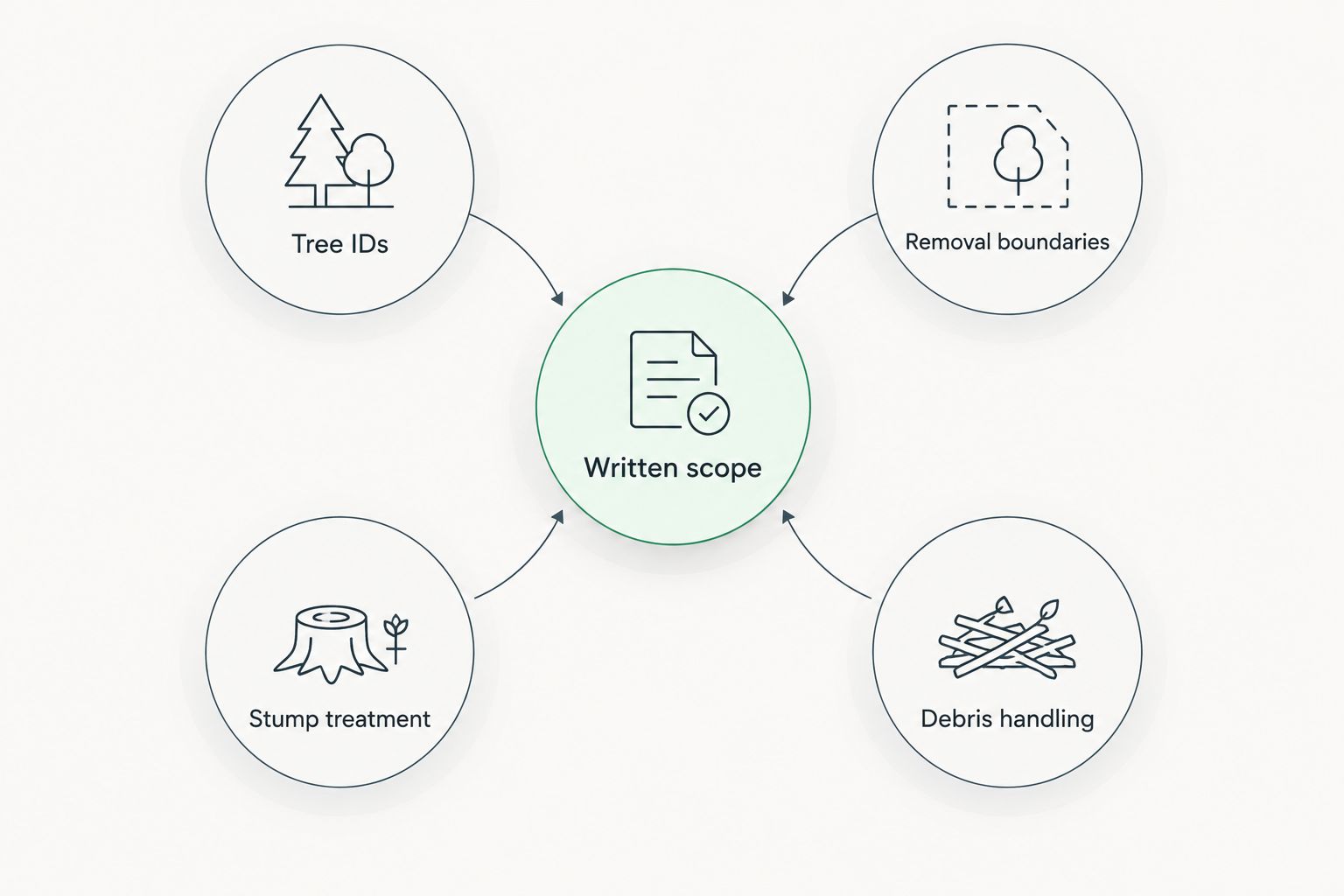
The written scope should connect each identified tree to an explicit outcome. Keep your 2026 site sketch with the quote so the approved trees and boundaries remain clear when the work is scheduled.
- Tree IDs: Match each quoted tree to your photographs and sketch.
- Removal boundaries: Identify the work area and vegetation to retain.
- Stump treatment: Specify whether stumps remain or receive separate treatment.
- Debris handling: State what leaves the property and what stays.
4. Coordinate tenant access and property operations
Map how the proposed work area intersects with daily activity. On a commercial property, deliveries, customer parking, employee arrivals, and accessible entrances belong in the planning conversation. Tell the contractor which routes must remain available and which restrictions require owner approval.
Designate 1 site contact for coordinating access and communicating changes. That recommendation gives tenants and the contractor a clear point of contact; it does not replace the contractor’s responsibility for its work area.
Before scheduling, agree on how affected occupants will receive instructions. Do not promise tenants uninterrupted access until the working arrangement has been assessed and confirmed. Keep emergency access requirements in that discussion rather than treating them as an afterthought.
- Identify tenant entrances and commonly used walking routes.
- Describe delivery access and loading areas.
- Confirm who authorizes parking restrictions or temporary closures.
- Assign responsibility for tenant notices.
- Agree on the process for communicating access changes.
5. Define debris, stump, and surface responsibilities
Describe the condition you expect when the work ends. A tree can be removed while wood, branches, a stump, or disturbed ground remain. Those outcomes are not interchangeable, and a proposal should not leave you guessing which one you are approving.
Ask whether debris removal covers all cut material or only specified items. If wood or chips will stay on-site, identify where they belong and whether that arrangement fits the property’s use. Do not assume leftover material can occupy parking spaces or landscaping beds.
For your 2026 maintenance plan, separate removal from follow-on work. Stump treatment, soil work, planting, and surface repairs need explicit responsibilities rather than an informal expectation that everything is included.
- Specify whether cut wood and branches leave the site.
- Identify any agreed location for retained material.
- Confirm whether stump work is included or separate.
- Define the cleanup expected around entrances and parking areas.
- Assign responsibility for landscaping or surface restoration.
6. Compare proposals against the same requirements
Build your comparison in a spreadsheet or a written checklist. Put each contractor’s proposal beside the same tree references, access requirements, and cleanup expectations. A shorter proposal is not necessarily simpler work; it can leave more decisions unresolved.
Resolve scope differences before selecting a proposal. If one contractor includes stump treatment and another excludes it, you are comparing different deliverables. Ask for clarification rather than assuming the omitted work is included.
Keep 2 quote versions when a proposal changes: the original and the revised version. Record which revision is approved so the contractor, property manager, and owner refer to the same document. For a more detailed checklist, review how to compare a tree removal quote in South Carolina.
- Compare the same identified trees and work boundaries.
- Check stump treatment and debris handling separately.
- Resolve exclusions and assumptions in writing.
- Confirm who handles access coordination and tenant notices.
- Mark the approved proposal and retain superseded versions.
7. Approve the scope and document completion
Before work begins, confirm that the authorized scope matches the latest property conditions. Tell the contractor about changes to parking, deliveries, tenant activity, or the affected tree. Do not quietly add another tree to the job after approving a proposal.
Agree on how additions or changes will be authorized. A written change should identify the added work and its effect on the existing agreement before that work proceeds. This protects the connection between the owner’s approval and the work actually requested.
Close your 2026 work order with a review against the written scope. Check the identified trees, debris arrangements, stump treatment, and agreed cleanup. Record unresolved items specifically rather than marking the entire project complete by default.
- Confirm the final tree references before scheduling.
- Share changes to site access or occupancy.
- Identify who can approve changes to the work.
- Review completion against the agreed scope.
- Record outstanding items and the responsible party.
Request a site-specific tree removal quote
Describe your commercial property, affected trees, access restrictions, and cleanup requirements.
Compare quoting and scope options
Quote format and job scope are separate decisions. Photos help begin the conversation; an assessment addresses the site. Removal and cleanup then need their own written boundaries. Use the table to identify what you are requesting, not to assume every option produces the same deliverable.
| Option | Best for | Main advantage | Key limitation |
|---|---|---|---|
| Photo-based estimate | Initial communication and documenting visible conditions | Gives the contractor a shared visual reference | Does not replace assessment of access and site conditions |
| Site-assessed quote | Work near buildings, occupied areas, or restricted access | Connects the proposed work to observed property conditions | Still needs explicit inclusions, exclusions, and authorization |
| Removal-only scope | Managers arranging debris or stump work separately | Keeps the requested removal task distinct | Leaves follow-on responsibilities to be coordinated |
| Removal-and-cleanup scope | Managers seeking a defined handover condition | Places removal and specified cleanup in the same scope | Does not automatically include stump treatment or restoration |
Pmmidlands provides tree services within its confirmed service area. Request a site-specific proposal rather than assuming a particular removal method, cleanup package, or completion date. The best quote for your property is the one that defines the work you actually need approved.
Common mistakes commercial property managers make
Sending different scopes to different contractors
One request names an entrance tree; another asks about every tree near the building. The resulting proposals answer different questions. Send the same tree references, photographs, and desired outcomes to each contractor, then document any requested alternatives separately.
Treating parking access as permission to occupy the lot
A contractor’s route through a property is not the same as permission to use tenant spaces or close a walkway. Explain operational restrictions during the assessment. Confirm the working arrangement before notifying occupants about closures or access changes.
Assuming cleanup includes stump removal
Tree removal, debris handling, stump treatment, and restoration are distinct scope items. List each desired outcome instead of relying on the word cleanup. If the stump will remain, record its location and account for it in subsequent property work.
Approving work without a clear authority chain
A maintenance contact can coordinate a visit without having authority to approve additional work. Identify who can authorize the original scope and later changes. Put that distinction in the project record so a conversation on-site does not become an undocumented instruction.
Combining tree removal with an undefined clearing project
Removing selected trees and preparing a lot for another use require different boundaries. Mark vegetation to retain and explain the planned use of the area. If clearing is part of your 2026 project, request that scope separately instead of adding it as a vague note to the removal quote.
FAQ
What should a commercial tree removal quote include?
A commercial tree removal quote should identify the trees, work boundaries, access conditions, debris responsibilities, stump treatment, and exclusions. It should also make clear who can approve the work and any later changes.
Can I get a tree removal quote using photos?
Photos can support an initial estimate and help explain the job. They do not replace a site assessment of access, nearby structures, and the working area.
Is a site-assessed quote better than a photo estimate?
A site-assessed quote is the appropriate basis for defining work around occupied buildings and restricted access. A photo estimate helps start the conversation but leaves site conditions unresolved.
Does tree removal include stump grinding and debris removal?
Stump grinding and debris removal are included only when the written scope says so. Ask for each item to be identified separately, including what material stays on the property.
How do I compare tree removal quotes for a commercial property?
Compare quotes against the same trees, access restrictions, cleanup expectations, and exclusions. Resolve differences in writing before approving a proposal.
Which South Carolina counties does Pmmidlands serve?
Pmmidlands serves Richland, Lexington, Newberry, Orangeburg, Sumter, Kershaw, and Fairfield counties in South Carolina. Provide the property address when requesting a site-specific tree removal quote.
What should tenants know before tree removal starts?
Tenants should receive confirmed instructions about affected entrances, parking, deliveries, and pedestrian routes. Coordinate those instructions after the contractor and property manager have agreed on the working arrangement.
One last thing
Define the handover condition before you approve removal. The standing tree is easy to identify; the remaining stump, retained material, and follow-on landscaping are easier to overlook. Write down what you expect to remain, what must leave, and who handles the next task. That final description belongs beside the tree references in your approval file.