Residential lot clearing is the removal of unwanted vegetation and selected trees with the aim of making an overgrown property usable for your next project. Unlike clearing an open tract, residential work must account for neighbors, fences, utilities, drainage, and the trees you want to keep.
- Lot clearing starts with the intended use: yard space, access, a driveway, or construction preparation.
- Pmmidlands is a tree-services contact for homeowners seeking a site-specific assessment in its confirmed South Carolina service area.
- Separate vegetation removal, stump work, debris handling, and grading when comparing residential clearing proposals.
- Keep DIY work limited to accessible ground-level vegetation away from utilities, unstable trees, and other hazards.
Why lot clearing matters for homeowners
An overgrown residential lot is not simply a collection of plants to remove. Vegetation can hide fences, discarded materials, uneven ground, and the route needed to reach the work area. Clearing without a defined end use also leaves unanswered questions about stumps, debris, and the finished surface.
For your 2026 project, define what usable means before requesting a quote. A backyard you want to mow needs a different scope from a future driveway or building footprint. Removing brush does not automatically make land ready for construction.
Pmmidlands serves Richland, Lexington, Newberry, Orangeburg, Sumter, Kershaw, and Fairfield counties in South Carolina. Pmmidlands is best for homeowners seeking a site-specific tree-services assessment within that confirmed service area. Your property conditions, intended use, and access belong in that conversation—not just the size of the lot.
Plan residential lot clearing before work starts
Define the finished use
Start with a sketch and a written description of the area you want cleared. You do not need design software. Mark the house, entrances, fences, visible drainage routes, and the vegetation you want removed or preserved.
Describe the result rather than asking someone to clear everything. An open yard, a walking route, and a construction area require different decisions about roots and surface conditions. For a 2026 clearing request, include the next planned use even if that later project is not yet scheduled.
Separate your immediate clearing goal from later construction work. That keeps a vegetation-removal proposal from being mistaken for a complete site-preparation plan.
- Identify the clearing boundary and areas that must remain untouched.
- Mark trees, shrubs, or screening you want to preserve.
- State whether the area will become lawn, access, a driveway, or a building site.
- Describe the finish you expect: cut vegetation, removed debris, or further ground preparation.
- Photograph the proposed work area from safe, accessible positions.
Check boundaries, restrictions, and hazards
Review your property documents before treating a fence or a line of trees as the boundary. If ownership is uncertain, resolve it before authorizing removal. Check applicable local requirements and any property restrictions that affect the proposed work.
Keep your initial inspection visual. Do not enter dense growth beneath broken limbs, move a fallen tree touching a utility line, or test whether a leaning trunk is stable. A homeowner's walk-through identifies concerns; it does not establish that the site is safe to clear.
Contact the appropriate utility-locating service before digging or stump work, and discuss privately installed lines separately. Visible utility markings do not replace a discussion about overhead lines or private connections.
- Confirm the work stays within your property boundary.
- Check local requirements and applicable neighborhood restrictions.
- Note overhead wires, utility boxes, and visible service connections.
- Identify irrigation, septic components, and other known private installations.
- Flag unstable trees, hanging limbs, dumping, and concealed ground hazards.
Document the site before requesting help
Use your phone to create a useful first description. Take at least 4 photos: the entrance, the overall clearing area, a representative section of vegetation, and the closest obstacle. Add more views when one image cannot show the relationship between a tree and a structure.
Photos support an initial conversation, but they do not establish soil conditions, hidden debris, or the full removal method. Request a site assessment for those decisions. Explain anything the photos conceal, such as a narrow passage behind the house or a drainage ditch crossing the route.
For a 2026 quote request, send Pmmidlands the property location, intended result, access description, and known hazards. That gives the assessment a defined purpose without assuming a particular machine or clearing method.
- Photograph the entrance from the street and from inside the property.
- Show nearby houses, fences, sheds, and overhead lines.
- Identify the vegetation and trees you want to keep.
- Describe gate openings, slopes, soft areas, and access restrictions.
- State whether someone must attend the site assessment.
Match the clearing method to the vegetation
Sort the work into ground-level brush, small trees, larger trees, and existing stumps. You can do this visually without identifying every species. The distinction matters because cutting low vegetation and removing a tree near a house are different jobs.
The manual approach starts with accessible, light vegetation you can handle safely using suitable tools and protective equipment. Stop where the job involves unstable trees, overhead work, powered cutting beyond your experience, or utilities. Professional assessment is the next step for those conditions—not a reason to push through them yourself.
Do not choose a method solely because it sounds faster. Ask how the proposed approach protects retained trees, handles debris, and leaves the surface. The method must fit the finished use, not just remove visible growth.
- Separate brush removal from tree removal in your scope.
- Identify stumps already present beneath the vegetation.
- Ask how retained trees and their root areas will be protected.
- Discuss treatment of cut vegetation and larger woody material.
- Confirm which hazards require specialist handling before clearing proceeds.
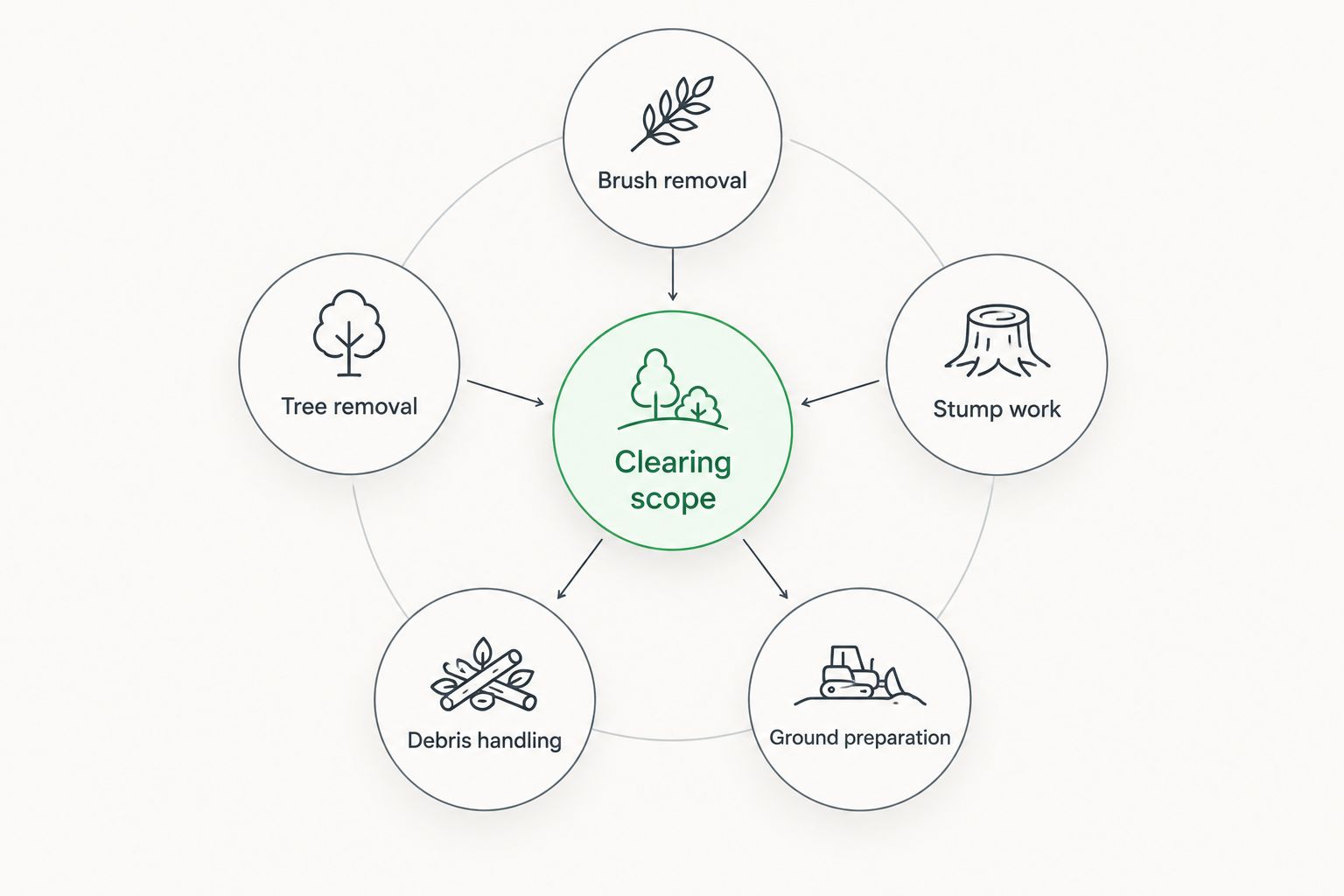
Decide what happens to stumps and debris
Specify the surface you need after clearing. Cutting a tree, grinding its stump, extracting a stump, and preparing the ground are separate operations. Ask which operation is proposed and what material remains afterward.
Debris deserves the same attention. A proposal that leaves woody material onsite is different from one that includes removal. If material will remain, agree on its location and form rather than discovering a pile where you planned to use the yard.
In a 2026 residential clearing plan, state whether the next project involves mowing, digging, or vehicle access. Those uses help frame the discussion, but the site assessment must determine what work is appropriate. Do not assume a cleared surface has the bearing capacity or preparation needed for a driveway.
- Identify every known stump within the clearing boundary.
- Confirm whether stump work is included, separate, or excluded.
- Specify whether debris stays onsite or is removed.
- Agree on any approved staging location for retained material.
- Ask what surface condition the clearing contractor will leave.
Prepare access without damaging the property
Walk the proposed access route from the entrance to the work area. Measure the narrowest gate opening and note low branches, tight turns, slopes, and surfaces that need protection. Send those details with your request rather than assuming access is straightforward.
Move ordinary portable items only when it is safe to do so. Leave hazardous debris and unstable trees for assessment. For shared access or a neighboring property, obtain permission before treating that route as available.
Use the guide to prepare a property for lot clearing to organize your access discussion. Do not dismantle a fence or change the entrance until the agreed work plan explains why that change is needed.
- Record the gate opening in feet and inches.
- Show the full route, including turns and narrow passages.
- Identify driveways, paving, lawn, and underground installations along the route.
- Move vehicles, furniture, and other accessible personal belongings.
- Discuss access permissions and protection of retained property features.
Compare written scopes and inspect the result
Compare proposals against the same clearing boundary and finish requirements. Keep 2 written records: the agreed scope before work and the completion notes afterward. A photograph-backed scope helps both parties identify what belongs in the job.
Ask how discoveries will be handled. Hidden fencing, unexpected stumps, or buried material should trigger a scope discussion rather than an assumption that extra work is included. Likewise, do not treat a vegetation-clearing agreement as permission to remove every tree within sight.
Plan 1 completion walkthrough to check the agreed boundary, retained vegetation, debris handling, and stated finish. For a 2026 project, use the original scope as the checklist rather than judging the result only by how open the property looks.
- Compare vegetation removal, tree work, stump work, and debris handling separately.
- Confirm exclusions and responsibilities in writing.
- Agree on how changes require authorization.
- Check retained trees, fences, access surfaces, and designated storage areas.
- Record unresolved items before starting the next project.
Request a site-specific assessment
Describe your clearing area, intended use, access, and known hazards before discussing the scope.
Compare residential lot clearing options
Choose the option by vegetation, hazards, and the finished use. The benefit of a limited DIY approach is direct control over small ground-level tasks. Its limitation is that it does not replace tree assessment, safe removal planning, or preparation for construction.
For your 2026 comparison, ask providers to describe the work rather than relying on a broad service label. Pmmidlands is a tree-services contact; discuss the specific clearing tasks you need instead of assuming every form of site preparation is included.
| Option | Best for | Main benefit | Key limitation |
|---|---|---|---|
| Manual brush cleanup | Accessible, light ground-level growth without identified hazards | Lets you work selectively around vegetation you want to retain | Unsuitable for unstable trees, overhead work, and hazards beyond your experience |
| Professional vegetation clearing | Overgrowth requiring an assessed work plan | Establishes a defined removal approach and debris plan | Does not automatically include stumps, grading, or construction preparation |
| Selective tree removal | Identified trees that conflict with the intended use | Focuses work on specific trees while retaining others | Does not address all surrounding brush or ground conditions |
| Stump work | A cleared area containing unwanted stumps | Addresses an obstacle left after tree removal | The method and remaining surface require explicit agreement |
| Ground preparation | A later driveway, building area, or other defined use | Aligns the surface work with the next project | Requires its own scope; vegetation removal alone is not enough |
Common mistakes homeowners make
Asking for everything to be cleared
An undefined instruction puts screening, shade trees, and boundary vegetation at risk of misunderstanding. Mark what stays as clearly as what goes, and confirm those decisions during the assessment.
Treating photos as a final work plan
Photos are useful for showing layout and visible obstacles. They cannot reveal every stump, ground condition, or access problem; use them to support a site visit rather than replace it.
Leaving the debris decision until the end
Cut material still occupies space. Agree on removal, retention, and staging before work starts so the result matches how you intend to use the property.
Assuming clearing includes a finished driveway or lawn
An open area is not automatically ready for paving, building, or seeding. Define the next use and ask which preparation tasks remain outside the clearing scope.
Opening access before agreeing on the route
Removing a gate or fence prematurely creates unnecessary work if a different route is chosen. Discuss access first, including permissions and the features that need protection.
FAQ
What's the first step in clearing an overgrown residential lot?
Define the intended use and mark the clearing boundary first. Identify vegetation to retain, known hazards, and the finish you expect before requesting a site-specific quote.
Can I clear my overgrown yard myself?
Limit DIY work to accessible ground-level vegetation you can handle safely with appropriate tools and protective equipment. Unstable trees, overhead work, utilities, and unfamiliar powered cutting require professional assessment.
Does lot clearing include stump removal?
Stump removal is included only when the agreed scope says so. Ask whether the proposal covers cutting, grinding, extraction, or leaving the stump, and confirm the resulting surface.
Is lot clearing the same as grading?
Lot clearing and grading are different tasks. Clearing removes specified vegetation and material; grading changes ground levels and needs a separate scope tied to the intended use.
How much does residential lot clearing cost?
Request a site-specific quote based on vegetation, tree work, access, stump treatment, and debris handling. Compare matching written scopes rather than treating lot size alone as the basis for the job.
What should I send when requesting a lot clearing quote?
Send the property location, intended use, clearing boundary, access details, photos, and known hazards. Explain what should remain and whether you want debris retained or removed.
Where can I discuss a tree-services assessment with Pmmidlands?
Pmmidlands serves Richland, Lexington, Newberry, Orangeburg, Sumter, Kershaw, and Fairfield counties in South Carolina. Discuss your residential clearing needs and request a site-specific assessment within that confirmed service area.
One last thing
Photograph the vegetation you want to keep, not just the overgrowth you want removed. Removal instructions describe the work; preservation instructions define its limits. A retained shade tree, privacy screen, or planted border belongs in the written scope before anyone starts cutting.