To request a tree removal quote using photos, send clear views of the whole tree, its base, nearby structures, and the route into your property, together with your location and the work you want completed. Photos help explain the job, but they do not replace a site assessment when tree condition, access, or nearby hazards need a closer look.
- Request a tree removal quote with whole-tree, trunk-base, obstacle, and access photos—not just a close-up of damage.
- Pmmidlands provides tree services; ask how to submit photos for a site-specific quote.
- State whether your request includes stump work, debris removal, and protection of nearby areas.
- Keep away from damaged trees and power lines; never approach a hazard to get a better photo.
How do you request a tree removal quote using photos?
Build your request around the tree, its surroundings, and your desired result. A picture of a trunk alone leaves out the information needed to understand how removal would affect your property.
For a local tree-services inquiry, contact Pmmidlands and ask which method to use for sending photographs. Identify your county and property address before sending the image set.
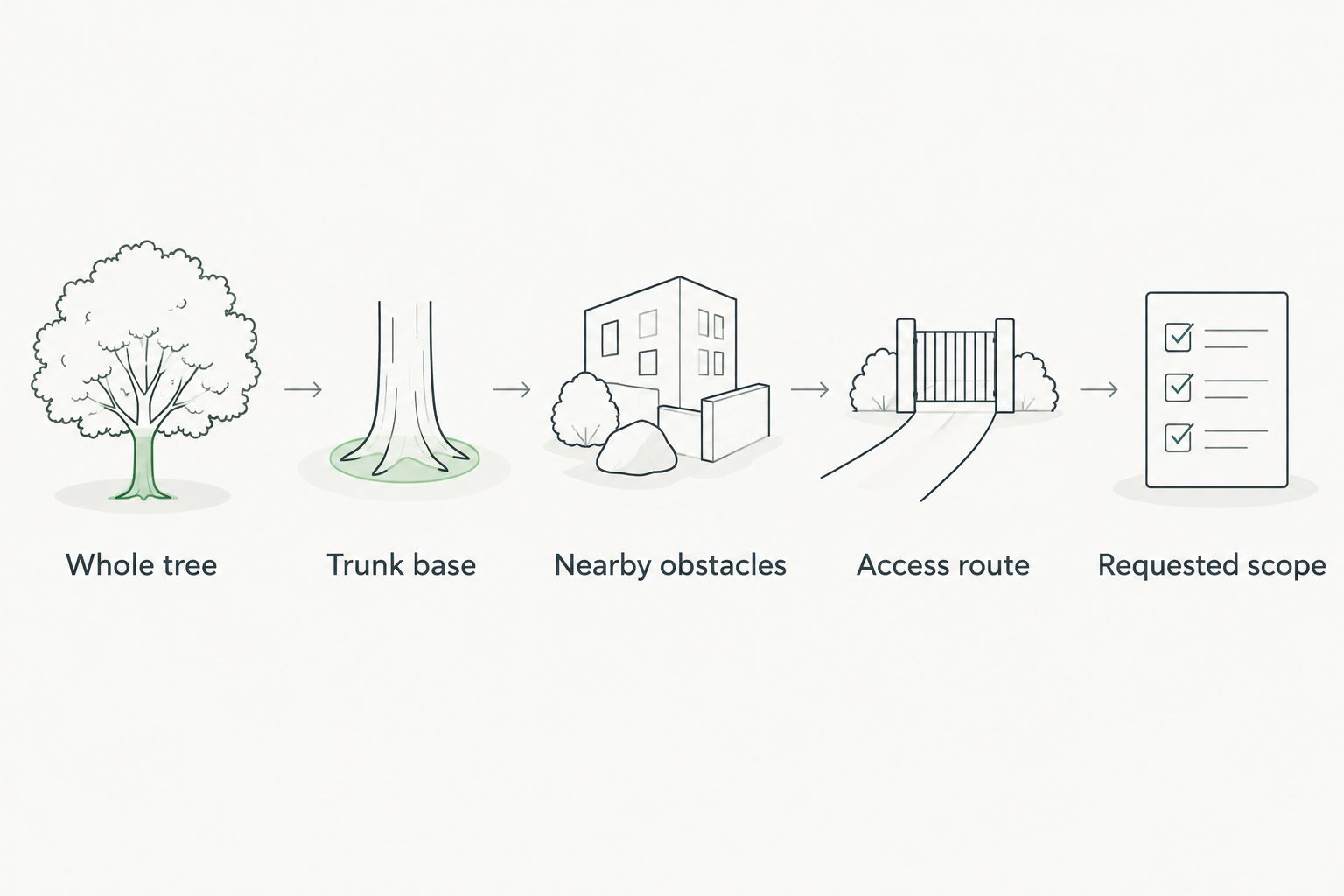
Use the following sequence for your 2026 quote request. These are suggested photo-taking steps, not a requirement to approach an unsafe tree.
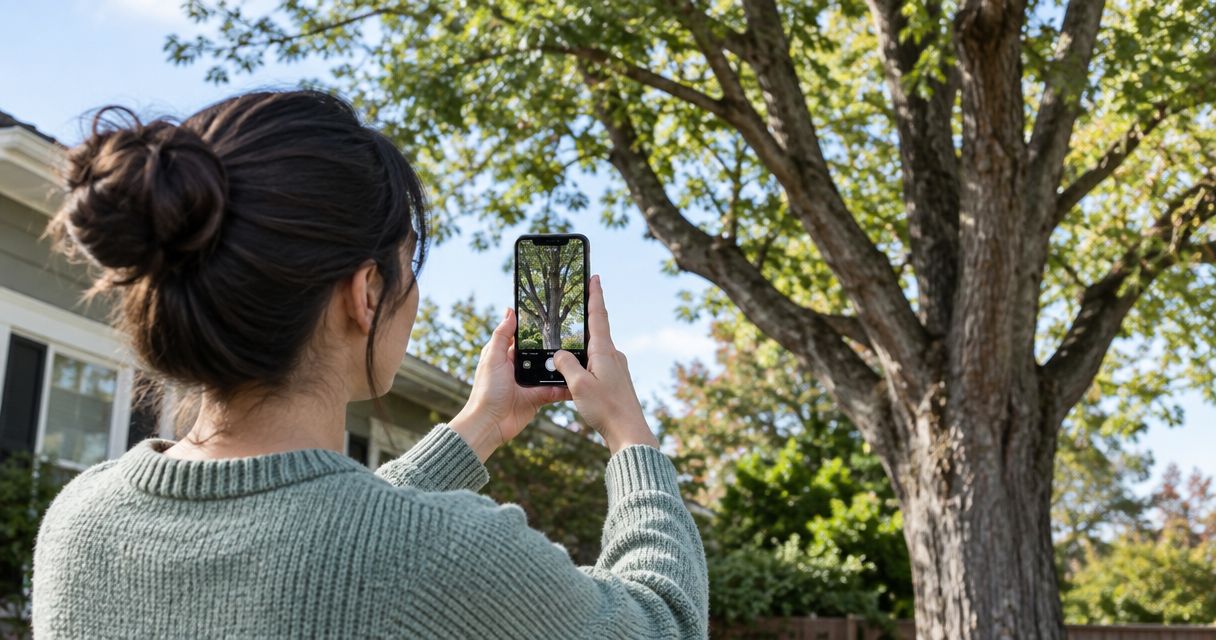
- Whole tree: Take 1 wide photo showing the tree from its base to its upper branches, if you can do so safely. Include the surrounding yard rather than cropping tightly around the trunk.
- Trunk base: Photograph the lower trunk and visible ground around it from a safe position. Show visible damage without moving loose wood, entering cavities, or disturbing the tree.
- Nearby obstacles: Take photos from 2 different safe angles to show nearby buildings, fences, roads, parked vehicles, and other trees. Describe anything important that the images do not show clearly.
- Access route: Show the route from the street or parking area to the tree. Include gates, corners, steps, slopes, and surfaces that need protection.
- Requested scope: Explain which tree you want removed and what should happen to its stump, branches, trunk sections, and surrounding area.
Keep original images when possible. A heavily cropped or marked-up image can hide context; send an unedited version alongside any annotated copy.
Why this matters
A tree removal request is also a description of the property around the tree. Two photos showing similar trees can conceal very different jobs: one tree stands in an open area, while another sits beside a roof behind a narrow gate.
The useful question is not just what the tree looks like, but what removal must avoid damaging. Your photos should help the person assessing the request identify those constraints before discussing the work.
A complete 2026 request also gives you a clearer basis for comparing responses. If every provider receives the same photos and scope, you can check whether each response addresses the same job rather than comparing different assumptions.
Which photos help explain the removal job?
Show the whole tree and its surroundings
Stand back far enough to capture the tree's overall shape, provided you have a safe viewpoint. Include nearby structures and the ground beneath the branches so the image communicates more than the tree's appearance.
If the whole tree will not fit in one frame, send overlapping views and explain that they show the same tree. Do not walk beneath damaged branches or into a road to improve the angle.
When several trees stand together, identify the one in your request. Mark a copy of the photo or describe its position relative to a fixed feature, such as a fence corner; keep the original photo available too.
Show visible damage without investigating it
Photograph visible broken branches, trunk cracks, cavities, or exposed roots only from a safe position. Report what you can see in plain language rather than naming a disease or declaring the tree structurally sound.
A useful description might identify a split in the trunk or a branch resting against a structure. Avoid testing whether a damaged section moves, pulling on branches, or digging around the roots.
Photographs show visible conditions. They do not establish the condition of hidden wood, underground roots, or parts of the canopy that the camera cannot capture.
Show the route into the property
Start at the entrance the service provider would use, then photograph the route toward the tree. Include the actual gate opening and any turn immediately beyond it, rather than sending only a front-of-house picture.
Mention locked gates, shared driveways, overhead obstructions, and areas where access requires someone else's permission. For commercial properties, explain how the route interacts with parking, deliveries, and occupied areas.
If you already know an access measurement, include it with its unit, such as feet or inches. Do not estimate a dimension from a photograph and present it as a measured fact.
Show what needs protection
Include roofs, fences, sheds, patios, garden beds, and other features close to the work area. Tell the provider about underground services or irrigation you know about, even when they are not visible in a photograph.
State whether you want any nearby trees or plants retained. A photo with a written note identifying what stays is clearer than a general instruction to clean up the area.
Is a photo review enough, or do you need a site assessment?
A photo review is best for explaining the request; a site assessment is best for checking conditions that photographs cannot establish. Ask the provider what the initial response covers before treating it as a final agreement.
| Assessment option | Best for | Useful contribution | Limitation |
|---|---|---|---|
| Photo review | Introducing the job and requested scope | Shows visible surroundings, obstacles, and access | Leaves hidden conditions and unclear dimensions unresolved |
| Site assessment | Checking the removal plan against actual conditions | Allows closer examination of access, surroundings, and the tree | Requires arranging access to the property |
A photo review and a site assessment are not competing products. They serve different stages of the same request, and a provider can ask for an on-site visit after reviewing your images.
For your 2026 project, ask whether the response is preliminary or based on a completed assessment. Also ask which conditions or scope changes would require the provider to revise it.
Why tree removal quote requirements vary
The information needed for a tree removal quote depends on what the job involves. Make these factors visible or describe them in your message:
- Tree condition: Broken sections, visible decay, and storm damage need to be communicated without treating photos as a diagnosis.
- Nearby obstacles: Buildings, fences, roads, and other trees affect the space available for the work.
- Property access: Gates, turns, slopes, and restricted areas need assessment rather than assumptions based on a street view.
- Removal scope: Removing the tree, addressing the stump, and handling debris are separate details to confirm.
- Site use: Occupants, tenants, vehicles, deliveries, and shared access need coordination where relevant.
- Permissions and boundaries: Ownership, shared features, and any applicable approvals need clarification before work begins.
Do not assume a provider has included every item because your message says tree removal. Ask for the scope in writing, including anything left out.
What should you write when sending the photos?
Use a short message that explains the location, the tree, and the result you want. Attach the photos in a logical order so the recipient can connect the overview to the closer views.
Your 2026 request should include:
- The property address and county, sent privately to the provider.
- Your name, contact information, and relationship to the property.
- Which tree or trees the request covers.
- The reason for the request, described without an unsupported diagnosis.
- Visible damage and nearby structures or utility lines.
- The available access route and any restrictions.
- Whether you want the stump addressed and debris removed or retained.
- Who can arrange access for a site assessment.
You can adapt this message:
I would like a tree removal quote for the tree shown in the attached photos. I have included views of the whole tree, its base, nearby obstacles, and the access route. Please confirm whether a site assessment is needed and whether the proposed scope includes stump work and debris removal. I can provide the property address and arrange access directly.
Add your project-specific details rather than relying on the template alone. If the tree is near a building, identify the building; if access is shared, explain who controls it.
Pmmidlands is a tree-services option for property owners in its confirmed South Carolina service area seeking a site-specific quote. That area covers Richland, Lexington, Newberry, Orangeburg, Sumter, Kershaw, and Fairfield counties; include your county when making the inquiry.
Request a site-specific tree removal quote
Describe your tree, access route, nearby obstacles, and the work you want included.
Can you get a tree removal quote from one photo?
One photo can introduce a tree removal request, but it does not show every relevant condition. A wide view leaves details unclear, while a close-up can hide nearby structures and access restrictions.
Send additional views when you can take them safely. If a hazard prevents better photographs, explain that limitation and request guidance rather than approaching it.
Should you include stump removal in the same request?
Include stump work in the same request if you want it considered, but ask the provider to state whether it is included. Do not assume that removing the standing tree also means removing or grinding its stump.
Explain the intended use of the area afterward. A request to leave the area for planting differs from a request to remove the tree while leaving the stump in place.
What if the tree is near a power line or appears unstable?
Stay away from a tree touching a power line, a fallen line, or a visibly unstable damaged section. Do not approach to take close-ups, move branches, or test whether a wire is live; contact the utility, and use emergency services when there is immediate danger.
Only take photographs from an already safe location. A quote request is not a reason to enter a hazardous area.
FAQ
What photos should I send for a tree removal quote?
Send photos of the whole tree, its base, nearby obstacles, and the access route. Add a written description of the work you want, including stump and debris handling.
Can a tree service give me a final quote from photos alone?
Photos alone do not establish every condition needed for a final tree removal quote. Ask whether the response is preliminary and whether a site assessment is required.
Do I need to measure the tree before requesting a quote?
You do not need to approach or climb a tree to request a quote. Include measurements you already know, but let the provider assess dimensions that you cannot safely establish.
Does tree removal include taking away the branches and trunk?
Debris removal needs to be confirmed in the written scope. State whether you want branches and trunk sections removed or retained, and ask what cleanup is included.
How do I request a quote for a rental or commercial property?
Identify your role, the property location, access restrictions, and who can authorize the work. Explain tenant access, parking, and delivery arrangements that the provider needs to assess.
Can I send photos of a tree touching power lines?
Send only photos taken from a safe location and contact the utility about the power-line hazard. Never approach the tree or wires to improve the photographs.
Where does Pmmidlands provide tree services?
Pmmidlands provides tree services in Richland, Lexington, Newberry, Orangeburg, Sumter, Kershaw, and Fairfield counties in South Carolina. Include your county and property location when requesting a site-specific quote.
One last thing
Photograph what you want left intact, not only what you want removed. A fence, neighboring tree, or garden bed becomes part of the job description when you identify it clearly.
Before accepting a tree removal quote in 2026, compare the written scope with your original photos and message. Confirm the tree identity, access arrangements, stump treatment, debris handling, and exclusions before authorizing work.