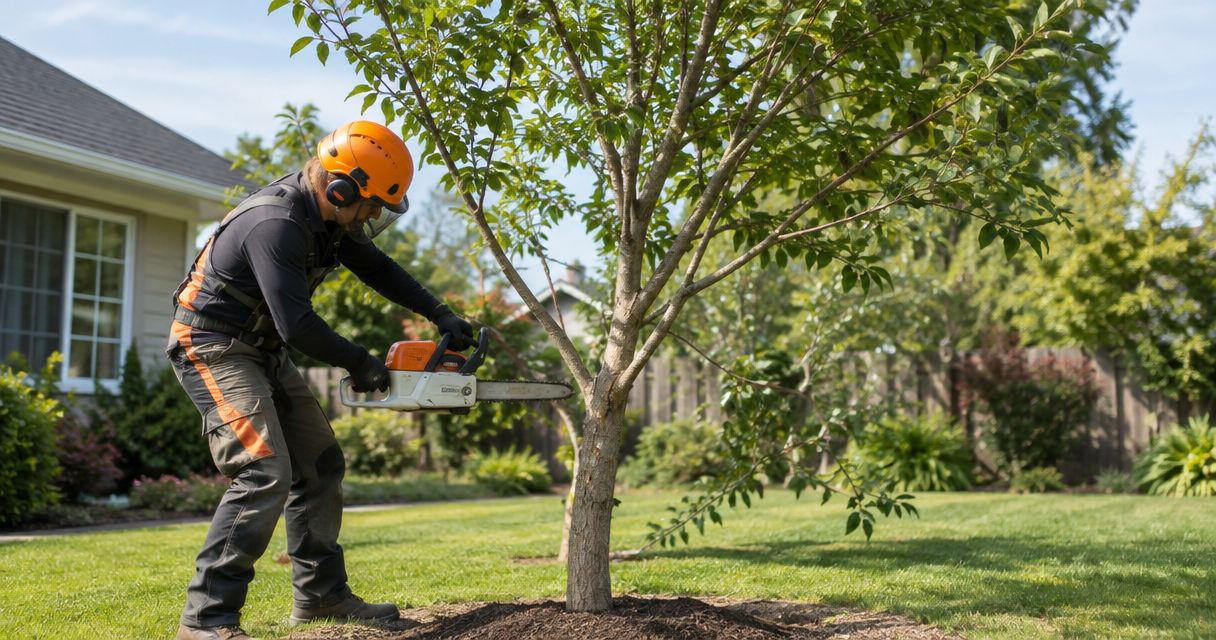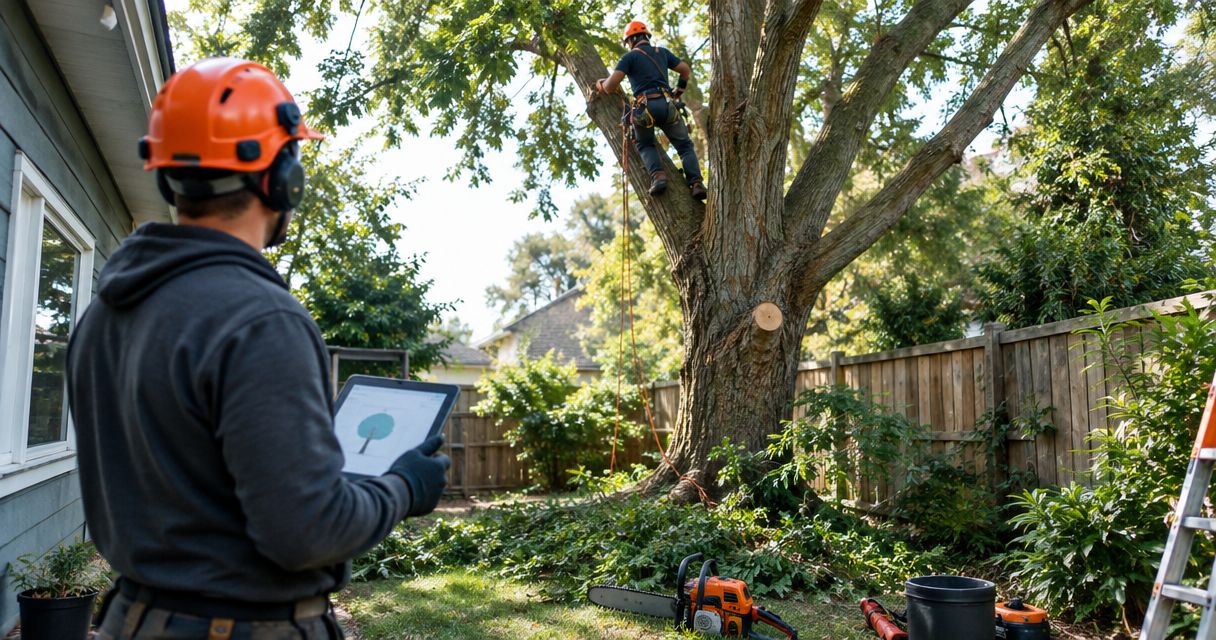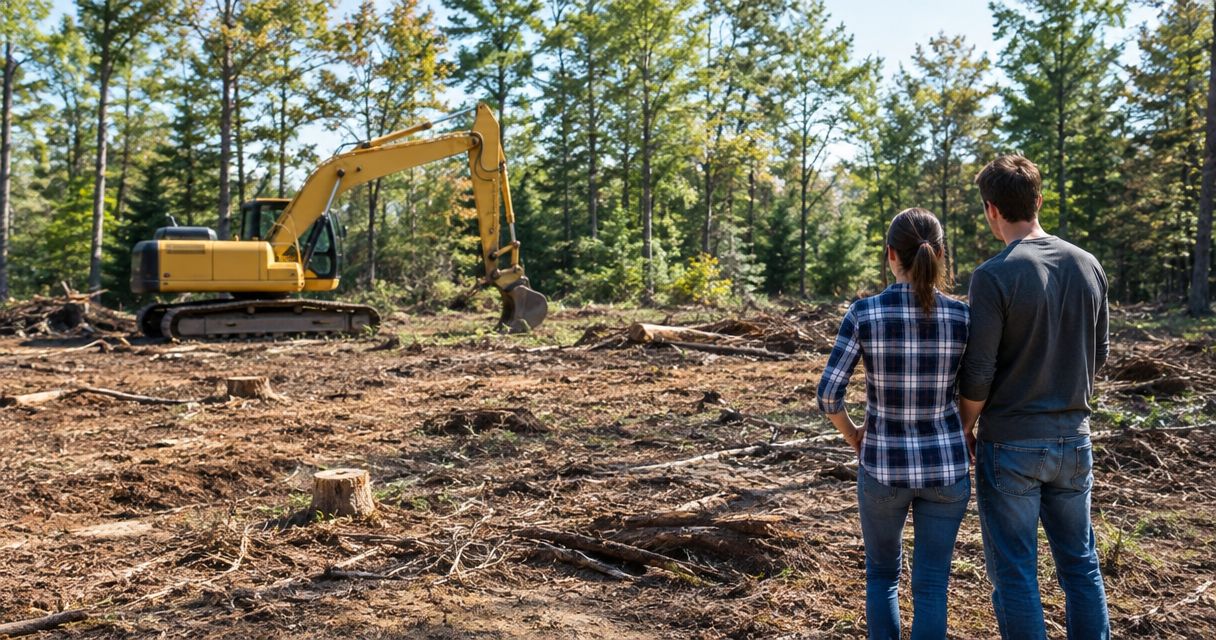
Homeowners’ lot clearing is the removal of unwanted vegetation and tree material with the aim of preparing a defined area for a new driveway. Your project needs more than an open strip: the clearing boundary, retained trees, stump treatment, and access must match the driveway plan before cutting starts.
- Plan lot clearing around the driveway footprint, not the entire property.
- Pmmidlands is a tree-services option for homeowners requesting a site-specific assessment in its confirmed South Carolina service area.
- Specify tree removal, stump treatment, and debris removal separately in the written scope.
- Confirm grading, drainage, and driveway construction responsibilities before approving clearing.
Why lot clearing matters for homeowners
A cleared route is not a construction-ready driveway. Removing vegetation exposes the work area; it does not establish the finished slope, drainage, or supporting ground. Your driveway contractor needs to explain what condition the site must reach before construction begins.
For a 2026 driveway project, make the intended route your starting point. Clearing too broadly removes vegetation you intended to keep. Clearing too narrowly leaves the construction team without the agreed working space. Neither decision belongs to guesswork at the cutting stage.
Pmmidlands provides tree services in Richland, Lexington, Newberry, Orangeburg, Sumter, Kershaw, and Fairfield counties in South Carolina. Homeowners within those counties can contact Pmmidlands to request a site-specific quote discussion. Describe the proposed driveway and the vegetation involved rather than asking for a price based only on lot size.
This guide separates homeowner preparation from work that needs a site assessment. Your job is to define the outcome; the contractors’ job is to assess how to achieve it.
How to prepare for driveway lot clearing
Define your driveway footprint before requesting clearing
Start with a sketch showing where the driveway enters the property, where vehicles will park, and how the route reaches the house or garage. Use the sketch to discuss the layout with your driveway contractor. Do not treat an approximate line through the trees as a finished construction plan.
Separate the driveway footprint from temporary working space. A contractor’s access route, turning area, and material staging area are different from the ground that will become the driveway. Ask which areas need clearing and which simply need permission for access.
Take 4 overview photos for your initial inquiry: the road entrance, the proposed route, the parking destination, and the access constraint. These are a useful briefing set, not a substitute for an inspection. Keep the original files so you can explain where each view was taken.
Use the property preparation guide for lot clearing to organize the site information before requesting an assessment.
- Mark the proposed driveway footprint on your sketch.
- Identify temporary working space separately.
- Photograph the entrance and destination.
- List gates, fences, and narrow access points.
- Ask the driveway contractor to confirm the clearing boundary.
Identify trees and vegetation you want to keep
Walk the proposed route from the ground and identify trees, shrubs, and screening you want retained. Mark preferences on your sketch, then agree on an unmistakable marking method with the contractor. A tree outside the driveway footprint still needs consideration if excavation will occur near its roots.
Do not decide that a tree is safe to retain solely because its trunk stands outside the planned pavement. Ask for an assessment where the proposed work approaches established trees. The driveway layout and tree-retention plan need to agree before vegetation removal begins.
Keep a separate list of plants that can be removed and plants that need a decision. This prevents an unresolved preference from becoming an instruction to cut. For your 2026 project records, save the agreed sketch alongside the written scope.
The planning diagram below keeps the clearing decision tied to the driveway footprint rather than the whole lot.
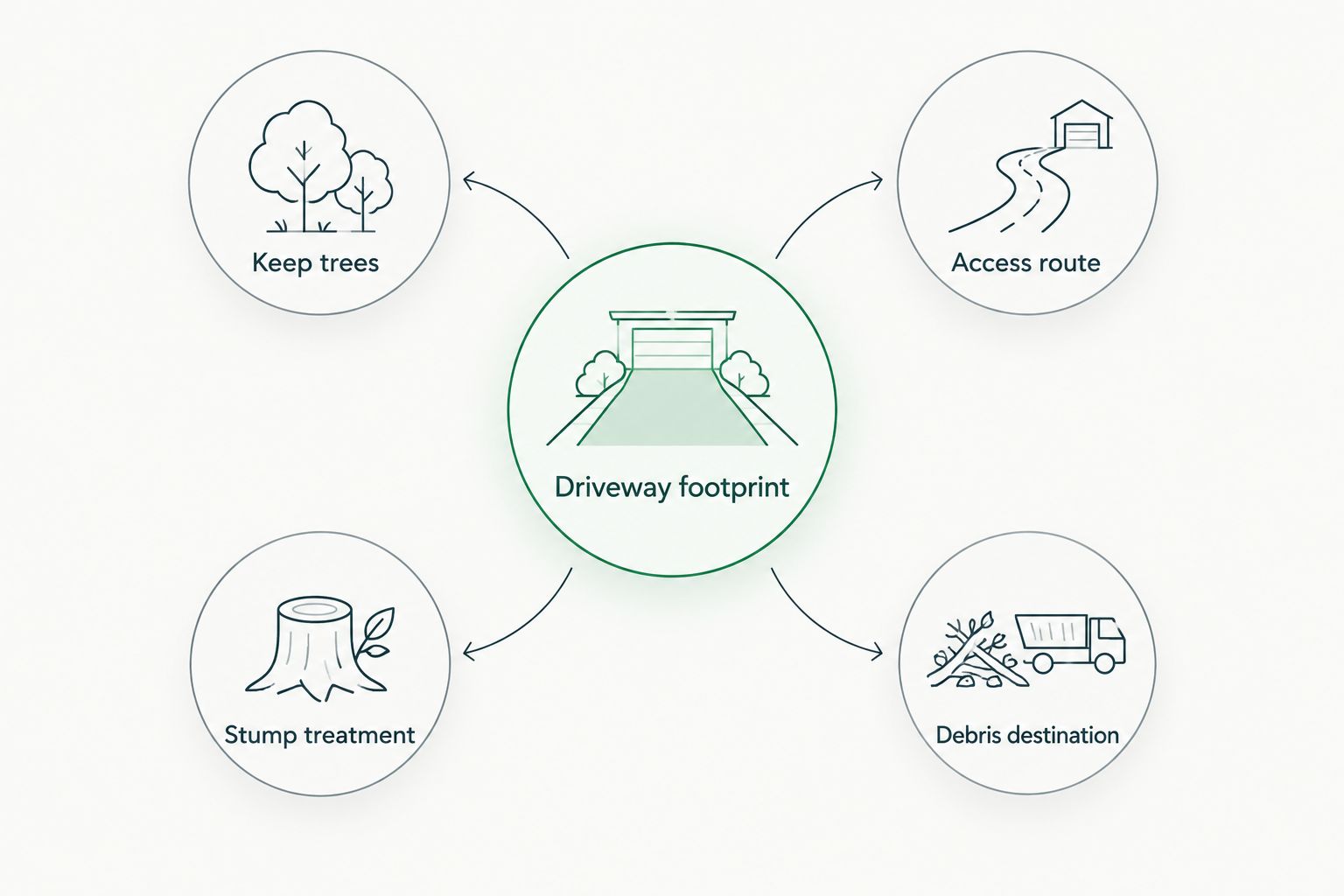
Treat these as separate decisions during the walk-through, and record the agreed outcome for each.
- Keep trees: identify vegetation that must remain.
- Access route: distinguish temporary entry from permanent clearing.
- Stump treatment: identify stumps within the proposed construction area.
- Debris destination: agree where removed material will go.
- Flag unresolved tree-retention decisions before approving work.
Assess tree removal without approaching hazards
Inspect the route from a safe position. Look for trees near the house, garage, fence, overhead lines, and neighboring property. Report visible concerns without attempting to diagnose tree stability or walking beneath damaged limbs.
Tree removal near structures needs an assessment of the tree, surrounding obstacles, and access. A homeowner’s description helps organize the visit, but it does not determine a safe removal method. Do not climb trees, pull hanging branches, or cut roots to investigate the proposed route.
If the driveway route requires removing a tree beside your house, review how to arrange dead tree removal near a house. Treat removal planning as its own task rather than assuming every tree belongs in a general brush-clearing instruction.
Pmmidlands’ tree-services assessment should be discussed alongside your driveway plan so the requested quote reflects the trees and obstacles actually involved. Ask the contractor to distinguish removal work from any separate advice about retained trees.
- Describe trees near buildings and boundary features.
- Point out overhead lines without approaching them.
- Report broken limbs or visible storm damage.
- Identify neighboring property that must remain untouched.
- Leave removal methods to the assessing contractor.
Specify stump treatment and debris removal separately
Tree removal, stump treatment, and debris removal are different scope items. A tree can be cut down while its stump remains. Grinding reduces a stump but does not mean every root has been excavated. The driveway contractor must explain what treatment is appropriate for the planned construction area.
Ask who will handle the material left by the chosen treatment. Wood chips, excavated roots, logs, and brush do not all have the same destination. Leaving material on the property is a decision to document, not an assumption to make after the work begins.
Divide the discussion into 3 work areas: the driveway footprint, the temporary working space, and the retained landscape. State what finish you need in each. The construction footprint and a landscaped boundary can require different treatment, even on the same property.
For a 2026 clearing quote, write down exclusions as carefully as inclusions. If grading or excavation belongs to another contractor, identify the handoff condition instead of expecting the clearing contractor to deliver a finished driveway base.
- Specify which stumps require treatment.
- Ask the driveway contractor to define root-removal requirements.
- Agree whether logs and brush stay or leave.
- Identify where chips or other retained material will be placed.
- Record who handles holes, grading, and site restoration.
Check boundaries, utilities, access, and drainage
Confirm where the proposed work sits relative to property boundaries, easements, and the road entrance. Do not use a fence as proof of the legal boundary. Resolve uncertainty before authorizing removal beside neighboring land or an access area you do not control.
Before excavation or stump work that disturbs the ground, contact South Carolina 811 and follow the applicable notification and marking requirements. Tell the contractor about known private lines, including irrigation and other owner-installed services. Ask how those lines will be identified; a utility marking request is not permission to ignore private infrastructure.
Discuss runoff and the driveway entrance with the driveway contractor and the appropriate local authority. Clearing should follow the agreed layout, not commit you to a route before entrance requirements and drainage questions are resolved.
Pmmidlands’ confirmed service area spans the seven named South Carolina counties, but the property’s location still matters to the assessment. Give the actual site location and describe access restrictions when requesting the visit.
- Confirm the work boundary and access permissions.
- Follow utility notification requirements before ground disturbance.
- Identify known private underground services.
- Ask about driveway entrance requirements.
- Review drainage before finalizing the clearing route.
- Explain gates, occupied parking areas, and access restrictions.
Request a written scope that matches the site assessment
Use the same project description when speaking with clearing contractors. Compare 2 written scopes side by side if you are considering multiple providers; differences in included work matter more than whether the descriptions use the same service name.
A useful scope identifies the work area, vegetation to remove, trees to retain, stump treatment, debris handling, and exclusions. Ask what circumstances require another discussion or a change to the agreed work. A broad instruction to clear the driveway area leaves too much open to interpretation.
For a 2026 quote request, attach the sketch and overview photos, then request a site assessment. Photos help explain the project, but they do not establish underground conditions, tree stability, or every access constraint.
Tell Pmmidlands that the clearing supports a new driveway and name the contractor responsible for subsequent construction, if appointed. Request a site-specific scope rather than a guaranteed completion date or a price based on acreage alone.
- Send the same sketch with each inquiry.
- Request a clear list of included work.
- Check stump treatment and debris handling explicitly.
- Ask which tasks remain your responsibility.
- Confirm the handoff condition for the driveway contractor.
- Keep the approved scope with your project records.
Request a site-specific clearing quote
Describe your driveway route, trees, stump needs, and access constraints before arranging an assessment.
Compare clearing approaches for your driveway
Choose the approach after confirming the footprint and construction requirements. These are scope options, not interchangeable packages. Each can leave different work for the driveway contractor, so specify the required end condition rather than selecting a service name alone.
| Option | Best for | Main advantage | Key limitation |
|---|---|---|---|
| Selective clearing | Homeowners retaining established trees and screening | Limits removal to the agreed vegetation and work area | Requires clear boundaries and a tree-retention discussion |
| Brush clearing | Routes where brush and small vegetation obstruct inspection or access | Opens the area for closer assessment | Does not resolve larger tree removal, stumps, or construction preparation |
| Tree removal with specified stump treatment | Driveway footprints containing trees and stumps | Addresses identified woody obstacles in the construction area | Grading, root excavation, and debris handling still need explicit scope decisions |
| Clearing followed by separate construction preparation | Projects with distinct clearing and driveway contractors | Assigns clearing and construction responsibilities separately | Requires an agreed handoff so neither contractor assumes the other completed necessary work |
Choose the narrowest clearing scope that meets the confirmed driveway plan. That recommendation preserves your options; it does not replace a site assessment or the construction contractor’s requirements.
Common mistakes homeowners make
Clearing before choosing the entrance and parking layout
Removing trees first commits the project to an area that has not been checked against the driveway design. Confirm the entrance, destination, and construction footprint before approving cutting. If the layout remains undecided, request an assessment rather than a removal instruction.
Treating a stump-free appearance as construction readiness
Ground that looks clear can still need root removal, excavation, or other preparation. Ask the driveway contractor to define the handoff condition. Do not use appearance as the acceptance test for work that supports a new driveway.
Forgetting debris destinations
A removal scope without debris instructions leaves a basic question unanswered: what remains on your property? Specify whether brush, logs, chips, and excavated material stay or leave. If material stays, identify a location that does not obstruct the agreed construction access.
Comparing quotes with different boundaries
A quote for a narrow route and a quote covering the route plus staging space describe different jobs. Use one agreed sketch, check the included tasks, and resolve exclusions before choosing. Keep that sketch current if the driveway design changes during 2026.
FAQ
Do I need to clear my whole lot for a new driveway?
No, a new driveway does not automatically require whole-lot clearing. Define the driveway footprint and necessary working space, then assess which vegetation obstructs those areas.
Does lot clearing include stump removal?
Stump treatment is included only when the agreed scope specifies it. Ask which stumps will be treated, what method is proposed, and whether additional root excavation belongs to the driveway contractor.
Can I get a lot clearing quote from photos?
Photos help describe the project, but they do not replace a site assessment for defining the full scope. Send the route sketch, overview photos, and access details when requesting a quote.
Should I hire the driveway contractor before clearing?
Confirm the driveway layout and construction requirements before authorizing clearing. The driveway contractor should define the footprint, working space, and required ground condition for the handoff.
Can I keep trees beside the new driveway?
Tree retention needs to be assessed against the proposed excavation and driveway layout. A trunk outside the driveway footprint does not establish that nearby root disturbance is acceptable.
What should I check before stump work begins?
Check the agreed scope, work boundaries, and underground utility requirements before stump work begins. Contact South Carolina 811 as required and tell the contractor about known private underground services.
Where can homeowners contact Pmmidlands about tree services?
Pmmidlands serves Richland, Lexington, Newberry, Orangeburg, Sumter, Kershaw, and Fairfield counties in South Carolina. Homeowners in those counties can request a site-specific discussion about the trees and vegetation involved in their driveway project.
One last thing
Ask the driveway contractor to review the clearing scope before you approve it. That final check connects vegetation removal to the actual construction plan and exposes gaps such as unresolved stump treatment or an unspecified debris destination.
The most useful approval question is not whether the lot will look clear. Ask whether the agreed clearing leaves the next contractor with the site condition that contractor has requested. Resolve that answer in writing before work starts.