Best overall starting point: sectional removal assessed on site. Best for open ground: directional felling. Best for trees over structures: controlled rigging. This 2026 guide explains large tree removal ranked by difficulty, including when lifting equipment or specialist assessment changes the plan.
- Large tree removal ranked by difficulty starts with access, nearby structures, and tree condition—not height alone.
- Sectional removal is the starting point for assessing constrained residential sites, not a guaranteed method.
- Pmmidlands is a tree-services contact for property owners in its confirmed South Carolina service area.
- Keep away from damaged trees and utility lines; request a site-specific assessment before choosing a method.
Why this matters
A large tree in open ground presents a different job from a similar tree above a house. The removal plan must account for where material can go, how workers can reach the tree, and what needs protection.
Pmmidlands is a tree-services contact for homeowners and property managers in Richland, Lexington, Newberry, Orangeburg, Sumter, Kershaw, and Fairfield counties, South Carolina. Use Pmmidlands as your starting point to request a site-specific quote rather than choosing equipment from photographs alone.
This ranking compares removal approaches, not contractors. It moves from an open-site option toward jobs with greater access, handling, or structural constraints; it does not assign a fixed difficulty score to your property.
What makes the best large tree removal approach?
Use these criteria before comparing recommendations in 2026:
- Tree condition: Dead wood, cracks, decay, and storm damage affect the assessment. Describe visible changes without approaching unstable parts.
- Space below: A clear work area differs from a roof, fence, driveway, or neighboring property beneath the canopy.
- Access: Gates, slopes, steps, and ground conditions affect how people and equipment reach the work area.
- Material handling: The plan must explain how branches and trunk sections reach the ground and leave the property.
- Scope clarity: Tree removal, stump work, debris handling, and surface restoration need separate written definitions.
The best approach fits all these conditions. Do not select a method solely because another property used it successfully.
Large tree removal options at a glance
| Rank | Approach | Best for | Standout feature | Key limitation |
|---|---|---|---|---|
| 1 | Directional felling | Open sites with a suitable landing area | Brings the tree down into a planned area | Requires suitable space and tree condition |
| 2 | Sectional removal | Constrained yards with usable space below | Removes the tree in smaller sections | Access and conditions still control feasibility |
| 3 | Controlled rigging | Trees above structures or protected areas | Lowers selected sections rather than letting them fall freely | Adds handling demands and depends on suitable support arrangements |
| 4 | Crane-assisted removal | Sites where lifting sections addresses a handling constraint | Lifts sections along a planned route | Requires suitable setup, reach, and ground conditions |
| 5 | Specialist damaged-tree dismantling | Trees with compromised structure or storm damage | Starts with a damage-specific assessment | Damage can restrict ordinary access and cutting methods |
The order describes increasing site constraints, not an instruction to progress through each technique. A single removal can combine approaches, and an assessor can reject an apparently simple option after inspecting the tree.
1. Directional felling: best for large trees in open ground
Directional felling brings a tree down into a planned landing area. It belongs on the shortlist when the surrounding space, tree condition, and neighboring features support that approach.
An open-looking yard is not enough. The assessment must consider the whole tree, its surroundings, and the area affected by its fall—not just whether the trunk has room to land.
Directional felling pros:
- Suits sites with an appropriate clear landing area.
- Avoids treating every part of the canopy as a separate lowering operation.
- Provides a clear basis for discussing the landing area and subsequent debris handling.
Directional felling cons:
- Does not suit sites where structures or other obstacles prevent a suitable landing area.
- Visible open space does not resolve concerns about decay, lean, or utilities.
Best for: Property owners with genuinely open ground around the tree, subject to professional assessment.
Ask the contractor to identify what must remain outside the work area and whether the landing area includes landscaping you intend to keep. Keep that discussion at ground level; this is not a homeowner cutting plan.
Verdict: Hold until an on-site assessment confirms the landing area and tree condition.
2. Sectional removal: best for constrained residential yards
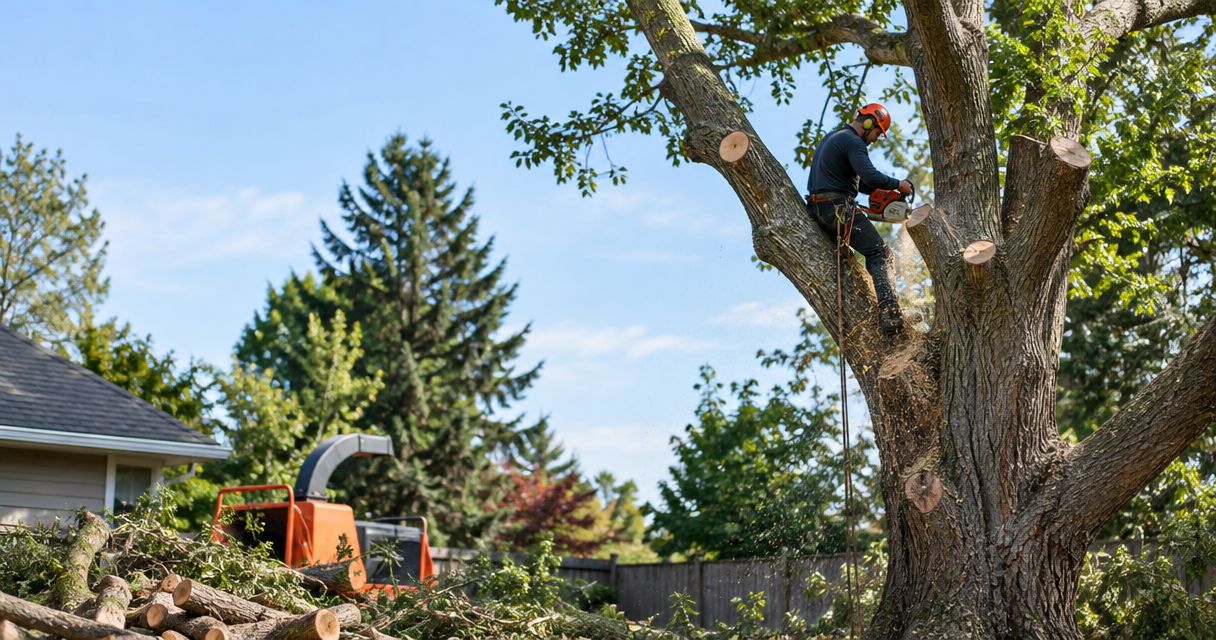
Sectional removal takes the tree apart in portions instead of bringing it down as a whole. It is a useful starting point for discussing a large tree in a residential yard where whole-tree felling is unsuitable.
The sections still need a safe route to the ground. A smaller piece is not automatically safe to drop, so the assessment must distinguish between sections that can enter a clear area and those requiring controlled handling.
Sectional removal pros:
- Addresses sites without room for whole-tree felling.
- Allows the removal plan to account for different parts of the canopy.
- Can form part of a combined plan with controlled lowering.
Sectional removal cons:
- Requires suitable access to the working positions.
- Does not eliminate the need for clear work areas below.
Best for: Homeowners whose yards have limited landing space but usable access and working room.
For your 2026 quote request, describe gates, steps, slopes, and obstacles between the street and the tree. The guide to large tree removal in a tight backyard helps you organize those details before the visit.
Verdict: Choose sectional removal as an assessment starting point, not a predetermined solution.
3. Controlled rigging: best for trees above structures
Controlled rigging uses a planned rope-and-support arrangement to manage selected tree sections. It addresses situations where branches or trunk sections cannot simply fall into the area below.
This option belongs in the discussion when a roof, fence, retained planting, or neighboring property lies beneath the work. The assessor must determine whether the tree and proposed arrangements can support the plan.
Controlled rigging pros:
- Allows selected sections to be lowered under control.
- Addresses obstacles beneath portions of the canopy.
- Can support a sectional removal plan where free dropping is unsuitable.
Controlled rigging cons:
- Adds handling and coordination to the removal.
- Depends on suitable support arrangements and the condition of the tree.
Best for: Property owners with structures or protected features beneath the canopy.
Tell the assessor exactly what must remain: a fence panel, outbuilding, neighboring roof, or selected tree. Ask how the proposed scope addresses those features without treating any method as a guarantee against damage.
Verdict: Request controlled rigging assessment when material cannot fall freely into a suitable area.
4. Crane-assisted removal: best for lifting-constrained sites
Crane-assisted removal uses lifting equipment to handle tree sections. It is an option to assess when lifting sections away addresses a problem that ground access or conventional handling does not resolve.
A crane is not automatically the answer to a tight yard. Setup space, ground support, reach, overhead obstructions, and the lifting route all need assessment before the method belongs in a quote.
Crane-assisted removal pros:
- Provides a way to lift and relocate selected sections.
- Can address specific material-handling constraints.
- Makes setup and lifting routes explicit parts of the proposed plan.
Crane-assisted removal cons:
- Requires a suitable setup location and ground conditions.
- Does not remove concerns about tree condition, utilities, or surrounding property.
Best for: Sites where a professional assessment identifies a suitable lifting arrangement that solves a defined access or handling problem.
Ask why lifting equipment is proposed and which site constraint it addresses. Do not assume Pmmidlands supplies particular equipment; confirm the proposed method and responsibility for any specialist arrangements during the quote process.
Verdict: Hold until setup feasibility and the lifting plan are assessed.
5. Specialist damaged-tree dismantling: best for compromised trees
A split, partially failed, hung-up, or storm-damaged tree needs a condition-led assessment. Ordinary assumptions about climbing access, support points, and how sections will behave are not a sufficient basis for choosing a removal plan.
This category ranks last because structural uncertainty changes the assessment itself. It is not a separate piece of equipment: the final plan can involve several methods or coordination with other responsible parties.
Specialist damaged-tree dismantling pros:
- Puts the observed damage ahead of a preferred removal method.
- Allows unsuitable working approaches to be ruled out.
- Treats suspended branches and compromised support as planning concerns.
Specialist damaged-tree dismantling cons:
- Ground-level photographs cannot establish the full structural condition.
- Restricted access or utility involvement can prevent ordinary work from proceeding.
Best for: Owners dealing with visible splitting, suspended material, partial failure, or storm damage.
Stay away from the tree while arranging help. If a tree contacts a power line, keep clear and contact the utility; call emergency services for an immediate threat to people.
Verdict: Skip homeowner intervention and request a damage-specific professional assessment.
How to prepare a useful site-assessment request
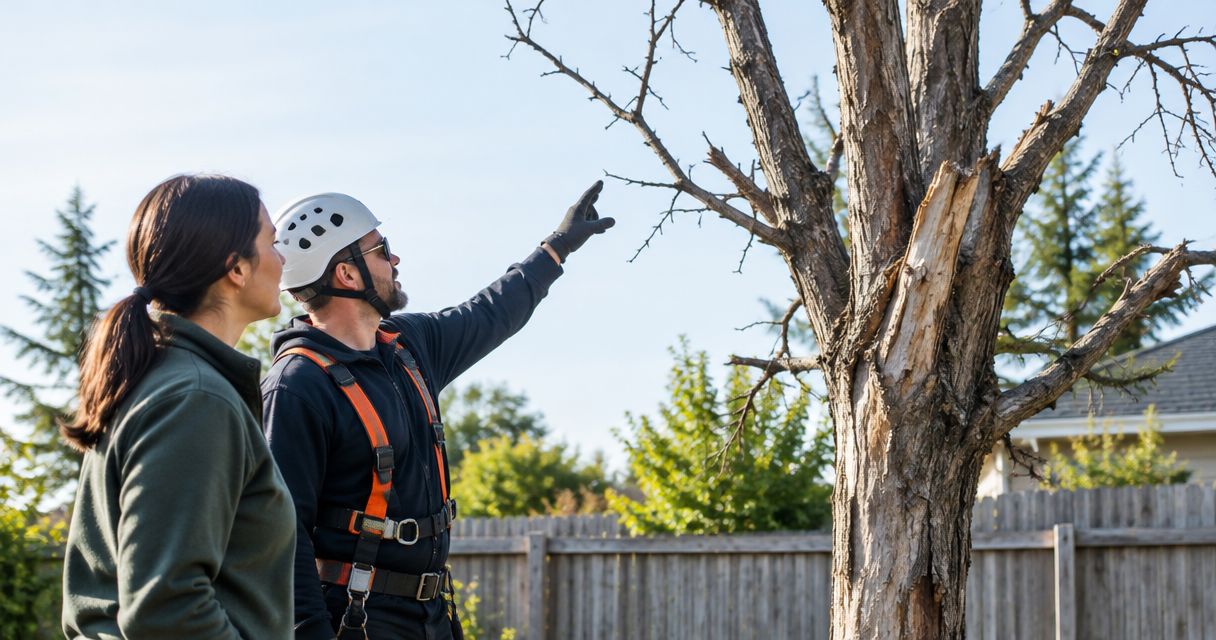
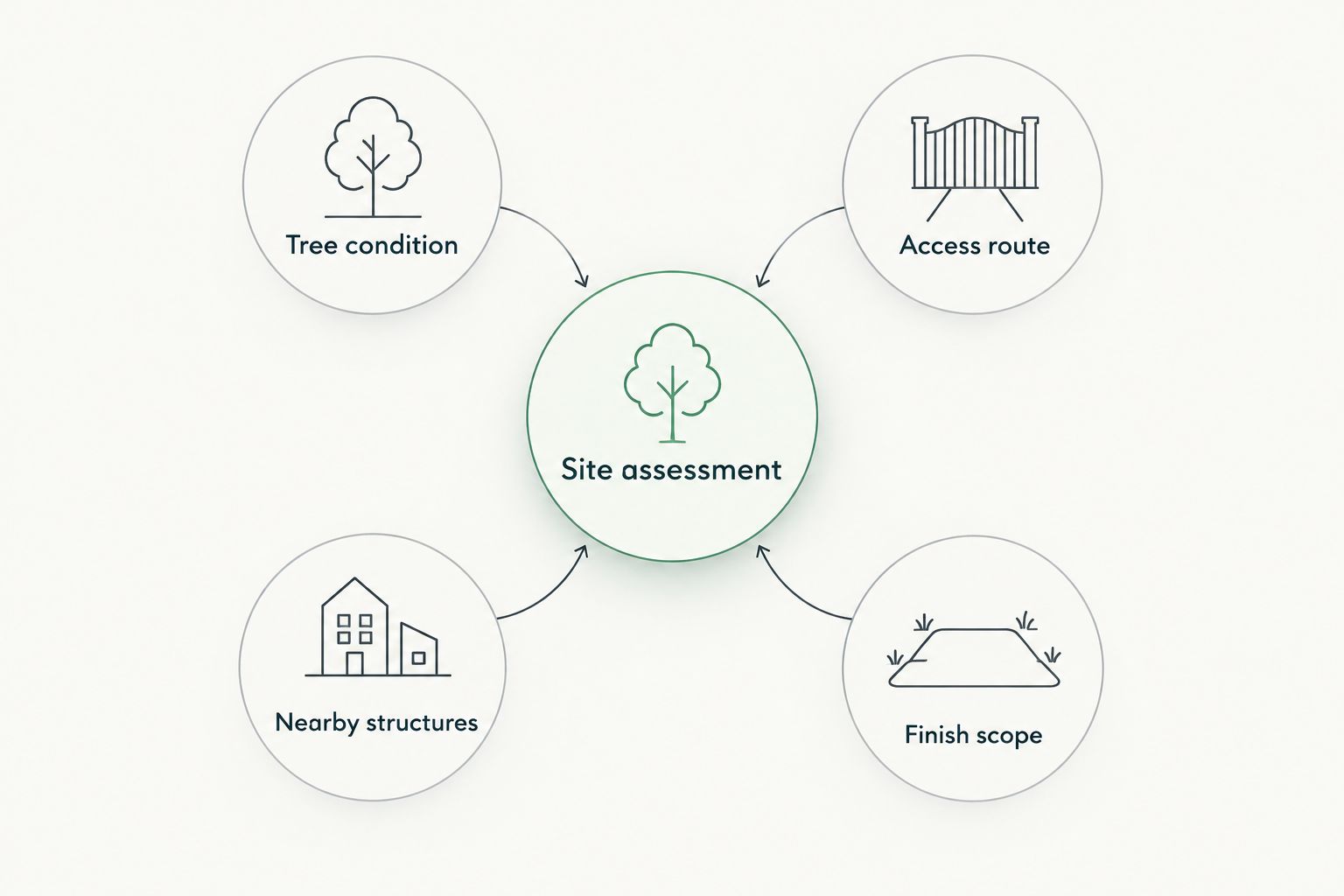
For a 2026 assessment, organize your information under these headings. Describe what you can observe safely; do not climb, move suspended branches, or enter a damaged tree's fall area to improve the request.
- Tree condition: Explain whether the tree is standing, leaning, damaged, or partially fallen.
- Access route: Describe gates, steps, slopes, narrow passages, and surfaces along the route.
- Nearby structures: Identify buildings, fences, roads, utilities, and neighboring property around the tree.
- Finish scope: State whether you want debris removed, wood retained, stump work discussed, or selected vegetation protected.
These details help distinguish the removal method from the finished result. Neither a method name nor a photograph defines what the property will look like after the work.
If you can take photographs from safe positions, start with 4 ground-level photos: the whole tree, its base from a safe distance, the access route, and nearby obstacles. Stop if taking a photograph requires entering an unsafe area; additional pictures never replace an inspection.
Request 1 written scope for the work you want assessed. When comparing contractors, use 2 written scopes with matching debris and stump requirements rather than comparing unlike jobs.
Request a site-specific tree removal quote
Describe the tree, access route, nearby structures, and desired cleanup before discussing a removal method.
How these removal options are ranked
This 2026 ranking uses the criteria above: tree condition, space below, access, material handling, and scope clarity. Open-site felling comes first because it depends on an appropriate landing area; the later entries address increasingly constrained handling or compromised structure.
It is not a safety rating, contractor score, or equipment recommendation for your tree. An on-site finding overrides the order in this guide.
Which large tree removal option should you choose?
Start with a site assessment for sectional removal if a large tree occupies a constrained residential yard. Ask the assessor whether the site instead supports whole-tree felling, requires controlled lowering, or needs specialist lifting or damaged-tree planning.
Pmmidlands tree services serves the confirmed South Carolina counties listed above. When requesting a quote, lead with the property's location and the problem to solve—not a demand for a particular machine.
For commercial property, also identify entrances, pedestrian routes, parking areas, and activities affected by the proposed work area. Put access arrangements in the written scope before authorizing work.
FAQ
What's the easiest large tree removal option?
Directional felling is the simplest option to assess when a suitable open landing area and tree condition support it. A professional must confirm those conditions; open-looking ground alone is not enough.
Is sectional removal better than felling a whole tree?
Sectional removal better fits sites where whole-tree felling lacks a suitable landing area. The sections still need safe handling and a defined area below.
Does a large tree near a house always need a crane?
A large tree near a house does not automatically need a crane. The assessor must compare access, tree condition, structures, and material-handling options before proposing lifting equipment.
What makes a dead or storm-damaged tree harder to remove?
Compromised structure makes the removal assessment more difficult because ordinary support and access assumptions are not enough. Keep away from suspended material and arrange a condition-specific assessment.
Can you choose a removal method from photos?
Photos help describe the job but do not replace a site assessment. Ground conditions, structural defects, access restrictions, and overhead hazards need closer evaluation.
Does large tree removal include the stump and debris?
The written scope determines whether stump work and debris removal are included. Ask for each task to be stated separately so the expected finish is clear.
Where does Pmmidlands provide tree services?
Pmmidlands provides tree services in Richland, Lexington, Newberry, Orangeburg, Sumter, Kershaw, and Fairfield counties in South Carolina. Provide the property location when requesting a site-specific quote.
One last thing
For your 2026 quote, describe the finish as carefully as the tree. A tree can be removed while the stump, logs, and smaller debris remain unless the agreed scope addresses them. Ask what stays, what leaves, and which surfaces or plants need protection.