For dead tree removal at a property boundary, start with the owner of the land where the trunk stands; if the trunk crosses the line, establish ownership and permission with the adjoining owner before authorizing work. A tree service assesses the removal job, but a surveyor establishes a disputed boundary and a local attorney addresses contested rights or payment.
- Dead tree removal starts with trunk location, ownership, and permission—not which yard contains the branches.
- Resolve a disputed boundary before authorizing cutting; a removal quote does not establish ownership.
- Agree on access, fence protection, stump work, and debris removal in writing.
- Pmmidlands provides tree services; request a site-specific assessment rather than assuming the boundary determines the removal method.
Who handles dead tree removal on a property boundary?
Separate who can authorize the work from who performs the work. The owner or an authorized representative arranges the project once ownership and permissions are established; the tree service evaluates how to carry it out. A disputed boundary requires a separate resolution, not a guess made during the removal visit.
For a site-specific discussion, contact Pmmidlands with the property address, photographs taken from a safe location, and an explanation of the boundary concern. Identify any disagreement before asking someone to schedule cutting.
| Where the trunk stands | What to establish before removal | Next move |
|---|---|---|
| Entirely within your confirmed boundary | Your authority to approve work and any access permissions | Request an assessment and a written scope |
| Entirely within the adjoining property | The adjoining owner's involvement and permission | Notify the owner and discuss the next step |
| Across the boundary | Ownership, applicable legal requirements, and authorization | Resolve those questions before approving cutting |
| Location is disputed | The actual boundary position | Consult a licensed surveyor rather than relying on the fence |
This table is a planning guide, not a determination of South Carolina property rights. Neither a contractor's quote nor a neighbor's assumption settles a disputed boundary.
Why this matters in 2026
A boundary-tree project combines a physical hazard with a permission problem. Solving only one leaves the job unfinished: an agreed removal plan still needs safe access, and a clear access route does not establish your right to remove the tree.
For your 2026 project, keep ownership, access, and removal scope as separate decisions. That makes it easier to identify whether the next call belongs with a neighbor, a surveyor, a tree service, or an attorney.
When the trunk is entirely on your property
If the boundary is confirmed and the trunk stands entirely on your property, begin by requesting a removal assessment. Tell the contractor about branches extending over the adjoining yard, nearby structures, and anything that limits access. Do not treat your ownership of the tree as permission to enter someone else's land.
Ask whether the proposed work requires access through the neighboring property. If it does, obtain permission covering the intended route and work area before scheduling that part of the job. Put any agreement about moving fence panels or using a driveway in writing.
Best for an undisputed boundary: establish the work area before approving the removal scope. This avoids treating a narrow strip along the fence as usable space without checking who controls it.
When the trunk is entirely on your neighbor's property
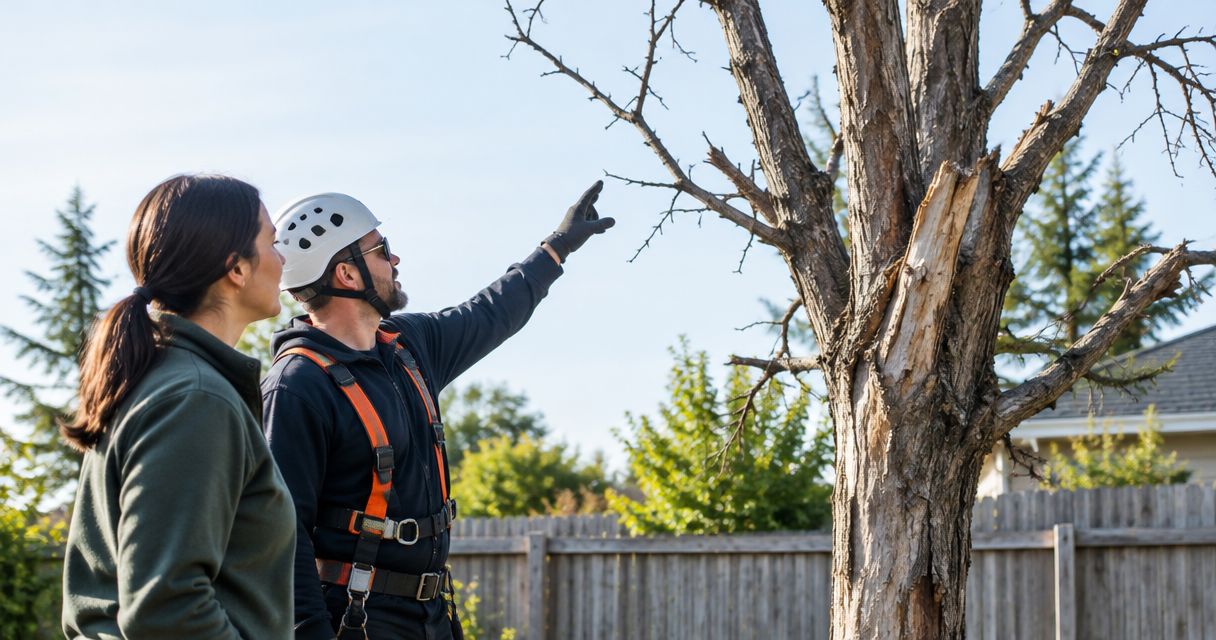
Contact the adjoining owner with a factual description of your concern. State where the tree stands and what you can observe from your own property, such as a fallen limb, a split trunk, or branches above a building. Avoid presenting your own inspection as a professional assessment.
Ask the owner to arrange an assessment and discuss any access needed from your side. Keep a dated copy of your message and photographs; those records document what you communicated, but they do not establish fault or guarantee reimbursement.
Do not hire someone to remove the neighbor's tree solely because its branches cross your boundary. If the owner refuses to engage and you believe the situation threatens people or property, seek advice from a South Carolina attorney about your rights and the appropriate next step.
When the trunk straddles the boundary
Treat a trunk crossing the property line as an ownership and consent question before treating it as a scheduling question. Confirm the line, identify the affected owners, and establish what authorization is required under the applicable law.
A written agreement should describe the tree, the approved work, permitted access, and the agreed payment arrangement. Include what happens to the fence, stump, and debris rather than assuming that permission to cut covers everything around the tree.
Do not turn a proposed equal split into an assumed legal obligation. Owners can discuss sharing the expense, but a voluntary arrangement and a legal duty are different things. Get legal advice if the parties disagree about either.
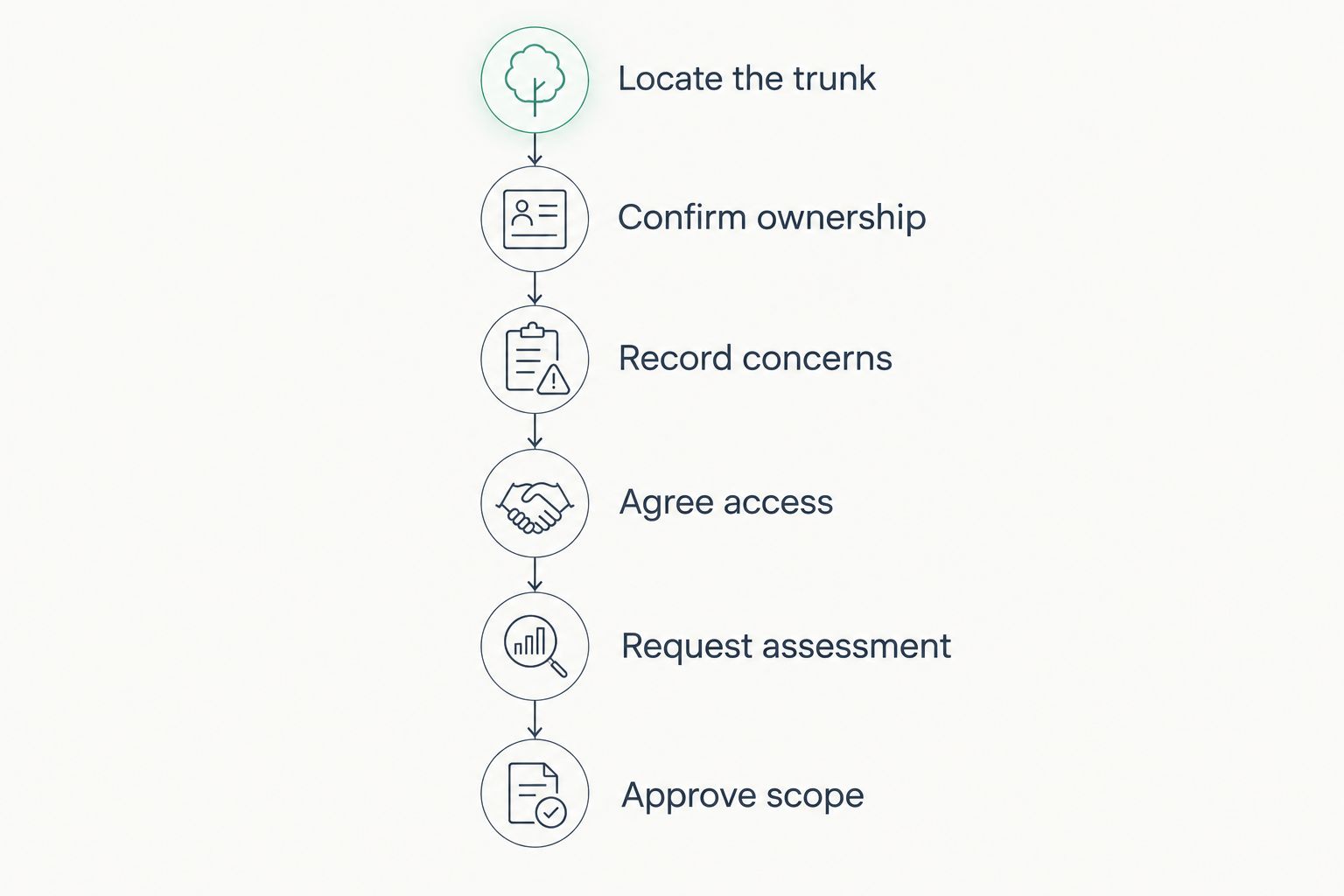
How to arrange boundary-tree removal in 2026
Use this sequence to prepare a 2026 removal request without mixing up ownership evidence, neighbor permission, and contractor instructions. Stop at any unresolved authorization issue rather than asking the crew to resolve it on arrival.
- Locate the trunk. Record where the trunk meets the ground relative to the known boundary. A leaning crown or overhanging branch is not a substitute for establishing the trunk's location.
- Confirm ownership. Review the available property records and existing survey information. Use a licensed surveyor when the boundary remains uncertain.
- Record concerns. Photograph the tree and nearby buildings from a safe position. Do not stand beneath hanging limbs or enter another property to get a better picture.
- Agree access. Identify the proposed entrance, work area, and any neighboring land involved. Obtain the necessary permission before that land becomes part of the plan.
- Request assessment. Ask the tree service to evaluate the removal scope, site constraints, and cleanup requirements. Keep any unresolved ownership dispute explicit.
- Approve scope. Confirm who authorizes the work, who receives the quote, and who agrees to pay. Match those decisions to the written scope before work begins.
The sequence keeps the legal boundary question ahead of the physical work. It also gives the contractor a clear account of what has been agreed and what remains unresolved.
Why the removal plan varies
A property line does not determine how a tree can be removed. The site assessment needs to account for the tree, the surrounding space, and the permissions available for the proposed work.
- Tree condition: Dead limbs, damaged sections, and visible decay need assessment before a removal method is selected.
- Nearby structures: A house, garage, shed, or fence changes the space available for handling tree sections.
- Access route: Gates, steps, narrow passages, and adjoining land affect the proposed route into the work area.
- Utilities: Overhead lines and buried services require attention before cutting or ground disturbance.
- Cleanup scope: Leaving wood onsite, removing debris, and addressing the stump are different instructions.
- Boundary agreement: An approved work area on one property does not automatically include space on the other.
For a tree beside a building, review how to arrange dead tree removal near a house. Tell the assessor about the boundary issue as well as the building; both belong in the project description.
What should your written agreement cover?
A useful agreement identifies the tree and the permitted work without relying on verbal shorthand. Attach a photograph or marked site sketch so both owners are discussing the same tree. Describe removal, stump work, and cleanup separately.
Record these decisions before the job proceeds:
- Authorization: Who approves the removal and any later change to the scope?
- Access: Which entrances and work areas are permitted, and on whose property?
- Protection: How will the proposed work address the fence and other nearby features?
- Material handling: What wood stays, and what debris leaves the property?
- Payment: Who contracts for the work, and what contribution has each owner agreed to make?
For a 2026 agreement, use the actual property details and current scope rather than copying an old neighbor arrangement. If a dispute involves ownership, liability, or an enforceable payment obligation, ask an attorney to address it; a removal scope is not a substitute for legal advice.
What should you send when requesting a quote?
Send the property address, a short description of the tree, and photographs showing its position relative to the boundary and nearby structures. Explain whether the boundary is confirmed, whether the adjoining owner is involved, and whether access permission is already settled.
Useful measurements include the gate opening in feet, the narrowest passage in inches, and the approximate distance to the nearest structure in feet. Measure only from a safe location. These details help describe the site; they do not replace an onsite assessment or establish a safe removal method.
Pmmidlands is a tree-services contact for property owners seeking a site-specific quote in Richland, Lexington, Newberry, Orangeburg, Sumter, Kershaw, and Fairfield counties in South Carolina. Explain the boundary concern when requesting that quote, not after accepting a scope based on unrestricted access.
Request a site-specific tree removal quote
Describe the boundary, access route, nearby structures, and the cleanup you want included.
Does a fence prove who owns the dead tree?
A fence alone does not settle a disputed property boundary. Use the relevant property records and survey information, and consult a licensed surveyor when the line remains uncertain.
Describe the fence's position to the tree service, but distinguish it from a confirmed boundary. That prevents a visible barrier from becoming an unsupported ownership assumption.
Should you split the removal expense with your neighbor?
Split the expense only under an agreement you both understand, or after establishing the applicable legal obligation. A tree near the line does not, by itself, supply the terms of a payment arrangement.
Agree on the scope before discussing contributions. An apparent agreement can break down if one owner expects stump removal and debris hauling while the other has approved cutting only.
What if the dead tree appears ready to fall?
Keep people and pets out of the affected area and avoid approaching the tree to inspect it. If there is immediate danger to people, contact emergency services; if a tree or limb involves a power line, stay away and contact the utility.
Do not attempt emergency cutting to settle a boundary dispute. Address the immediate safety concern first, then obtain the appropriate advice about authorization and responsibility.
FAQ
Who do I call first about dead tree removal on a property line?
Start with the adjoining owner when ownership or access affects both properties, and request a tree-service assessment once authorization is clear. Use a licensed surveyor for a disputed boundary and a South Carolina attorney for contested rights.
Can I remove a dead tree because its branches hang over my yard?
Overhanging branches alone do not establish your authority to remove the entire tree. Confirm ownership and applicable rights before authorizing cutting.
Does my neighbor have to pay half for boundary-tree removal?
Do not assume your neighbor owes half. Establish any applicable legal obligation or agree on a contribution in writing before approving the work.
Can the tree crew use my neighbor's driveway?
Arrange the necessary permission before including your neighbor's driveway in the work plan. Specify the permitted route and work area rather than relying on a general conversation about removal.
What should a boundary-tree removal quote include in 2026?
A 2026 boundary-tree removal quote should describe the tree, removal scope, access assumptions, and cleanup instructions. Ask separately about the stump, fence-related work, and any access permission needed.
Can Pmmidlands tell me where my legal property line is?
A tree-service assessment does not establish a disputed legal boundary. Consult a licensed surveyor for boundary location and an attorney for contested ownership or removal rights.
One last thing
Permission to remove a tree is not the same as permission to use the neighboring yard. Ask a final, specific question before scheduling: does the approved removal plan fit entirely within the land and access areas you are authorized to use?
If the answer changes during assessment, update the permissions and scope before work starts. A clear tree-removal agreement should match the actual work area, not just the location of the trunk.