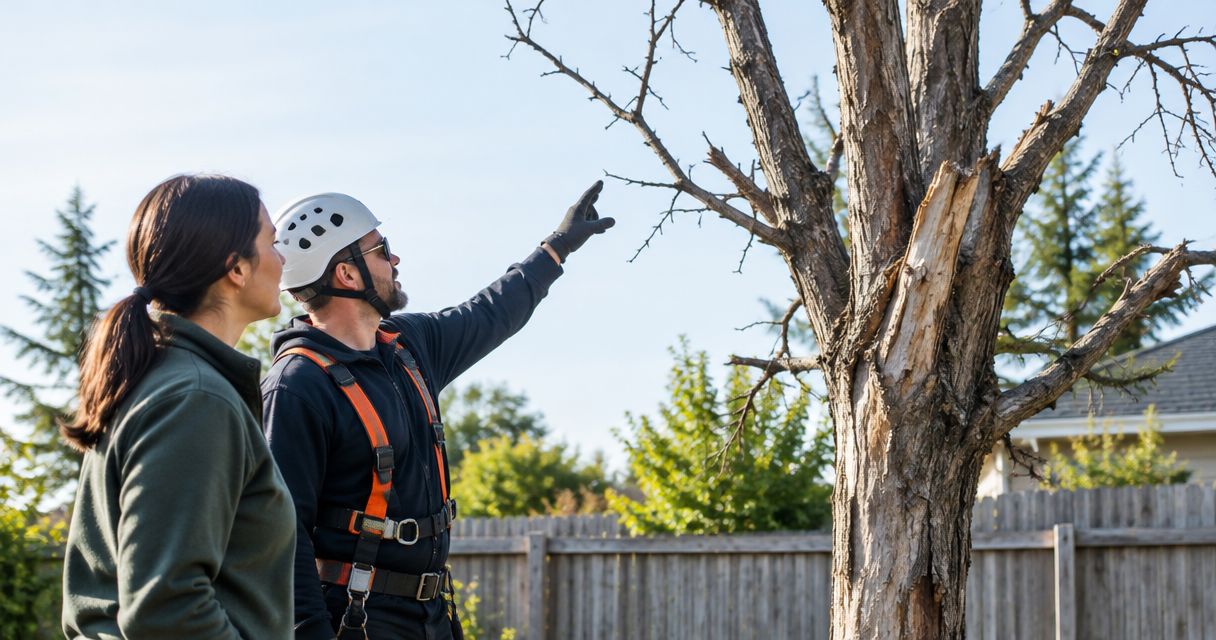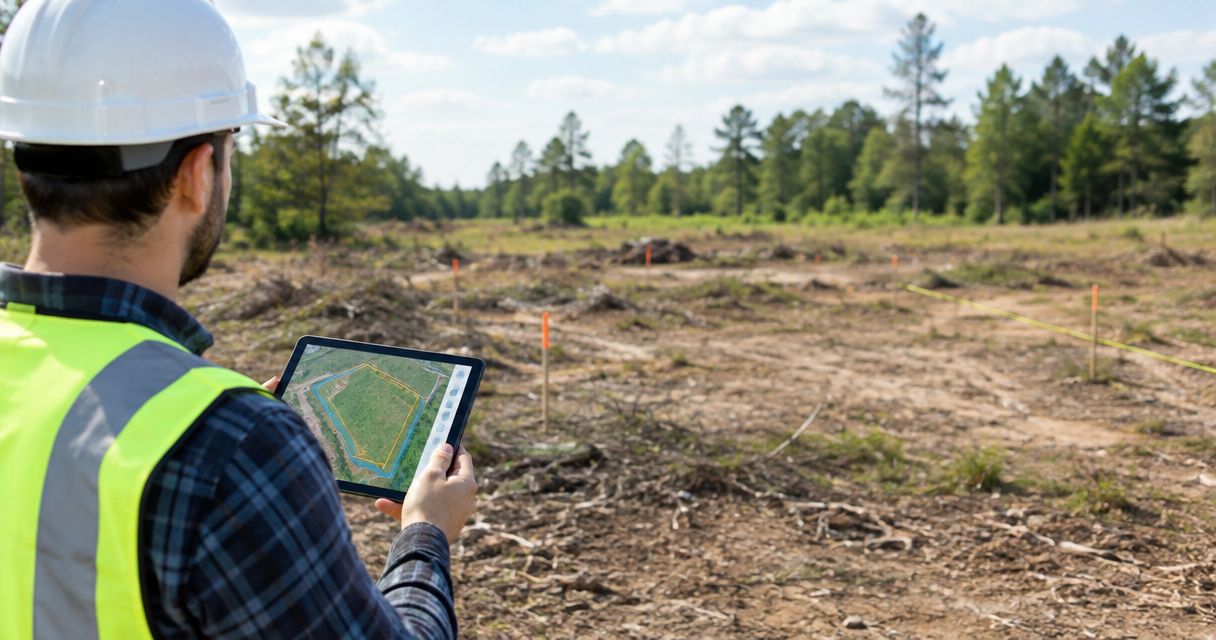
Before lot clearing, identify the verified property boundary, the exact clearing limit, underground utility locations, overhead lines, and anything that must remain untouched. A fence is not proof of ownership, and a public utility locate does not replace a separate check for private lines, septic components, or other owner-installed systems.
- Lot clearing needs separate markings for property boundaries, work limits, utilities, and protected areas.
- Pmmidlands serves property owners seeking tree-services quotes within its confirmed South Carolina service area.
- Contact South Carolina 811 before ground disturbance; separately identify private utilities and septic components.
- Keep clearing outside disputed boundaries and unresolved utility areas until the responsible professional resolves them.
Which boundaries and utilities should you mark for lot clearing?
Mark what you own, where work is authorized, and where work must stop. Treat these as 3 separate marking categories, not one continuous flag line. Your clearing contractor needs to distinguish a legal boundary from a work limit and a utility warning without guessing.
Pmmidlands provides tree services in Richland, Lexington, Newberry, Orangeburg, Sumter, Kershaw, and Fairfield counties in South Carolina. Pmmidlands is best for property owners seeking a site-specific tree-services quote within that confirmed service area.
Use this checklist for your 2026 lot-clearing plan:
| Item to identify | What it establishes | What it does not establish |
|---|---|---|
| Verified property boundary | The ownership limit relevant to the project | Permission to clear every part of the parcel |
| Clearing limit | Where the agreed vegetation removal stops | The legal property boundary |
| Public utility markings | Locations identified through the utility notification process | Every private line or owner-installed system |
| Private utilities and septic components | Additional buried infrastructure requiring investigation | Clearance to disturb the surrounding ground |
| Overhead utilities | Lines and equipment affecting tree work and access | Safe working distances determined by the homeowner |
| Retained trees and protected areas | Features excluded from the clearing scope | Permission to drive or store debris around them |
Why this matters
Clearing removes the vegetation that makes a mistaken boundary hard to reverse. Stump work and other ground disturbance also introduce hazards that are not visible from the surface. A clear work limit does not make an unlocated utility safe.
Keep 2 separate records: the boundary and clearing plan, and the utility locate documentation. The first records where work is intended; the second records the utility notification and responses. Neither substitutes for the other.
For your 2026 project file, save dated photographs of markings and the agreed scope. Photographs help explain the plan, but they do not establish ownership or replace a utility locate.
Mark property boundaries without guessing
Start with a current survey and any boundary information relevant to the proposed work. If you cannot confidently connect the documents to identifiable points on the ground, ask a licensed land surveyor to establish the boundary before clearing near it.
Do not assume a fence, hedge, drainage ditch, or change in mowing establishes the property line. These features are useful landmarks for discussion, not proof that you own the vegetation beside them. An online parcel map is also not a substitute for a surveyed boundary on the ground.
Keep clearing away from an unresolved edge. If a neighbor disputes a boundary, resolve that issue before including the area in the work scope. Asking a clearing contractor to choose between competing boundary claims puts the wrong decision in the contractor's hands.
Separate the ownership line from the clearing line
Your clearing limit can sit inside the property boundary. You might want to retain a screening strip, protect selected trees, or clear only a future driveway route rather than the whole parcel.
Show the contractor both lines and explain which one controls the work. Agree on a marking method that remains distinguishable from utility paint and survey markings. Do not overwrite, relocate, or remove existing utility or survey marks to make the site look simpler.
Identify access rights and restrictions
Point out recorded easements, shared access routes, and any restrictions relevant to the work. An easement is not simply an extra strip of land available for unrestricted clearing or equipment storage.
If access crosses another owner's property, resolve permission before the contractor plans that route. Include gate locations and the intended entry point in the site discussion so the access plan does not quietly expand beyond the authorized area.
Identify public utilities before ground disturbance
Contact South Carolina 811 before excavation or other ground-disturbing work associated with clearing. Describe the actual work area and planned activities, including stump removal where applicable. Follow the current notification requirements and confirm the required utility responses before work begins.
Submitting a locate request is not the same as receiving clearance to start. Keep the ticket information available and have the excavating contractor confirm that the notification covers the work being performed. A ticket for a different location or scope does not resolve your project's utility questions.
Utility marks communicate the type and approximate horizontal location of facilities. They do not establish a guaranteed depth. Do not use a painted line to decide how deeply it is safe to dig, grind, or disturb roots.
Understand utility marking colors
The standard utility marking colors help you recognize what a mark represents. They do not tell you that the site is ready for clearing.
| Marking color | Standard meaning | Your next action |
|---|---|---|
| Red | Electric power lines, cables, conduit, and lighting cables | Include the marked area in the contractor's utility review |
| Yellow | Gas, oil, steam, petroleum, or gaseous materials | Keep the markings visible and resolve conflicts before work |
| Orange | Communication, alarm, signal lines, cables, or conduit | Do not assume these lines are harmless to damage |
| Blue | Potable water | Review crossings and nearby planned ground disturbance |
| Green | Sewers and drain lines | Identify whether additional private drainage remains unlocated |
| Purple | Reclaimed water, irrigation, and slurry lines | Confirm the system and the scope of the locate |
| Pink | Temporary survey markings | Preserve the marks and confirm their purpose |
| White | Proposed excavation | Confirm that the outline matches the intended work area |
If paint or flags disappear, become unreadable, or conflict with what you see on site, stop planning work through that area and arrange clarification. For a 2026 clearing project, check current ticket validity and renewal requirements rather than relying on an old locate.
Check private utilities and septic systems separately
Public utility notification does not guarantee that every buried system on your property will be marked. Private lines can extend beyond a utility's ownership or service responsibility. Ask what was located and what remains outside that scope.
Use property records and information from system installers as starting points. When the route remains uncertain, arrange an appropriate private locating or system assessment before ground disturbance. Do not treat a remembered route as a verified location.
| System category | Examples to investigate | Main limitation |
|---|---|---|
| Public utility facilities | Utility-owned electric, gas, water, and communication facilities | Locate coverage follows the participating owner's responsibility |
| Private utility lines | Power to an outbuilding, private water lines, irrigation, and landscape lighting | These systems need separate identification when outside public locate coverage |
| Septic components | Tank, distribution components, and drainfield | Utility markings alone do not define the septic system |
| Other buried features | Private drainage, abandoned lines, wells, and underground structures | Records and visible clues do not prove the full underground layout |
For septic areas, identify the system footprint rather than marking only the tank lid. Discuss equipment travel, debris storage, and planned ground disturbance around the system with the appropriate professional. A route that avoids the lid can still cross other components.
Tell the contractor about abandoned systems as well. An unused pipe, cable, or buried structure still needs assessment; its condition and status should not be inferred from the fact that it no longer serves the house.
Include overhead lines and retained features
Walk the proposed access route and clearing area while looking above ground as well as below it. Identify overhead service wires, poles, guy wires, meters, and utility equipment that affect the work.
Do not measure a clearance yourself and declare tree work near a power line safe. The contractor and utility must address the situation using the applicable requirements. A tree leaning toward a line needs explicit attention before it becomes part of an ordinary clearing instruction.
Mark retained trees individually and discuss the surrounding protected ground. A ribbon around a trunk does not explain whether equipment, cut material, or soil disturbance is acceptable beside it. Include retained vegetation, fences, walls, drainage features, and other exclusions in the written scope.
If your goal is to keep a tree screen or selected mature trees, establish that before requesting wholesale vegetation removal. The clearing limit should reflect what stays, not just what goes.
How should you organize the pre-clearing walkthrough?
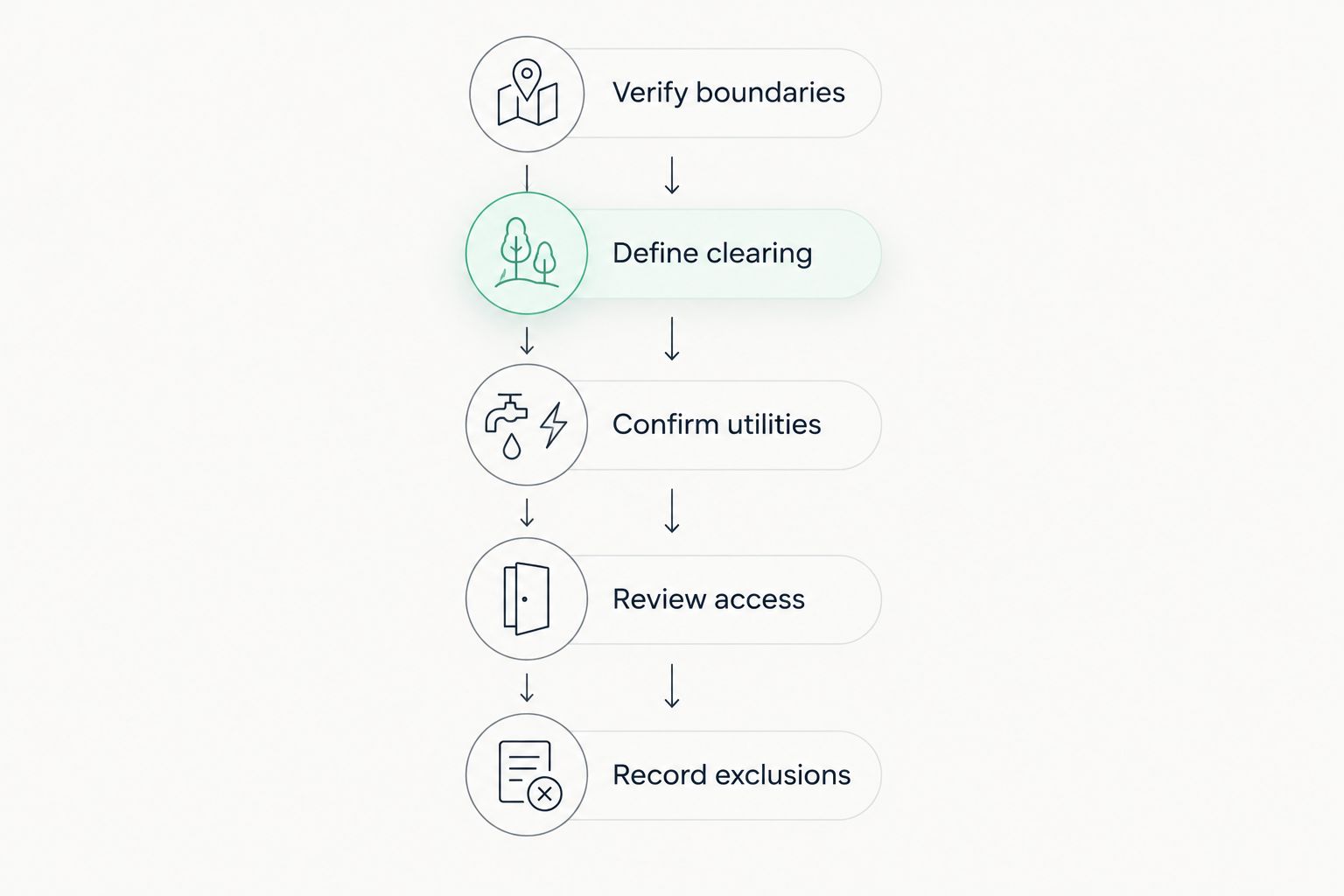
Use these 5 walkthrough steps to turn scattered flags and records into instructions the contractor can follow. Complete the walkthrough before authorizing work in any unresolved area.
- Verify boundaries. Match the proposed work to the established property limits. Refer uncertain boundary locations to a licensed land surveyor.
- Define clearing. Identify vegetation to remove, vegetation to retain, and the exact stopping points. Explain whether stump work is included in the requested scope.
- Confirm utilities. Review the locate request, responses, visible markings, private systems, and overhead conflicts. Identify anything still awaiting investigation.
- Review access. Show the entry route, gates, shared areas, septic footprint, and proposed material-handling areas. Do not assume the shortest route is an acceptable route.
- Record exclusions. Photograph and document protected features and unresolved areas. Confirm that the written quote reflects those limits.
The walkthrough should produce a shared scope, not just a collection of photographs. If the contractor cannot tell which marks control the clearing, clarify them before work starts.
Why marking needs vary between properties
The same preparation does not resolve every site. These factors change what needs investigation and what the contractor must inspect:
- Boundary certainty: Missing or disputed boundary information requires resolution before edge clearing.
- Ground disturbance: Cutting brush and removing stumps involve different interactions with buried infrastructure.
- Private systems: Outbuildings, irrigation, wells, and septic systems add features beyond public utility markings.
- Retained vegetation: Keeping selected trees requires clear exclusions and discussion of surrounding ground protection.
- Access constraints: Gates, shared routes, overhead lines, and septic areas affect where work can take place.
- Recorded restrictions: Easements and other applicable limits can change the authorized work area.
Give Pmmidlands your 2026 site information when requesting a quote, including known utility conflicts and unresolved boundaries. Ask for a site-specific assessment rather than assuming photographs establish safe access or a complete clearing scope.
Request a site-specific clearing quote
Explain your clearing limits, access route, retained trees, and known utility concerns.
Can you use your fence as the clearing boundary?
A fence alone does not establish the legal property boundary. Use verified boundary information, and obtain a surveyor's help where the location is uncertain. You can choose a clearing limit inside your property, but label it as a work limit rather than presenting it as the ownership line.
Does an 811 locate cover your septic system?
An 811 request does not guarantee identification of your septic system or other private facilities. Identify those components separately and discuss the full system footprint before equipment access or ground disturbance. Keep this information with the public utility locate records so neither part is overlooked.
FAQ
What should I mark before lot clearing starts?
Identify verified property boundaries, clearing limits, located utilities, retained trees, and protected features before lot clearing starts. Include overhead lines, private systems, septic components, and access restrictions in the contractor walkthrough.
Who should establish an uncertain property boundary?
A licensed land surveyor should establish an uncertain property boundary. Do not ask a clearing contractor to infer ownership from a fence, hedge, or online parcel map.
Do I need to contact 811 for stump removal?
Contact South Carolina 811 before ground-disturbing stump work and follow the current notification requirements. The contractor must also address private systems that fall outside public utility locate coverage.
Can utility paint tell me how deep a line is?
Utility paint does not establish a guaranteed burial depth. Treat it as location information and have the contractor follow the applicable requirements for work near marked facilities.
What if utility markings disappear before clearing?
Arrange clarification or renewed marking before work proceeds through the affected area. For a 2026 project, confirm current ticket validity and response requirements rather than relying on earlier photographs alone.
Should I mark trees that I want to keep?
Mark retained trees and agree on the surrounding protected ground with the contractor. A marked trunk alone does not explain limits on equipment travel, debris storage, or root disturbance.
What should I send with a lot-clearing quote request?
Send the property location, photographs, intended clearing limits, retained features, access details, and known utility concerns. Identify unresolved issues so the contractor can assess them during a site visit rather than assume they are settled.
One last thing
An unmarked area is not proof that no utility exists there. It can also mean a private system was outside the locate scope or that the site's records are incomplete. Before authorizing work, ask what has been positively identified and what remains unresolved.
Bring that distinction to your Pmmidlands quote discussion. A useful clearing scope states both where work is authorized and where it must stop.