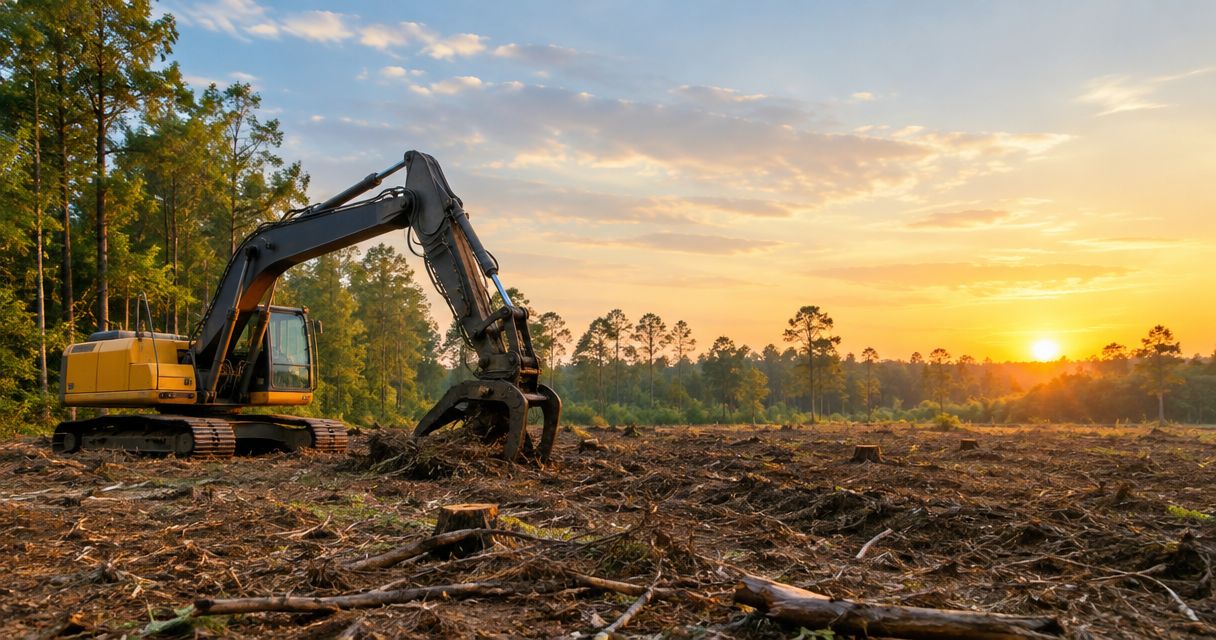
Best overall starting point: sectional removal with controlled lowering. Best for lifting sections past obstacles: crane-assisted removal. Best for an unobstructed site: whole-tree felling. Your choice among large tree removal near structure options depends on tree condition, equipment access, and where each section can safely land—not simply the distance to your roof.
- Compare large tree removal near structure options by tree condition, access, landing space, and protection needs.
- Sectional removal suits confined sites when an assessment confirms suitable support and a controlled lowering route.
- Crane-assisted removal requires suitable setup space and a site-specific lifting plan.
- Pmmidlands is a local tree-services option for property owners requesting a site-specific removal quote.
For properties in Richland, Lexington, Newberry, Orangeburg, Sumter, Kershaw, and Fairfield counties, Pmmidlands is a tree-services provider to contact about your project. Describe the nearby structure and request a site assessment; do not assume a particular removal method or equipment package is included.
Why this matters
A large tree beside a building creates a handling problem, not just a cutting problem. Branches, trunk sections, equipment, and workers need a planned route that accounts for the structure and surrounding property.
For a 2026 removal project, compare the proposed method before accepting a quote. A proposal that identifies access restrictions, material handling, and cleanup gives you more to assess than an unexplained promise to remove the tree.
The best removal method is the one the assessed tree and site can support safely. No method wins merely because it uses bigger equipment or sounds less disruptive.
What makes the best large-tree removal option?
Use these criteria to assess the proposal before comparing methods:
- Tree condition: Decay, dead branches, splits, and instability affect whether the tree can support climbing or rigging loads.
- Structure exposure: Roofs, walls, porches, fences, and neighboring buildings constrain cutting and material handling.
- Access and setup: Gates, driveways, overhead obstructions, slopes, and ground conditions affect equipment positioning.
- Landing space: The contractor needs a defined place to lower, lift, or place removed material.
- Property protection: The plan should address surfaces, landscaping, buried features, and areas people must avoid.
- Complete scope: Tree removal, stump work, debris handling, and final cleanup need separate, clear descriptions.
Treat these as questions for the contractor—not instructions for carrying out removal yourself. A photograph can show proximity to a house, but it cannot establish that the trunk or a branch is a suitable support point.
Large-tree removal options at a glance
The ranking below compares methods, not providers. A contractor can combine methods on the same tree, and this list does not establish which methods Pmmidlands offers.
| Rank and option | Best for | Standout feature | Key limitation |
|---|---|---|---|
| 1. Sectional removal with controlled lowering | Confined sites with suitable support and a usable lowering area | Removes the tree in manageable sections | Tree condition and support points constrain the plan |
| 2. Crane-assisted removal | Sites where sections need lifting past obstacles | Lifts cut sections toward a designated placement area | Requires suitable crane access, setup, and lift planning |
| 3. Aerial-lift-assisted removal | Sites with usable equipment access beside the tree | Provides an elevated work platform | Does not solve material handling by itself |
| 4. Whole-tree felling | Sites with sufficient unobstructed falling space | Brings the main tree down in a planned direction | Often unsuitable where structures restrict the falling area |
1. Sectional removal: best for confined sites
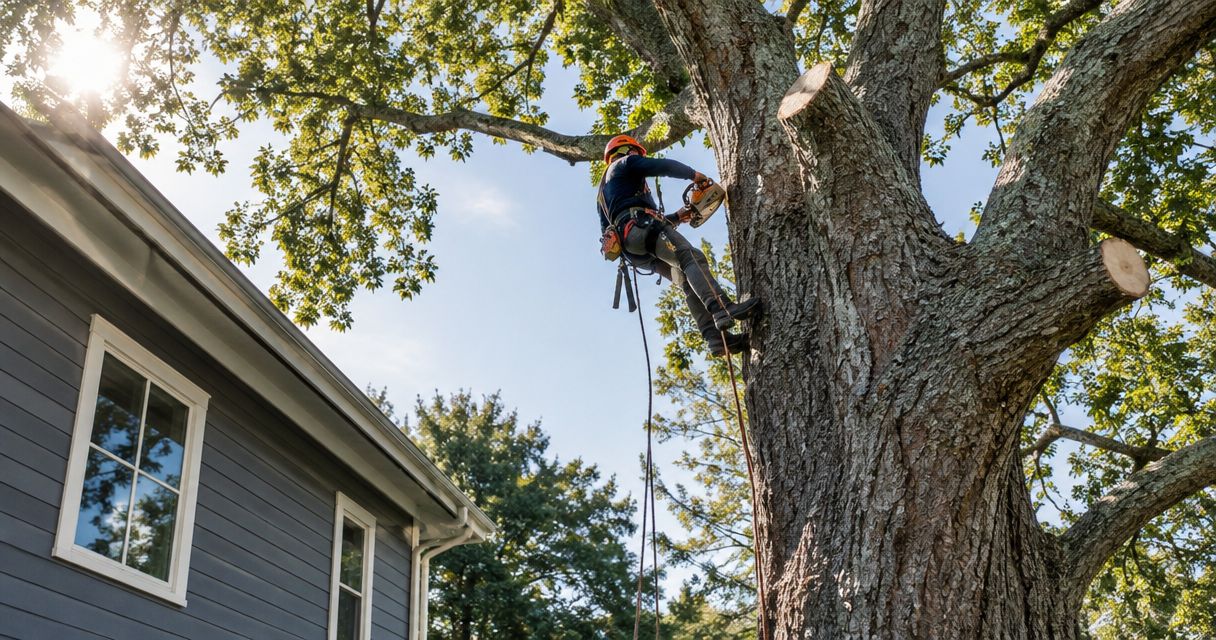
Sectional removal takes the tree apart rather than bringing it down whole. Where appropriate, ropes and rigging control the movement of cut material toward a designated landing area.
This is the strongest starting point for a discussion about a large tree close to a house. Its suitability still depends on the tree's condition, available support points, and a workable route for removed sections.
Sectional removal pros:
- Breaks the job into sections rather than requiring a full-tree falling area.
- Allows controlled handling around nearby obstacles when conditions support the plan.
- Can be planned around a defined landing and processing area.
Sectional removal cons:
- A compromised tree can limit climbing and rigging choices.
- Tight landing space still creates material-handling constraints.
- Controlled lowering does not eliminate the need for an exclusion area.
Best for: Property owners whose buildings restrict open falling space but whose site supports a sectional approach.
Ask the contractor how sections will travel from the tree to the landing area. The explanation should cover the nearby structure, not just identify that ropes will be used.
Verdict: Buy only after the assessment confirms suitable support and a controlled material-handling plan.
2. Crane-assisted removal: best for lifting past obstacles
Crane-assisted removal uses a crane to support and move tree sections as part of a planned lifting operation. It can address situations where lowering material through the space immediately beneath the tree is restricted.
A crane is not an automatic solution for every tight backyard. The setup location, ground conditions, lifting route, and surrounding obstructions all require assessment.
Crane-assisted removal pros:
- Provides a way to lift sections toward a designated placement area.
- Can address obstacles that complicate conventional lowering.
- Adds a material-handling option when site conditions support crane use.
Crane-assisted removal cons:
- Requires suitable access and setup space for the proposed crane.
- Ground conditions and overhead obstructions can restrict positioning.
- A crane plan still needs coordination of cutting, lifting, and ground handling.
Best for: Sites where the assessed lifting route solves a specific obstacle that other methods cannot address as effectively.
For a 2026 crane-assisted removal quote, ask where the crane would stand and what property access the operation requires. Do not assume that a nearby driveway is suitable merely because it looks wide enough.
Verdict: Hold until the contractor explains the setup location and why lifting improves the site-specific plan.
3. Aerial-lift removal: best for accessible work-platform positioning
An aerial lift provides an elevated platform from which a worker can reach parts of the tree. It addresses worker access; the contractor still needs a separate plan for controlling and moving cut material.
That distinction matters beside a structure. A platform near the canopy does not, by itself, explain how a limb will pass the roof or where a trunk section will land.
Aerial-lift removal pros:
- Provides an elevated working position where access and reach permit.
- Can reduce reliance on climbing the tree for the portions within reach.
- Can form part of a sectional-removal plan.
Aerial-lift removal cons:
- Requires suitable equipment access, positioning, and ground support.
- Reach and surrounding obstructions restrict usable work positions.
- Cut material still needs a controlled handling route.
Best for: Properties with suitable access and positioning space for an elevated platform beside the work area.
Ask the contractor to distinguish the access method from the removal method. Your quote should explain both how workers reach the tree and how material leaves it.
Verdict: Buy only when the proposed platform position and material-handling method both fit the site.
4. Whole-tree felling: best for genuinely open falling space
Whole-tree felling brings the main tree down in a planned direction rather than dismantling it completely while standing. It requires a suitable falling area and an assessment of the tree and surrounding hazards.
A tree beside a building does not automatically rule this method out, but a narrow gap is not proof that it fits. The contractor must assess the whole falling area, including obstacles beyond the tree's immediate surroundings.
Whole-tree felling pros:
- Avoids dismantling the entire standing tree when conditions permit.
- Moves the main trunk to ground level for subsequent processing.
- Fits sites where adequate unobstructed space exists.
Whole-tree felling cons:
- Requires substantially different space from a sectional approach.
- Tree lean, condition, and surrounding obstacles constrain suitability.
- The resulting ground-level tree still requires processing and debris handling.
Best for: Open properties where the assessed falling area keeps buildings and other obstacles clear of the planned operation.
Do not select whole-tree felling simply because it appears less involved. Ask why the available space and tree condition support it.
Verdict: Skip when the assessed falling area cannot accommodate the tree clear of structures and other hazards.
A 2026 site-assessment checklist
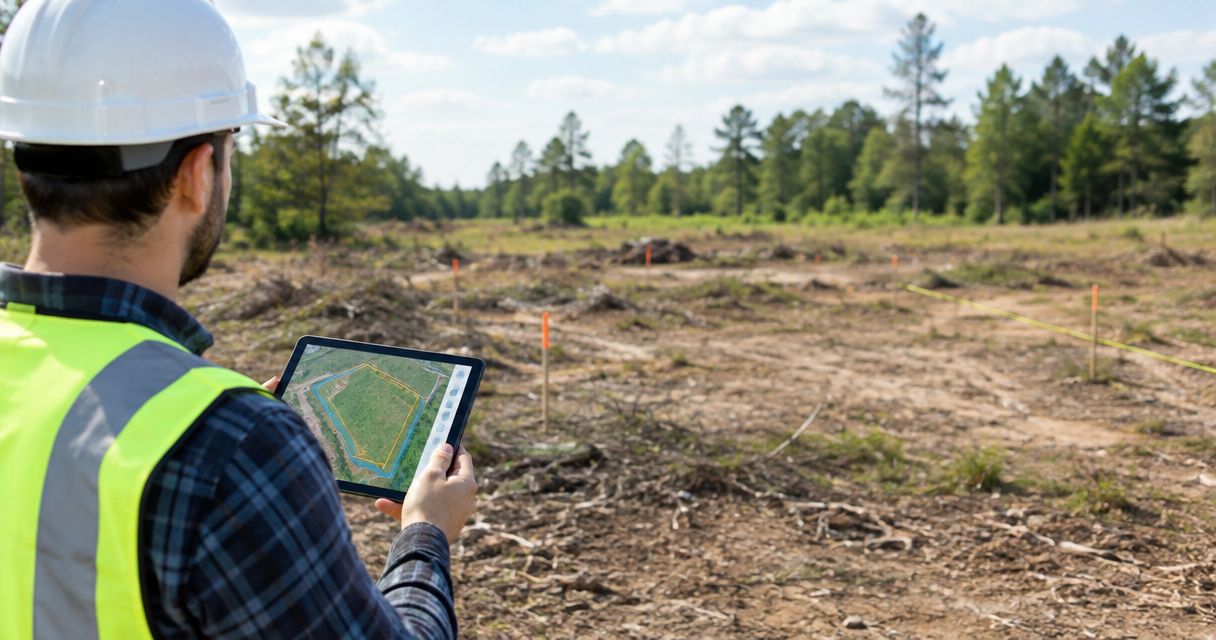
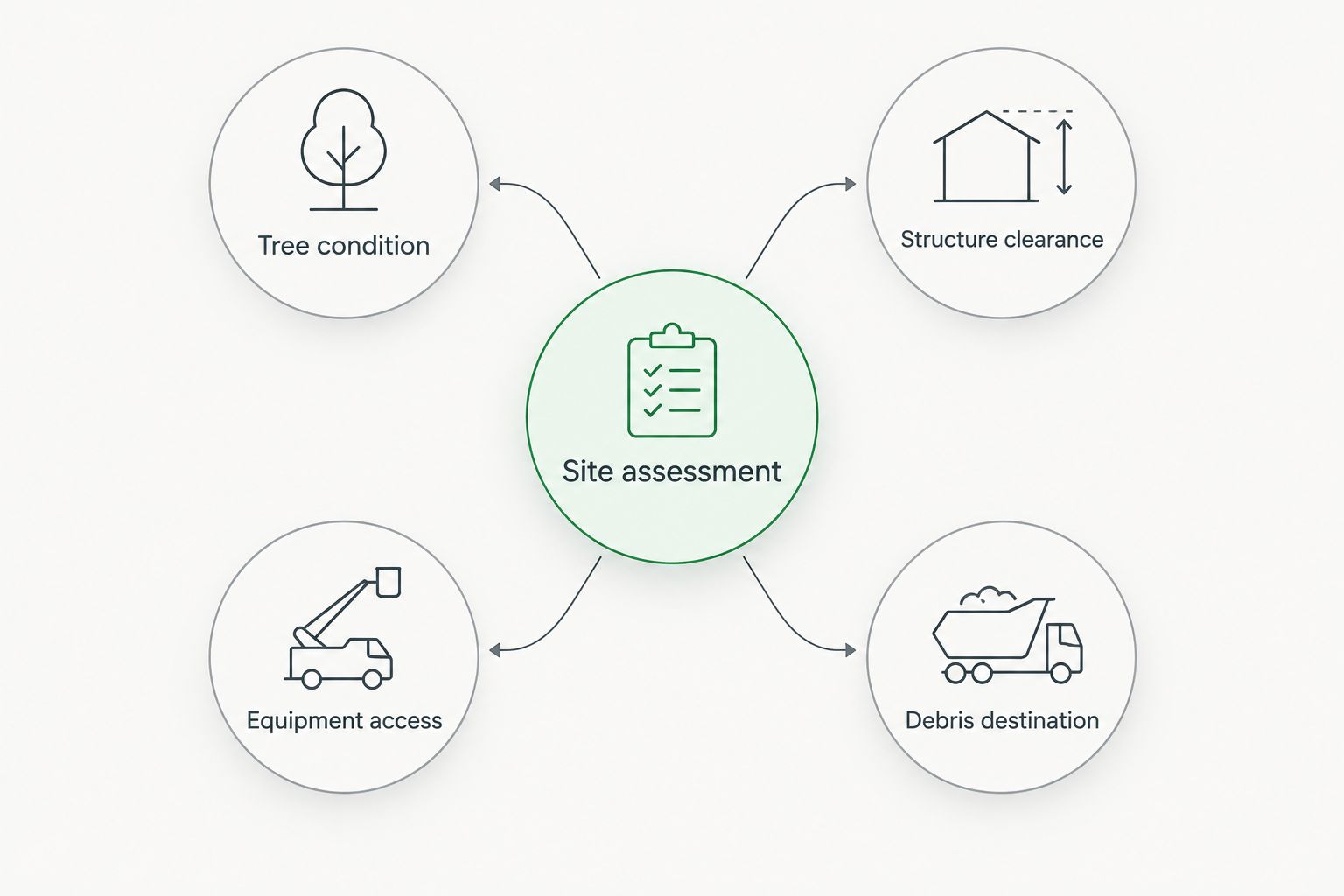
Before requesting a visit, organize information into four groups. Keep observations at ground level and outside any suspected hazard area; do not climb, cut, or disturb the tree to collect details.
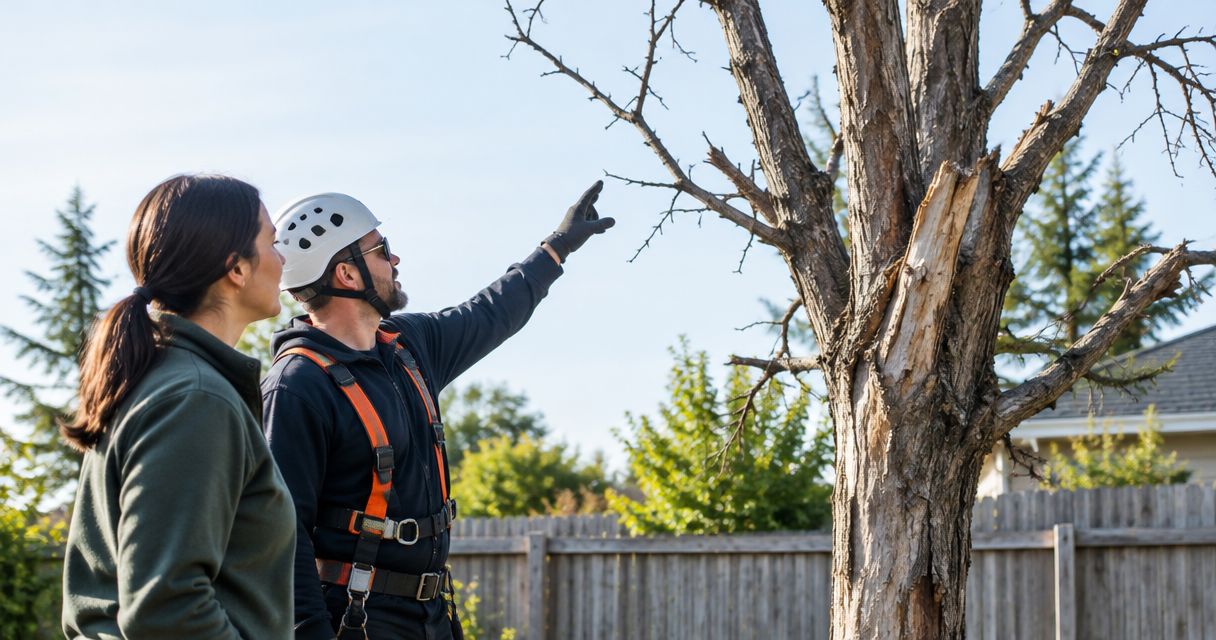
- Tree condition: Describe visible dead limbs, trunk openings, splits, hanging branches, or recent changes.
- Structure clearance: Identify the house, garage, porch, fence, or neighboring property exposed to the work.
- Equipment access: Describe gates, slopes, driveways, overhead lines, and known buried features.
- Debris destination: State whether you want material removed or selected wood retained.
These groups help explain why apparently similar trees need different removal plans. The contractor must connect the observed conditions to the proposed method.
For an initial inquiry, offer 3 photo views if you can take them safely: the whole tree from a distance, its relationship to the structure, and the access route. Explain what the photographs do not show, such as a gate beyond the driveway or a structure behind the canopy.
If safely measurable, provide 2 access measurements: the narrowest opening's width and any overhead clearance restriction along the proposed route. These help describe access; they do not establish that equipment can use it.
What your 2026 removal quote should explain
Request 4 scope components in writing: tree removal, stump work, debris handling, and surface cleanup. Each component should say what is included, excluded, or left for a separate decision.
A useful proposal also identifies the intended approach and the access assumptions behind it. Compare the scope using this guide to comparing a tree removal quote in South Carolina.
Ask direct questions:
- What method is proposed, and which site condition makes it appropriate?
- Where will equipment stand and removed material go?
- Which surfaces or landscaped areas need protection?
- What arrangements are needed for occupants, vehicles, pets, and neighboring access?
- What happens if the assessment identifies conditions requiring a different approach?
Pmmidlands tree removal inquiries should include the county, the nearby structure, and the access restrictions. Request a site-specific quote without assuming that stump work, hauling, or a particular removal method is included.
Request a site-specific tree removal quote
Describe the structure, tree condition, access route, and cleanup you need.
How these options are ranked
This ranking prioritizes control around structures, then access, tree condition, and complete material handling. Sectional removal leads as a discussion starting point because it does not require bringing the entire tree down at once—not because every tree can support the same technique.
Crane assistance and aerial-lift access solve different problems. Whole-tree felling belongs last for this particular query because a nearby structure makes available falling space a central constraint.
Which removal option should you choose?
Start by requesting an assessment for sectional removal, then ask whether crane assistance or elevated-platform access improves the plan. Choose whole-tree felling only when the assessed site supports an unobstructed falling area.
For your 2026 project, select the proposal that explains the method, access, material route, and cleanup obligations. Pmmidlands is a local tree-services option for property owners requesting a site-specific removal quote in its confirmed South Carolina service area.
FAQ
What's the best way to remove a large tree near a house?
The best method depends on tree condition, access, and available material-handling space. Sectional removal is a useful starting point for assessment when bringing the tree down whole would conflict with nearby structures.
Is crane-assisted removal better than climbing?
Crane-assisted removal is not automatically better than climbing-based sectional removal. A crane addresses lifting and material movement, while climbing addresses worker access; the assessed site determines which combination fits.
Can an aerial lift remove a tree without rigging?
An aerial lift does not replace a material-handling plan. It provides worker access, while the contractor must separately determine how cut sections will be controlled and moved around the structure.
Can a dead tree near a building be climbed?
A dead tree requires a professional condition assessment before climbing is considered. Visible appearance alone does not establish whether the tree can support a worker or rigging loads.
What should a large-tree removal quote include in 2026?
A large-tree removal quote should define the removal scope, access assumptions, debris handling, and cleanup. Ask for a separate statement about stump work rather than assuming it is included.
Can I choose the removal method from photographs?
Photographs alone do not establish the correct removal method. They help communicate the tree's position and access restrictions, but tree condition and equipment setup require site-specific assessment.
What should I do if the tree is touching a power line?
Keep away from the tree and contact the utility. Do not touch branches, attempt cutting, or approach wires; call emergency services if there is immediate danger.
One last thing
Decide whether you want the stump removed before agreeing to the removal scope. Taking down the standing tree and addressing the stump are different tasks, and leaving that decision unstated makes quotes harder to compare.
Tell the contractor what you want the space used for afterward. A lawn, planting area, and future construction project raise different follow-up questions even when the standing tree is identical.