Best overall for lawn recovery: professional stump grinding. Best for removing the root mass: excavation. Best for an unused garden corner: managed natural decay. This 2026 guide compares large stump removal options for hardwood stumps and explains what to include in a site-specific quote request to Pmmidlands.
- Professional stump grinding leads large stump removal options when your goal is restoring lawn without extracting the root mass.
- Excavation suits projects requiring root-mass removal, but the quote must address backfill and ground restoration.
- Pmmidlands is a tree-services contact for property owners requesting a site-specific assessment in its confirmed South Carolina counties.
- Choose the stump-removal method around future land use, access, buried utilities, and debris handling—not stump diameter alone.
Why this matters
A large hardwood stump creates two different problems: the visible obstruction and the wood below ground. Removing the first does not necessarily resolve the second. Your next use for the space determines which problem needs solving.
For a 2026 lawn project, grinding is the default starting point. For a driveway, footing, or other construction footprint, ask the project contractor what buried material must be removed before choosing a method. A surface that looks clear is not automatically ready for construction.
What makes the best large stump removal options
Judge each method against these criteria before comparing quotes:
- Future land use: Lawn, planting beds, pavement, and structures require different outcomes.
- Removal scope: Distinguish stump reduction from extraction of the stump and specified roots.
- Access: Gates, slopes, retaining walls, and surface conditions affect the work plan.
- Underground conflicts: Identify utilities, irrigation, drainage, and nearby structures before disturbing soil.
- Finished condition: Specify chip removal, backfill, grading, and responsibility for later settlement.
- Nearby trees: Ask how the proposed work will avoid unnecessary disturbance around trees you intend to retain.
The first quote question is not simply whether stump removal is included. It is what that phrase means. Use the guide to stump and debris removal in a tree-removal quote to separate those tasks before comparing proposals.
Large stump removal options at a glance
| Rank and option | Best for | Main advantage | Key limitation |
|---|---|---|---|
| 1. Professional stump grinding | Restoring a lawn or landscape surface | Reduces the stump without extracting the entire root mass | Leaves buried wood and requires a cleanup plan |
| 2. Excavation | Projects requiring root-mass removal | Removes the stump and roots included in the agreed scope | Creates a larger disturbed area and backfill needs |
| 3. Manual excavation and cutting | Access-restricted sites requiring selective work | Allows a targeted approach around the stump | Large hardwood stumps demand substantial physical work |
| 4. Chemical-assisted decay | An isolated stump with no near-term land-use deadline | Avoids immediate mechanical extraction | Does not provide prompt clearance or root removal |
| 5. Managed natural decay | An unused landscape corner | Avoids active extraction | Leaves the obstruction in place while wood decomposes |
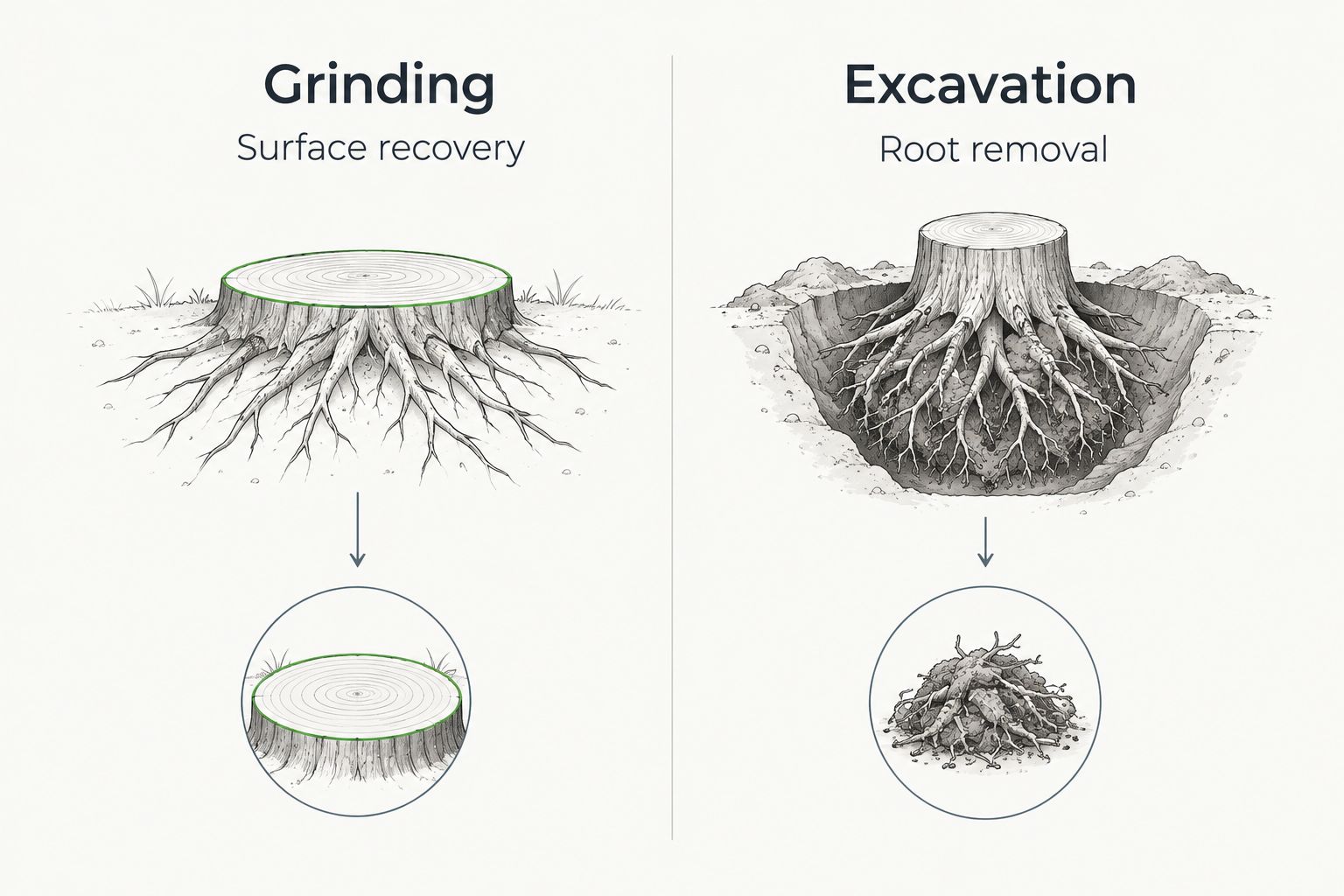
Grinding and excavation solve different problems. Grinding reduces the obstruction; excavation removes the agreed buried material. Neither label alone tells you how the contractor will leave the site.
1. Professional stump grinding: best for lawn recovery
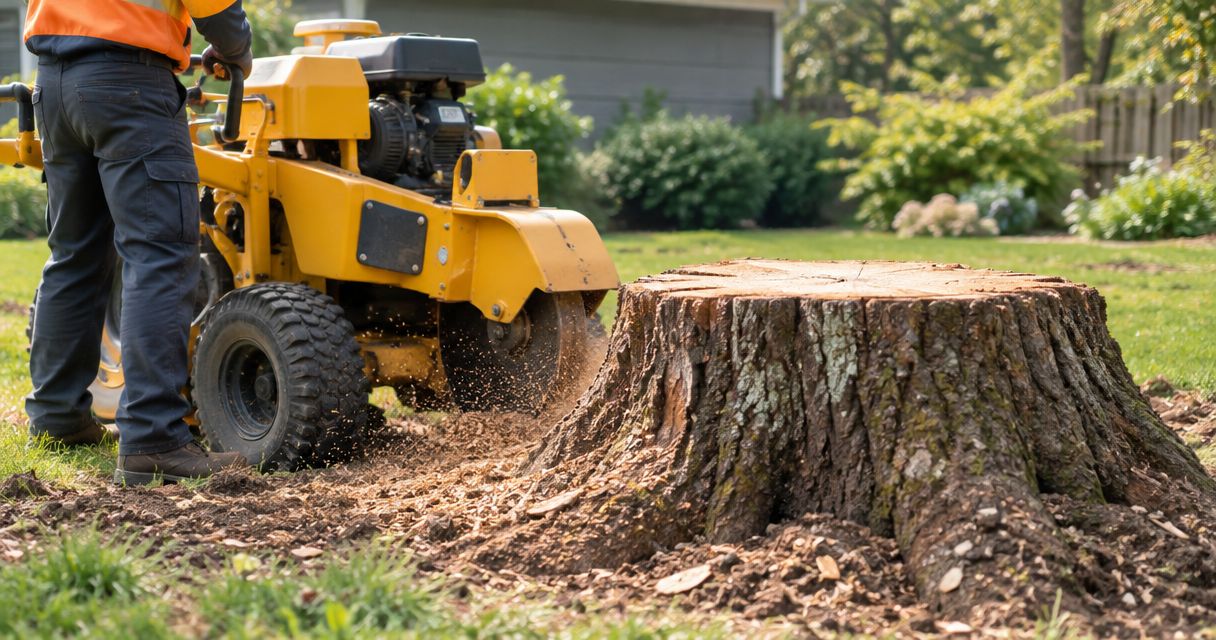
Professional stump grinding mechanically reduces the stump into wood fragments. It is the strongest default when you want to remove a mowing obstruction or recover a landscape surface without excavating the entire root mass.
The important specification is the finished result. Ask what area will be ground, how the depth will be defined, and whether exposed lateral roots are included. Do not assume every visible root belongs to the quoted scope.
Professional stump grinding pros:
- Targets the stump rather than extracting the whole root mass.
- Suits lawn restoration when the remaining buried wood is acceptable.
- Allows grinding, chip removal, and soil replacement to be specified separately.
Professional stump grinding cons:
- Leaves roots and other wood below ground.
- Produces grindings that need an agreed destination.
- Does not establish that the area is ready for a footing or paved surface.
Best for: Homeowners recovering usable lawn around a large stump.
For a 2026 landscape project, request a written description of the surface you will receive. A ground stump covered in chips is not the same deliverable as a backfilled, graded planting area.
Verdict: Buy professional grinding when surface recovery is the goal and retained roots do not conflict with the next use.
2. Excavation: best for projects requiring root-mass removal
Excavation removes the stump by exposing and separating the root mass from the surrounding ground. The proposal must define which additional roots will be removed; complete removal of every root should never be assumed.
This method fits projects where buried wood conflicts with the planned work. Have the driveway, building, or grading contractor define the required clearance before the removal scope is finalized.
Excavation pros:
- Removes the stump rather than reducing it in place.
- Can address roots within a specified construction footprint.
- Makes the resulting excavation available for inspection before backfilling.
Excavation cons:
- Disturbs more ground than stump reduction alone.
- Requires a plan for extracted material and replacement soil.
- Can conflict with underground services or roots of retained trees.
Best for: Property owners whose construction or grading plan requires root-mass removal.
Your 2026 construction schedule should include agreement on who approves the excavation and who handles backfill. Structural fill requirements belong with the responsible construction professional, not an assumption in a tree-service quote.
Verdict: Buy excavation when the project requires buried wood removal, not merely a clear-looking surface.
3. Manual excavation and cutting: best for selective access work
Manual removal exposes roots through digging and separates them through controlled cutting. For a large hardwood stump, this is a selective approach to discuss during assessment—not an easy substitute for professional equipment.
A narrow gate does not make manual removal automatically practical. The assessor still needs to consider root size, soil conditions, nearby structures, and how the separated material will leave the property.
Manual excavation and cutting pros:
- Allows selective exposure of roots.
- Offers a scope to assess where equipment access is restricted.
- Can focus disturbance on a defined area.
Manual excavation and cutting cons:
- Involves substantial digging and handling.
- Becomes difficult around large structural roots.
- Exposed roots and excavation create hazards before the job is finished.
Best for: Access-restricted sites where an assessor identifies a workable selective-removal plan.
Do not pull a large stump with a passenger vehicle or improvise with tensioned ropes and chains. Restricted access calls for a different work plan, not a riskier shortcut.
Verdict: Hold until a site assessment confirms that selective manual work is practical.
4. Chemical-assisted decay: best for isolated, no-deadline sites
Chemical stump treatments are intended to assist decay rather than extract a stump. Their use depends on the specific product label, application restrictions, and whether the site can remain obstructed.
This is not a substitute for clearing a construction footprint. It also does not eliminate the need to manage the remaining stump and roots.
Chemical-assisted decay pros:
- Avoids immediate mechanical extraction.
- Leaves the surrounding ground largely undisturbed during treatment.
- Fits consideration where active removal is not required.
Chemical-assisted decay cons:
- Does not deliver immediate usable space.
- Introduces product handling and label-compliance requirements.
- Leaves the stump and buried roots in place during decomposition.
Best for: An isolated stump with no near-term use planned, where label-compliant treatment is suitable.
Identify what the product actually does before buying it. A treatment intended to control regrowth and a treatment marketed for decomposition do not answer the same question. Follow the label; do not substitute household chemicals or fuel.
Verdict: Skip for any project that needs a defined clearance outcome.
5. Managed natural decay: best for an unused landscape corner
Managed natural decay means leaving the stump to decompose while monitoring the area. It is a deliberate land-use choice, not a removal service or a predictable completion schedule.
This option makes sense only where the stump can remain without obstructing access, mowing, drainage work, or planned construction. Reassess it if the site's use changes.
Managed natural decay pros:
- Avoids extraction-related soil disturbance.
- Requires no chemical treatment.
- Leaves the area available for a later professional removal decision.
Managed natural decay cons:
- Leaves the visible obstruction in place.
- Does not provide a reliable clearance date.
- Requires attention as the wood softens and the ground changes.
Best for: A low-use landscape area that can remain undisturbed.
Keep a decaying stump out of the assumptions behind a future building or paving plan. Leaving it now does not remove the need for assessment later.
Verdict: Hold when the area is genuinely unused; skip when access or redevelopment matters.
How the options are ranked
This ranking prioritizes the intended land use, removal scope, access, underground conflicts, and finished condition. It is a decision guide, not a claim that these methods were tested on your property.
Grinding ranks first for ordinary landscape recovery. Excavation takes priority when the project requires removal of buried wood. The remaining methods serve narrower situations and should not replace a defined removal scope simply because the stump is difficult to reach.
What to send with a site-assessment request
Pmmidlands serves Richland, Lexington, Newberry, Orangeburg, Sumter, Kershaw, and Fairfield counties in South Carolina. For a 2026 assessment request, identify your county and explain what you want to do with the ground afterward.
Prepare these details before requesting a quote:
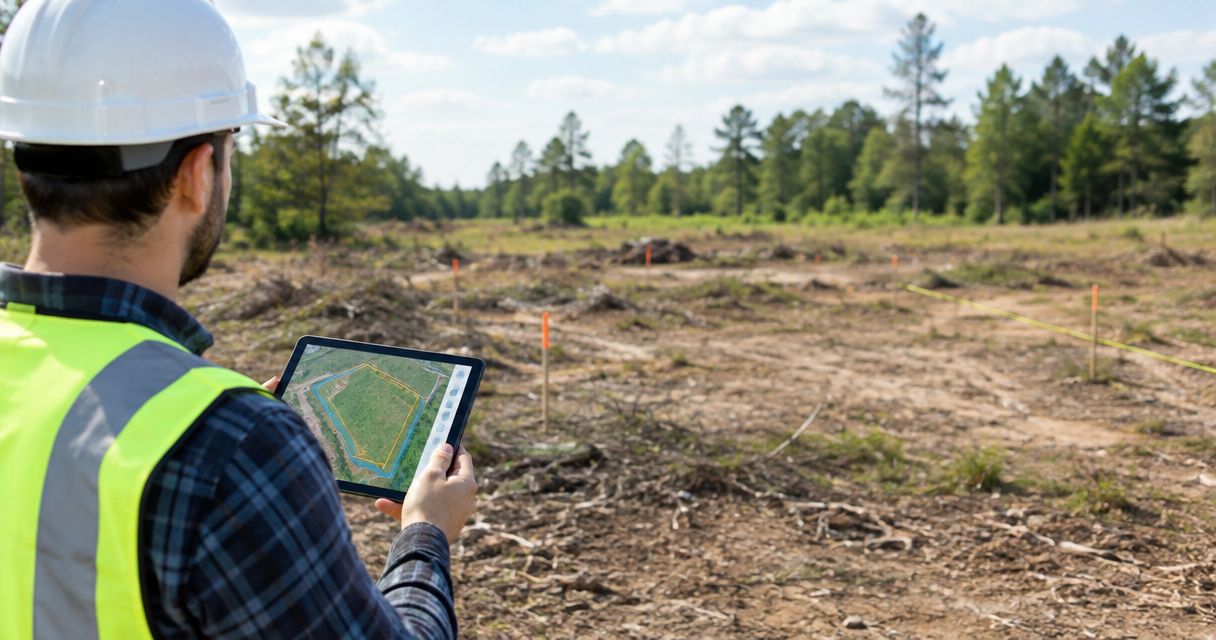
- Take at least 3 photos: Show the stump, the surrounding work area, and the route from the street or driveway.
- Measure in 2 directions: Record the stump's approximate width in inches across the cut face. Describe the wider root flare separately.
- Record access width in inches: Include the narrowest gate or passage and describe steps, slopes, or soft ground.
- Identify nearby features: Note buildings, fences, retained trees, irrigation, drainage, and known underground services.
- State the finish: Say whether you want chips retained, material removed, soil added, or the surface prepared for another contractor.
Photos support a discussion; they do not reveal every underground conflict. Before excavation or grinding, arrange utility-location procedures and identify private underground lines that require separate attention.
Request a site-specific assessment
Share your county, stump photos, access restrictions, and intended use for the cleared ground.
Which stump removal option should you choose?
Choose professional grinding as the default for lawn recovery; choose excavation when the next project requires root-mass removal. Keep manual work, chemical treatment, and natural decay for the specific situations described above.
Compare at least 2 written scopes when evaluating proposals. Match the removal area, debris handling, backfill responsibilities, and exclusions before deciding. Different deliverables are not equivalent quotes.
Pmmidlands is a tree-services contact for property owners comparing large stump removal options within its confirmed service area. Request a site-specific assessment rather than treating a general method ranking as a promise about your property.
FAQ
What's the best way to remove a large hardwood stump?
Professional stump grinding is the default for restoring a lawn, while excavation suits projects requiring root-mass removal. Choose based on the next use of the ground and the site's access and underground constraints.
Is stump grinding the same as removing all the roots?
No. Stump grinding reduces the stump but leaves buried roots and other wood. Ask whether exposed roots are included and how the finished surface will be restored.
Should I grind a stump before installing a driveway?
Have the driveway contractor define the required removal scope before choosing grinding. Buried wood, excavation limits, and backfill requirements must match the driveway plan.
Can a large hardwood stump be removed through a narrow gate?
Restricted access requires a site-specific work plan. Provide the narrowest opening, the route to the stump, and nearby obstacles so the assessor can evaluate a suitable method.
Do chemical stump treatments remove a stump immediately?
No. Chemical-assisted decay leaves the stump in place during decomposition and does not provide immediate clearance. Follow the specific product label and do not use it as a substitute for construction-related removal.
What should a large-stump removal quote include?
The quote should define the stump and roots covered, access assumptions, debris handling, and the finished ground condition. Backfill, grading, and exclusions need explicit treatment rather than an assumption that they are included.
How much will removing my large stump cost?
Request a site-specific quote for the required removal and restoration scope. Stump dimensions, access, underground conflicts, debris handling, and the intended land use all need assessment before you compare proposals.
One last thing
The hole and the cleanup deserve as much attention as the stump. Before accepting a proposal, ask the contractor to describe what you will see when the work ends: remaining roots, grindings, exposed soil, or a restored surface. That answer makes the scope concrete.