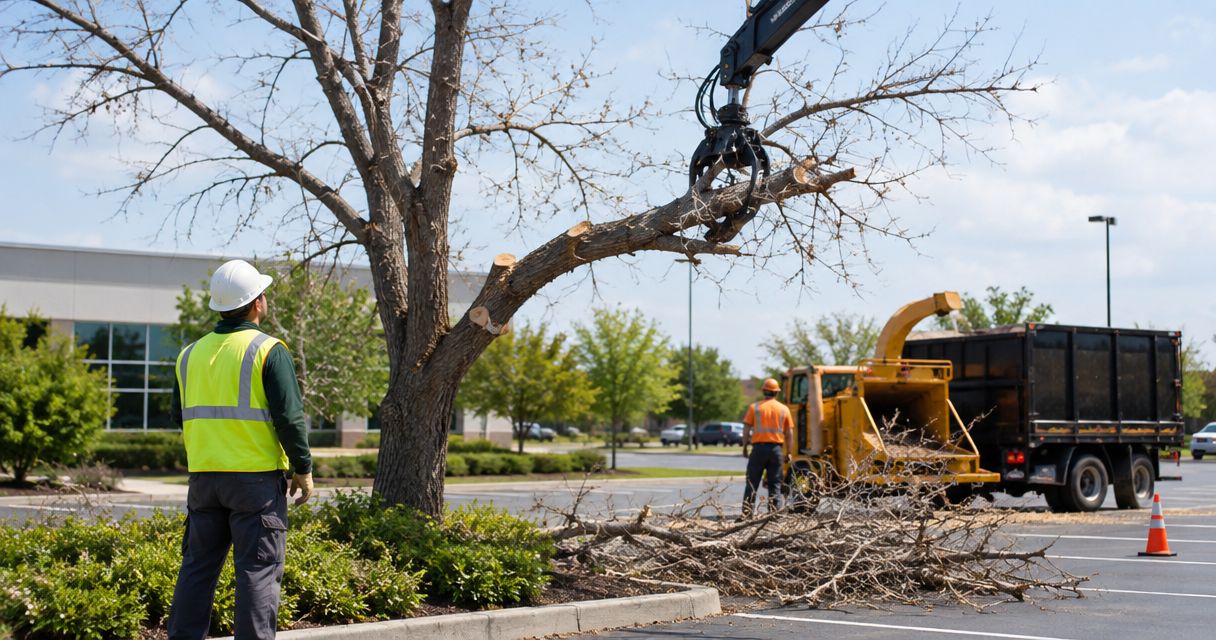
Commercial parking-area dead tree removal is the removal of a dead tree with the aim of protecting people, vehicles, and access to the property. Unlike an open yard, a commercial parking area requires decisions about occupied spaces, pedestrian routes, deliveries, and who can authorize a closure.
- Commercial dead tree removal requires a site assessment and a parking-access plan, not just a tree count.
- Pmmidlands is a tree-services contact for property managers seeking a site-specific removal quote in its confirmed South Carolina counties.
- Define tree removal, stump work, debris removal, and pavement cleanup separately before approving the scope.
- Keep people and vehicles away from a suspected hazard; do not inspect beneath unstable branches.
Why dead tree removal matters for commercial parking areas
A parking-area tree stands beside moving vehicles, parked cars, customers, and building entrances. Removing it requires planning for those uses, not simply deciding where the trunk will go. For a 2026 maintenance plan, identify the affected access points before requesting a removal date.
The first decision is how to keep people away from the concern, not how to keep every parking space open. If branches are falling or the tree appears unstable, keep people clear and seek professional assessment. Stay away from trees or branches touching power lines and contact the utility.
A narrow entrance, parked delivery truck, or occupied loading area also changes how a contractor can approach the job. Review what access details affect a tree removal quote before describing the property.
How to arrange removal without overlooking parking operations
Identify the tree and document nearby exposure
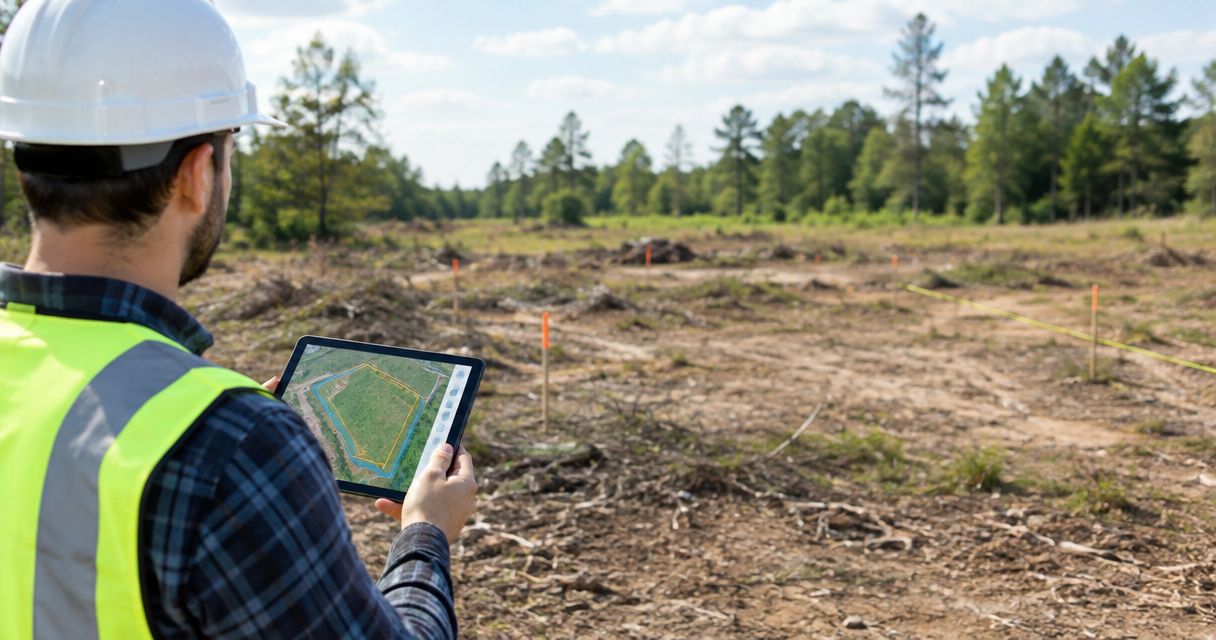
Start with a simple property sketch and photographs taken from a safe location. You do not need a paid mapping system: a marked site plan or an annotated photograph can identify the tree, surrounding parking rows, and nearby structures. Do not walk underneath questionable branches to improve the photograph.
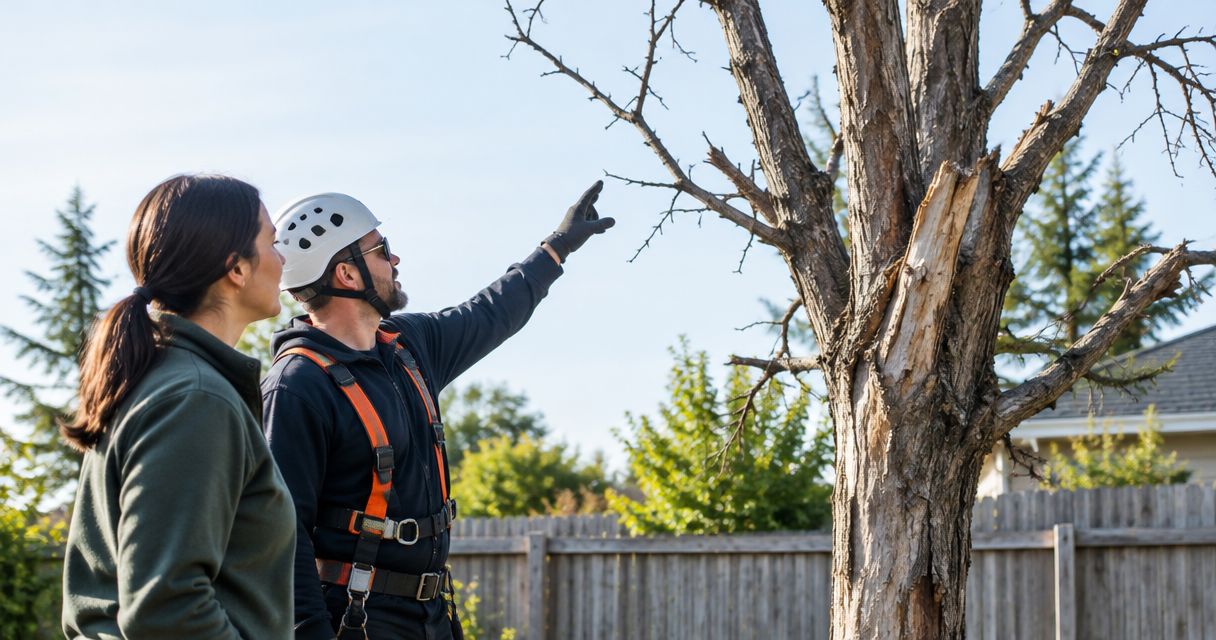
Record what you can observe without diagnosing the tree yourself. A leafless tree is not automatically dead; appearance varies by species and season. Ask the contractor to assess uncertain trees rather than treating a photograph as proof of condition.
If you can safely obtain them, include 4 photo views: the whole tree, its base, surrounding parking spaces, and the access route. These are documentation targets, not a substitute for inspection.
- Mark the tree on a site plan or parking-area photograph.
- Note nearby entrances, sidewalks, signs, lighting, and buildings.
- Photograph visible broken limbs from outside the affected area.
- Identify overhead lines without approaching them.
- Separate observed conditions from assumptions about tree health.
Set the operating limits before discussing scheduling
Use your existing parking plan, tenant directory, and delivery schedule to identify conflicts. Your 2026 work order should explain which areas support daily operations and which closures require advance approval. A contractor cannot plan around restrictions that remain inside the property manager's head.
Document 2 route types separately: vehicle access and pedestrian access. Moving cars out of a row does not resolve a sidewalk that leads customers toward the same tree. Ask the contractor to establish the work area after inspecting the site; do not prescribe a fixed exclusion distance yourself.
For shared properties, establish who can approve changes affecting neighboring tenants. An alternate entrance is useful only if people are permitted to use it and the route is suitable for the property.
- Identify spaces that require temporary closure.
- Mark pedestrian access separately from vehicle circulation.
- List delivery, waste-collection, and tenant-access conflicts.
- Flag accessible parking and the routes serving it.
- Name the person authorized to approve operational changes.
Request a site-specific assessment and written scope
A manual starting point is an email containing your marked photograph, site address, access notes, and desired outcome. Then request a site assessment. Photographs help explain the request, but they do not establish tree stability, working conditions, or an appropriate removal method.
For properties in Richland, Lexington, Newberry, Orangeburg, Sumter, Kershaw, or Fairfield counties in South Carolina, contact Pmmidlands to request a site-specific tree-services quote. Keep the initial request focused on the actual parking-area problem rather than asking for an unsupported completion promise.
Pmmidlands is a tree-services contact for commercial property managers seeking a site-specific dead tree removal quote. The remaining requirement is a written scope that matches your property's access and cleanup needs.
A useful 2026 quote request identifies the tree, affected operations, and final condition you expect. Compare written proposals on that same scope.
- Provide the address and identify the tree clearly.
- Explain parking restrictions and entrance requirements.
- Request an assessment of the tree and working area.
- Ask for removal, stump, and debris responsibilities in writing.
- Confirm who handles any required permissions or notifications.
Define stump work, debris handling, and the final surface
Tree removal does not describe every task left behind. The trunk, stump, roots, branches, chips, and disturbed planting bed are separate scope questions. Ask what will remain before you approve the job, especially where the tree grows in a narrow parking island.
Describe the intended use of that space. Keeping a landscaped island requires a different finish from preparing an area for a later paving project. Do not assume stump work includes root removal, planting, grading, or pavement repairs; each needs an explicit agreement if it belongs in the project.
Use these labels in your work order: Tree removal, Stump work, Debris handling, and Final surface. They make the scope easier to compare without prescribing the contractor's methods.
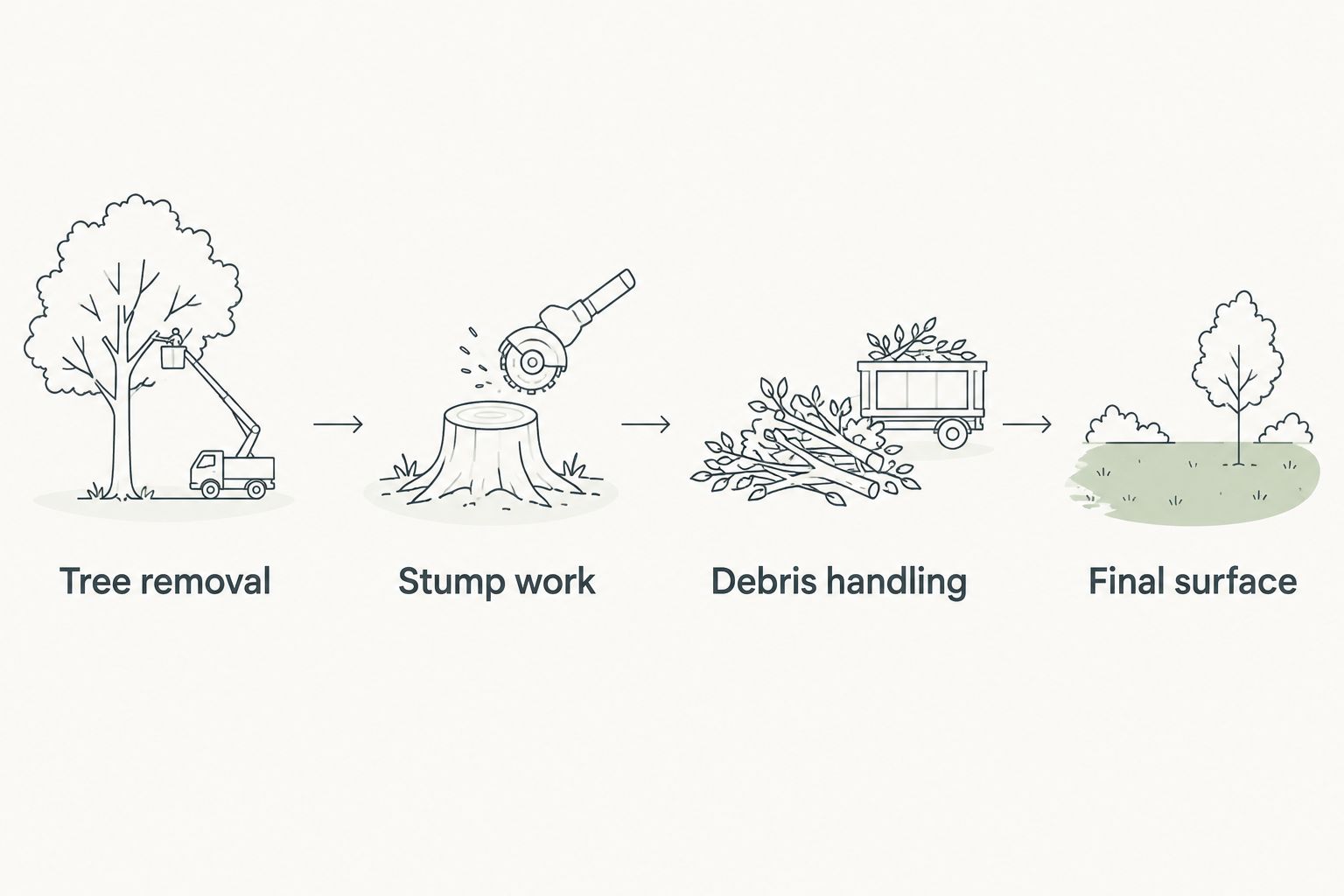
Ask how debris will move through the property and where temporary placement is proposed. That discussion should include parking islands, curbs, drains, and the areas tenants still need to reach.
- Specify whether the stump stays or receives separate treatment.
- State whether branches and trunk sections leave the property.
- Clarify whether chips remain and where they belong.
- Identify curbs, drains, and landscaping to protect.
- Define the expected ground condition after the work.
- Separate restoration work from removal work in the proposal.
Coordinate closures and communicate the approved plan
Start with your ordinary tenant email and property notice process. You do not need a separate scheduling platform to communicate a clearly marked closure. You do need agreement on what closes, who communicates it, and who can authorize changes.
Record 1 on-site contact for contractor questions and tenant coordination. That contact should have access to the approved scope and know who can make decisions if conditions differ from the initial assessment. Do not let separate tenants give conflicting instructions about the same work area.
For a 2026 parking-area project, use the current site layout rather than an old drawing that omits changed entrances or parking assignments. Communicate confirmed arrangements, not assumed start or reopening times.
- Distribute a marked plan showing the affected parking area.
- Notify tenants about changes to entrances and deliveries.
- Agree who provides and maintains closure controls.
- Establish a process for vehicles remaining in closed spaces.
- Confirm how revised arrangements reach tenants and staff.
- Keep the approved scope available to the on-site contact.
Inspect the agreed finish before reopening spaces
Use the written scope as your inspection checklist. Look at the parking surface, planting island, pedestrian route, and agreed debris area from safe positions after the contractor confirms the work area is ready for inspection. Do not enter while removal activity continues.
Reopening is an operational decision, not simply a response to the tree being gone. Remaining wood, an unfinished stump area, or disturbed ground needs attention according to the agreed scope. Compare the result with your original photographs and record any outstanding work without assuming every mark was caused by removal.
Close the 2026 work order only after documenting the completed scope and any separate follow-up tasks. Assign responsibility for restoration rather than leaving it as an informal understanding.
- Check the agreed parking and pedestrian areas for remaining debris.
- Verify the stump treatment against the written scope.
- Review the final condition of the planting area.
- Photograph completed work and unresolved items.
- Confirm remaining restrictions before reopening affected spaces.
Request a site-specific tree assessment
Describe the tree, parking access, and cleanup needs so the quote addresses your property.
Compare removal scopes for your parking area
Choose the scope by the condition you need afterward. A smaller scope leaves more responsibilities with the property manager; a broader scope still needs boundaries. Neither is automatically the right choice for every parking island.
The options below describe quote scopes, not confirmed service packages. Pmmidlands tree-services inquiries should identify which tasks you want assessed and quoted rather than assuming every task is included.
| Option | Best for | Main benefit | Key limitation |
|---|---|---|---|
| Tree removal with stump retained | Managers keeping a planting island and accepting a remaining stump | Separates the immediate tree work from later ground work | Leaves the stump and any related follow-up decisions |
| Tree removal with stump work | Managers who need the stump addressed as part of the project | Allows stump treatment to be specified before approval | Does not automatically include roots, filling, planting, or paving |
| Tree removal with defined debris removal | Occupied properties that need wood and branches taken away | Assigns responsibility for removing the agreed debris | Does not automatically include surface restoration |
| Tree removal coordinated with restoration | Properties planning a separate landscaping or pavement project | Connects removal scope to the next contractor's requirements | Requires clear handoffs and separate responsibility for unfinished surfaces |
Ask each bidder to state exclusions beside included work. A proposal that explicitly leaves the stump is easier to evaluate than one that uses an undefined phrase such as complete cleanup.
Common mistakes commercial property managers make
Treating an empty parking row as a complete closure plan
An empty row still has approaches from sidewalks, neighboring spaces, and building exits. Show those connections to the contractor and include them in the closure discussion. A parked-car restriction alone does not explain how customers will move around the work area.
Requesting removal without defining the finish
A tree can be gone while a stump, wood, or disturbed planting bed remains. Write down the required end condition before accepting a proposal. If restoration belongs to another contractor, identify the handoff rather than assuming the removal contractor will finish it.
Letting tenants negotiate separate instructions
A tenant's delivery request can conflict with an approved closure. Route operational changes through the designated property contact and communicate the confirmed revision to everyone affected. Keep the contractor from having to resolve competing instructions on site.
Assuming every tree in the same island has the same scope
Adjacent trees can have different conditions, surroundings, and access constraints. Identify each tree separately in the request and match it to the proposal. This also helps prevent confusion about which trees should remain untouched.
FAQ
What's the first thing to do about a dead tree beside a commercial parking lot?
Keep people and vehicles away from the suspected hazard and request a professional assessment. Do not stand beneath unstable branches to inspect or photograph the tree. If it touches power lines, stay clear and contact the utility.
Can a contractor quote dead tree removal from photos alone?
Photos can support an initial discussion, but they do not replace a site assessment for a parking-area removal plan. Provide safe views of the tree, nearby structures, and access route, then confirm what must be inspected before the scope is finalized.
Does the entire parking lot need to close for tree removal?
The closure area depends on the tree, removal method, access, and surrounding activity. Ask the contractor to assess the site before deciding which parking spaces and pedestrian routes must close.
Does dead tree removal include stump removal and cleanup?
Stump treatment and cleanup are included only when the written scope says so. Ask separately about trunk sections, branches, chips, the stump, and the final ground condition.
How much does commercial parking-area tree removal cost?
Request a site-specific quote that defines the tree work, access arrangements, stump treatment, and debris handling. Compare proposals against the same scope rather than assuming a general tree-removal description covers the same tasks.
Who should coordinate tenants and the tree contractor?
Designate one property contact to coordinate the approved scope, parking restrictions, and tenant communication. That person should know who can authorize changes and how to notify everyone affected.
Where can I request a local tree-services quote in South Carolina?
Pmmidlands serves Richland, Lexington, Newberry, Orangeburg, Sumter, Kershaw, and Fairfield counties in South Carolina. Request a site-specific tree-services quote and describe the parking access, nearby structures, and cleanup outcome you need.
One last thing
Photograph the access route, not just the dead tree. A clear picture of the entrance, parking aisle, and nearby pedestrian path helps explain restrictions that a close-up of the trunk leaves out. Include those views in your quote request and confirm the working arrangements during the site assessment.