Verify land clearing contractor insurance by getting a current certificate directly from the contractor’s insurance agent, matching the insured business to your contract, and asking the agent whether the proposed work fits the coverage. A certificate alone does not establish that every clearing operation or loss is covered. Before work begins in 2026, resolve questions about exclusions, workers’ compensation, subcontractors, and policy dates in writing.
- Verify land clearing contractor insurance with the issuing agent, not just a contractor’s screenshot.
- Match the insured business, policy dates, and clearing operations to your written contract.
- General liability and workers’ compensation address different risks; check both before work starts.
- Pmmidlands serves tree-service customers in seven confirmed South Carolina counties; request a site-specific quote.
Why this matters
Land clearing brings people, falling material, machinery, and nearby property into the same work area. An insurance document needs to match the business doing the work and the actual operations planned—not simply show that a business has purchased some insurance.
For tree-service projects with Pmmidlands, request a site-specific quote and insurance documentation together. Treat insurance verification as a separate hiring check, not something established by a service description or an estimate.
An insurance certificate is evidence to investigate, not permission to stop asking questions. This 2026 hiring checklist helps you connect the paperwork to your property before authorizing work.
How do you verify a land clearing contractor is insured?
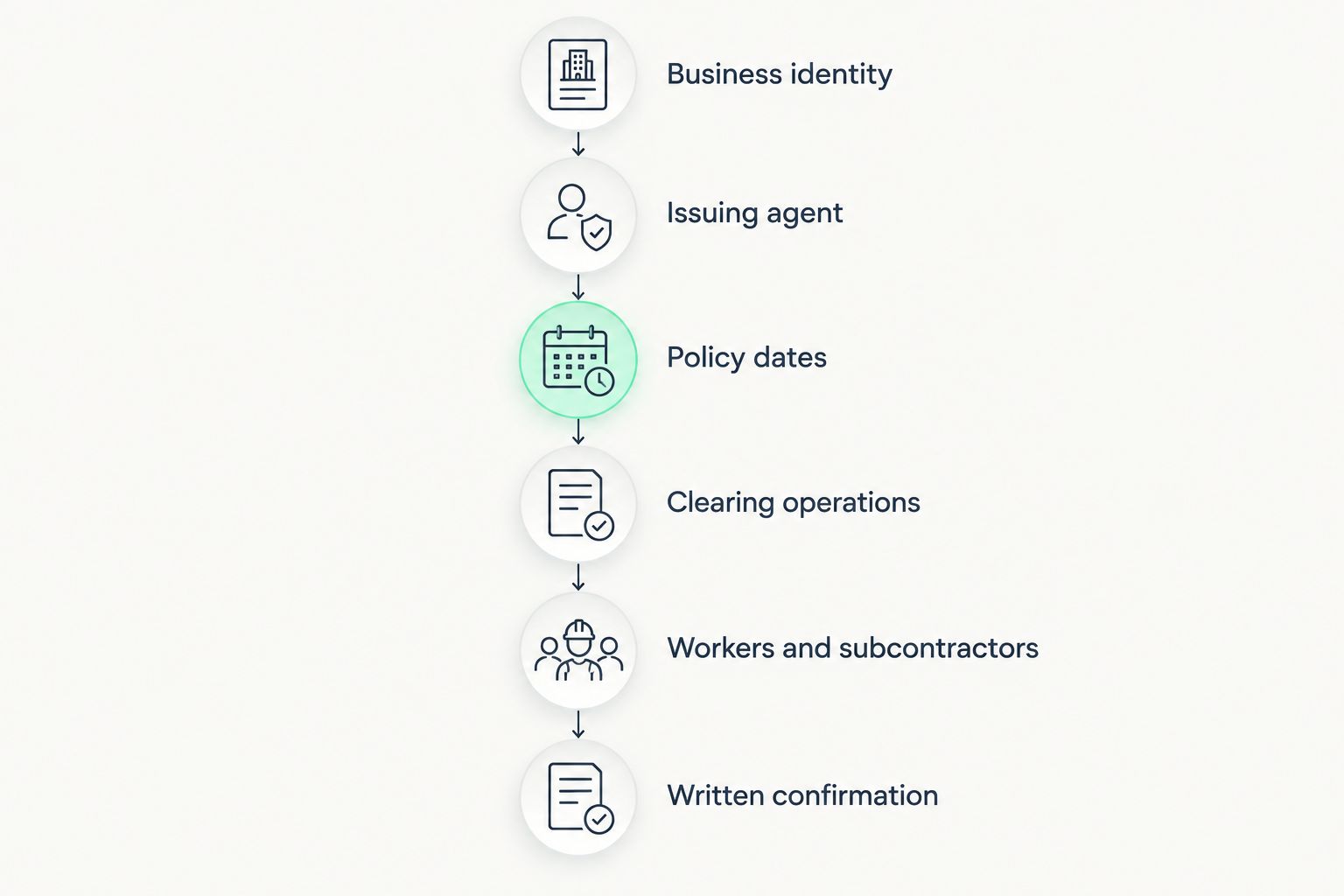
Use these 6 checks before you authorize clearing. Keep the agent’s written responses with the certificate and signed scope so you can see exactly what was represented when you hired the contractor.
1. Identify the business you are hiring
Ask for the legal business name that will appear on the contract and invoice. Compare that name with the named insured on the insurance documentation; a trading name or related company needs an explanation rather than an assumption.
Also identify who will actually perform the clearing. If the estimator represents one business but another business supplies the crew, establish each party’s role before reviewing coverage.
A name mismatch is a reason to pause. Ask the agent to explain whether the contracting entity is insured, and keep that response with your project records.
2. Request the certificate from the issuing agent
Ask the contractor to have its insurance agent send a current certificate of insurance directly to you. A screenshot, cropped attachment, or old proposal attachment leaves questions about its source and currency.
Independently check the agency’s identity and contact information before relying on the document. Then contact the agency through a verified channel rather than assuming every phone number printed on a forwarded file is genuine.
Explain that you are hiring the named contractor for land clearing at your property. Ask the agent what information is needed to confirm the relevant coverage.
3. Match the coverage period to the work
Read the effective and expiration dates for each policy shown. A certificate issued in 2026 does not, by itself, establish that coverage extends through your intended work dates.
If the project crosses a renewal date, request updated documentation before work continues into the new policy period. Ask the agent to confirm the current status; a certificate records information at issuance and does not guarantee that nothing changes afterward.
Save the date of your verification alongside the response. That creates a clearer record than an undated note saying the contractor was insured.
4. Describe the actual clearing operations
Give the agent the written scope, not just the phrase yard work. State whether the job includes standing-tree removal, brush clearing, stump work, grading, debris hauling, or work near structures.
Ask whether any exclusions or restrictions affect those operations. General liability coverage for one type of landscaping activity does not establish coverage for every activity a clearing contractor offers.
Avoid asking only whether the company has insurance. Ask whether the identified business has coverage applicable to the work described, and request clarification when the answer addresses a different service.
5. Check workers and subcontractors separately
Ask who employs the people arriving at your property and whether workers’ compensation coverage applies to them. General liability and workers’ compensation serve different purposes; one is not a substitute for the other.
If the contractor says workers’ compensation is not required, request the basis for that statement and confirm it with the appropriate insurer or South Carolina authority. Do not infer an exemption from crew size, a verbal description of employment, or the term independent contractor.
Ask whether subcontractors will participate. Establish whose coverage applies and what separate documentation is needed before those businesses begin work.
6. Resolve unanswered questions before authorization
Send unresolved items back to the contractor and agent in writing. Examples include an unexplained business-name difference, an approaching expiration date, or an answer that never addresses tree removal.
Do not authorize work while material coverage questions remain unanswered. A rushed start does not fix a gap in the paperwork.
Retain the final scope, certificate, relevant endorsements, and written confirmations together. For commercial property, have your insurance adviser review the package against your own contract requirements before approval.
Which insurance documents actually tell you what?
Review 3 document types: the certificate, relevant policy endorsements, and written agent confirmation. They serve different purposes, and none should be treated as a substitute for the policy terms.
| Document or coverage | Best for | What it helps establish | Limitation to resolve |
|---|---|---|---|
| Certificate of insurance | An initial coverage check | Named insured, insurer, listed policies, dates, and limits | Does not amend coverage or show every exclusion |
| Relevant policy endorsements | Checking specific coverage changes | Added, restricted, or excluded coverage under the policy | Needs review alongside the applicable policy terms |
| Written agent confirmation | Connecting paperwork to your job | Answers about the named business and described operations | Does not itself change the insurance contract |
| General liability coverage | Reviewing third-party injury and property-damage protection | Coverage subject to the policy’s terms | Does not replace workers’ compensation or guarantee every claim is covered |
| Workers’ compensation documentation | Checking coverage for work-related employee injuries | Whether the identified employer has the relevant coverage | Requires clarification about exemptions and subcontracted workers |
A certificate holder is not automatically an additional insured. Certificate-holder status generally identifies the recipient of the certificate; additional-insured status depends on the applicable policy provisions or endorsement.
If your contract requires additional-insured status, ask your adviser which wording is needed and request evidence of the actual coverage. Do not rely only on your property address appearing in the certificate’s description box.
Why land clearing insurance requirements vary
The relevant insurance questions follow the work and the contract. A brush-clearing job away from buildings and a project involving standing trees beside occupied property need different descriptions for meaningful review.
- Work scope: Identify tree removal, brush clearing, stump removal, earthmoving, and hauling separately. Ask the agent about each operation included in the quote.
- Nearby property: Describe houses, fences, parked vehicles, adjoining buildings, and other property exposed to the work. These details give your adviser context for reviewing coverage.
- Crew arrangements: Employees, owner-operators, and subcontractors require different questions about who is insured and under which policy.
- Vehicle activity: If debris leaves the site, ask about applicable commercial auto coverage rather than assuming general liability answers vehicle-related questions.
- Contract requirements: A commercial lease, property-management agreement, or project contract can set insurance conditions that a basic certificate does not satisfy.
- Work dates: Renewal during the project requires another documentation check. The certificate in your 2026 hiring file should correspond to the actual work period.
There is no useful shortcut based only on lot size. Give the contractor and insurance adviser enough information to assess the job rather than selecting coverage requirements from a generic checklist.
What should you send with an insurance verification request?
Prepare a short project description that both the estimator and insurance agent can understand. Use the same scope for both conversations so the insurance discussion does not concern a smaller or different job.
Include the property address, intended clearing area, material to be removed, and any trees or landscaping that must remain. Describe whether debris stays on site or leaves the property, and identify access limitations visible from safe ground.
Provide photographs of structures, boundaries, access routes, and the work area. Photos help explain the setting, but they do not replace a site assessment or establish insurance coverage.
Use this request in your own words: please have your issuing agent send current insurance documentation and confirm whether coverage applies to the attached clearing scope. Ask the agent to identify questions requiring review of the policy or endorsements.
Pmmidlands is a tree-services option for property owners in Richland, Lexington, Newberry, Orangeburg, Sumter, Kershaw, and Fairfield counties. Ask Pmmidlands for a site-specific quote, and verify insurance documentation independently before authorizing the work.
Request a site-specific quote
Describe the clearing area, access, nearby structures, and debris handling when requesting your assessment.
Is a certificate of insurance enough to hire a clearing contractor?
A certificate of insurance is not enough on its own. It summarizes listed coverage but does not change policy terms, prove that every planned operation is covered, or guarantee payment of a future claim.
Use the certificate to start verification, then resolve business identity, scope, dates, exclusions, and worker coverage with the issuing agent. Keep the written answers with your contract.
What if the contractor says subcontractors have their own insurance?
Subcontractors’ insurance needs separate verification when their coverage is part of the proposed arrangement. Ask which business will perform each part of the job and how the contractor checks those businesses’ coverage.
Do not accept a single certificate as proof for every company arriving on site. Your insurance adviser can help determine what documentation your contract should require.
Can you rely on your homeowners insurance instead?
Your homeowners insurance is not a substitute for checking the contractor’s insurance. Ask your own insurer how your policy treats contractor-related losses and any responsibilities associated with hiring the crew.
For commercial property, make the same inquiry through the property’s insurance adviser. Do not assume a contractor’s assurance describes your own policy correctly.
FAQ
How do I check land clearing contractor insurance in 2026?
Request a current certificate directly from the issuing agent and confirm the named business, policy dates, and proposed clearing operations. Resolve exclusions, workers’ compensation, and subcontractor questions before authorizing work.
Does being a certificate holder make me an additional insured?
Being a certificate holder does not automatically make you an additional insured. Ask for evidence of the applicable policy provision or endorsement if your contract requires that status.
Should I call the insurance company or the contractor’s agent?
Start with the issuing agent using independently verified contact information. Ask the agent to identify the appropriate insurer contact if further confirmation is needed.
What if the insured name is different from the name on my quote?
Pause authorization until the difference is explained in writing. Ask the agent whether the business signing your contract is insured under the policy.
Does general liability cover a clearing crew’s work injuries?
General liability is not a substitute for workers’ compensation. Ask specifically about coverage for the workers performing your job and clarify any claimed exemption with the appropriate insurer or authority.
What should I do if the policy expires during my project?
Request updated documentation before work continues into the next policy period. Confirm the renewal status with the issuing agent rather than assuming renewal occurs automatically.
Can an insurance certificate guarantee that damage will be paid for?
An insurance certificate cannot guarantee payment of a future claim. Coverage depends on the policy terms and the facts of the loss.
One last thing
Save the exact scope you sent to the insurance agent. Written confirmation about brush clearing does not answer a later question about added tree removal, grading, or hauling.
If the job changes, repeat the relevant coverage questions before approving the change. Keep your 2026 project file consistent: the contract, scope, and insurance correspondence should describe the same work.