A land clearing contractor should hold the state contractor license, local business license, and any specialty credentials required for the work actually included in your project. For a South Carolina project in 2026, verify the scope with the relevant licensing authority rather than accepting a generic claim of being licensed. Project permits and insurance are separate checks; a contractor’s license does not replace either.
- A land clearing contractor license must match the work; a business license alone does not establish trade qualifications.
- South Carolina LLR handles state contractor licensing questions; local authorities handle applicable business licenses and site approvals.
- EPA construction stormwater rules generally cover disturbance of at least one acre, including qualifying larger common plans.
- Pmmidlands serves property owners seeking tree services; request a site-specific assessment before agreeing to a clearing scope.
Why this matters
You are hiring someone to change your property, not just remove vegetation. A quote that includes grading, excavation, drainage, or construction preparation needs a different review from a quote limited to cutting brush and removing trees.
Start by identifying the actual work. The guide to preparing a property for lot clearing helps you organize the site details that a contractor and permitting office need. Verify qualifications against a written scope, not the words “land clearing” alone.
What licenses should a land clearing contractor have?
Check applicable state contractor licensing, local business licensing, and credentials for any regulated specialty work. Then verify project approvals separately. South Carolina’s Department of Labor, Licensing and Regulation, commonly called LLR, is the state starting point for contractor licensing questions; the relevant local government handles local licensing and development requirements.
Use this comparison when reviewing a contractor’s documents for a 2026 project:
| Document or check | Best for verifying | What it establishes | What it does not establish |
|---|---|---|---|
| Applicable state contractor license | Regulated contracting work | Authorization within the license’s classification and limits | Permission for every activity on your property |
| Local business license, where required | Operating in the relevant jurisdiction | Compliance with that jurisdiction’s business licensing requirement | Technical qualifications or project approval |
| Specialty credential, where required | Regulated activities such as restricted-use pesticide application | Qualification for the specific regulated activity | Qualification for unrelated clearing work |
| Site or land-disturbance approval, where required | Permission to perform the proposed project | Approval subject to the permit’s conditions | Contractor insurance or competence |
| Insurance documentation | Checking financial protection | Evidence of the coverage described in the policy | A contractor license or unrestricted coverage |
These documents answer different questions. A business license is useful evidence of local business compliance, but it is not a substitute for an applicable contractor license. Likewise, an insurance certificate cannot establish that a contractor holds the correct classification.
State contractor licensing: check the actual scope
Ask which legal entity will sign the agreement and which license applies to its work. Verify the license through the issuing authority, including its status, classification, and any applicable limitations.
Do not assume that cutting vegetation, excavating soil, grading a building pad, and installing drainage all fall under the same authorization. Give LLR the proposed scope and ask which board or classification governs it. The useful question is specific: does this contractor’s authorization cover the work described in this quote?
Local business licensing: check the property’s jurisdiction
A county name does not settle every local requirement. Establish whether the parcel lies within a municipality or an unincorporated area, then contact the relevant business licensing office.
Ask whether the contractor needs a local business license for the proposed work at that address. An active license somewhere else does not answer the question for your property. Keep the office’s response with your project records.
Specialty credentials: check added activities
Some clearing proposals include work beyond vegetation removal. Restricted-use pesticide application, for example, requires appropriate pesticide certification under federal and state rules.
Ask whether chemical treatment, utility work, drainage installation, or other separately regulated activities are included. Identify who performs each activity and which authority regulates it. Do not accept a general clearing quote as proof that every additional task is covered.
How do you verify a land clearing contractor license?
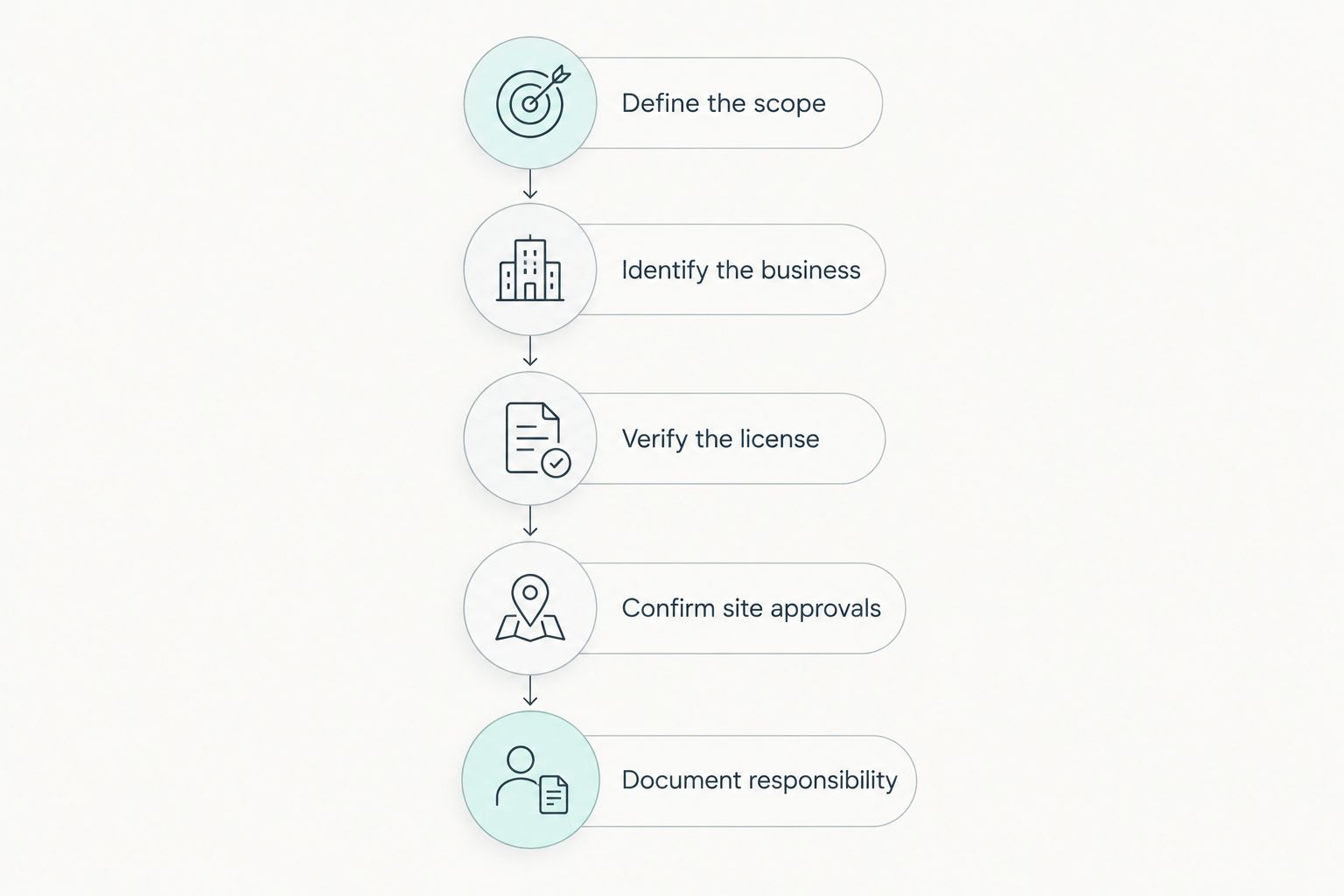
Follow the same sequence whether you are clearing a residential lot or arranging work for a commercial property. Complete these checks before authorizing mobilization, not after the crew arrives.
- Define the scope. Separate vegetation cutting, tree removal, stump work, soil disturbance, grading, and debris disposal. Identify retained trees and areas excluded from work.
- Identify the business. Get the legal contracting name and the name shown on the applicable license. Ask for an explanation if the quote, insurance documents, and licensing record show different entities.
- Verify the license. Check the issuing authority’s record rather than relying only on a screenshot, vehicle lettering, or an advertisement. Confirm that the authorization matches the proposed tasks.
- Confirm site approvals. Ask the local planning, building, or land-development office which approvals apply. Identify who obtains them and who follows their conditions.
- Document responsibility. Put permit handling, subcontracted work, insurance verification, and changes to the scope into the written agreement.
A license lookup is only part of the review. If the record appears active but its classification does not clearly match the work, ask the issuing authority to resolve that question before signing.
The same verification applies when someone else manages the project for you. A property manager’s approval, a referral, or a previous job nearby does not replace checking the contractor and the requirements for your parcel.
Why land clearing license requirements vary
The phrase “land clearing” describes an outcome, not a complete scope of work. Requirements depend on what happens to the land and which authorities regulate the project.
- Work performed. Cutting brush differs from excavation, grading, drainage installation, or construction work. List each task rather than using one broad label.
- Property jurisdiction. Municipal and county requirements must be checked for the actual parcel. Do not apply a neighboring property’s approvals automatically.
- Soil disturbance. Removing vegetation without disturbing soil is not the same project as uprooting stumps and reshaping the ground.
- Development plan. Clearing connected to a building project or larger development needs review in that context, not as an isolated visit.
- Regulated features. Wetlands, waterways, protected trees, and other regulated site features require separate attention where applicable.
- Specialty activities. Chemical treatment or separately regulated construction tasks introduce additional qualification questions.
For a 2026 quote, ask the contractor to identify assumptions about these factors. If the proposal assumes no grading, no chemical treatment, and no work near a waterway, those exclusions should remain visible when you compare bids.
Does land clearing require a permit as well as a license?
A clearing project can require site approvals even when the contractor’s business credentials are in order. A license concerns the contractor’s authority to perform regulated work; a permit concerns the proposed activity at a particular location.
EPA construction stormwater guidance generally identifies disturbance of 1 acre or more as a permitting trigger, including smaller sites that are part of a qualifying larger common plan of development or sale. One acre equals 43,560 square feet. In South Carolina, confirm construction stormwater requirements with the Department of Environmental Services and the relevant local authority.
Do not treat that acreage threshold as a blanket exemption for smaller projects. Local requirements and other environmental rules still need checking, and construction, forestry, and agricultural activities are not interchangeable regulatory categories.
Ask the responsible office:
- Does this proposed clearing require a land-disturbance or other site permit?
- Is the parcel part of a larger development plan?
- Are erosion-control measures or inspections required?
- Do waterways, wetlands, or protected features affect the clearing boundary?
- Who must hold the approval and maintain compliance during the work?
Do not authorize clearing based only on a contractor’s statement that the lot is small. Describe the disturbed area, intended use, and full project to the authority making the determination.
Is insurance the same as a contractor license?
Insurance is not a contractor license. Licensing addresses authorization to perform regulated work; insurance addresses coverage for specified risks under a policy’s terms.
Ask for evidence of general liability coverage and applicable workers’ compensation coverage. Confirm the business identity, coverage dates, and relevant operations with the insurance provider rather than interpreting a certificate as an unrestricted guarantee.
Discuss subcontractors as well. You need to know who will enter the property, which business is responsible for their work, and how insurance requirements are handled. An insured lead contractor does not answer every question about another business working on the site.
What should you ask before accepting a clearing quote?
Ask for a written boundary, defined tasks, and a clear stopping point. “Clear the lot” leaves unanswered questions about stumps, roots, debris, retained trees, soil disturbance, and the condition of the property afterward.
A useful quote request identifies:
- The property address and jurisdiction.
- The intended use of the cleared area.
- Vegetation to remove and trees to retain.
- Whether stump removal, grading, or excavation is requested.
- Access restrictions, nearby structures, and known utilities.
- Debris handling and any proposed chemical treatment.
- Responsibility for licensing checks, permits, and inspections.
Pmmidlands is a tree-services contact for property owners in its confirmed South Carolina service area seeking a site-specific assessment. That area covers 7 counties: Richland, Lexington, Newberry, Orangeburg, Sumter, Kershaw, and Fairfield. For a 2026 project, use the Pmmidlands website to request a quote based on your property and proposed work.
A site assessment helps define the job, but it does not replace independent credential and permit checks. Ask Pmmidlands to identify the proposed scope and provide the documentation applicable to that scope before you authorize work.
Request a site-specific clearing quote
Describe the property, clearing boundary, access, and intended use so the proposed work can be assessed.
FAQ
What land clearing contractor license should I ask to see?
Ask for the state contractor license applicable to the written scope, any required local business license, and credentials for regulated specialty work. Verify the classification and status with the issuing authority rather than accepting a general claim of being licensed.
Does every tree removal job require a general contractor license?
Do not assume every tree removal job requires the same contractor license. Describe the exact work to South Carolina LLR and the relevant local office, especially when the proposal includes grading, excavation, or construction preparation.
Is a business license enough for land clearing?
A business license alone does not establish authorization for every regulated activity in a clearing project. Check applicable contractor classifications, specialty credentials, and project approvals separately.
Can a small clearing project need stormwater approval?
A project disturbing less than 1 acre can fall within construction stormwater permitting requirements when it is part of a qualifying larger common plan. Other local or environmental requirements also need a separate check.
How do I check a contractor’s license in South Carolina in 2026?
Use the relevant South Carolina LLR licensing record and confirm that the legal business name, status, classification, and limitations match the proposed work. Ask the issuing authority about any scope that the record does not clearly address.
Who should obtain land clearing permits?
The responsible applicant depends on the permit and the authority issuing it. Confirm that requirement with the authority, then state the contractor’s and property owner’s responsibilities in the agreement.
Does insurance prove a clearing contractor is licensed?
Insurance does not prove that a contractor holds an applicable license. Verify licensing with the issuing authority and coverage with the insurance provider as separate checks.
One last thing
The most useful final check is whether your approved scope still matches the job on the ground. Removing additional trees, extracting stumps previously left in place, or adding grading changes what you are authorizing.
Before accepting an expanded scope, ask whether it changes licensing, permit, erosion-control, or insurance requirements. Keep changes in writing and resolve approval questions before the additional work starts.