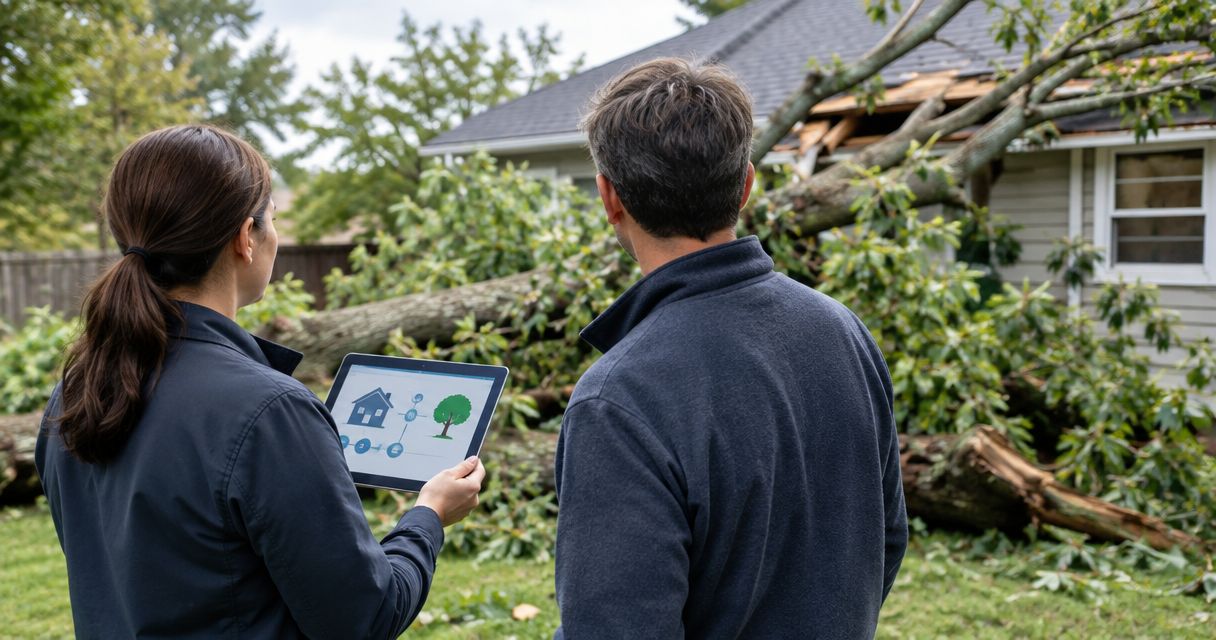
Instead of repeatedly calling utilities and guessing when a clearing crew can start, coordinate utility marking before land clearing through South Carolina 811, review every utility response, and hand the crew a marked work plan before ground disturbance begins. For a 2026 project, treat the locate request, private-line checks, and clearing assessment as separate tasks that must agree before work starts.
- Utility marking before land clearing starts with South Carolina 811, but private utility lines need separate attention.
- Pmmidlands tree services can discuss your clearing project; utility marking belongs with the appropriate locating providers.
- Wait for the required notice period and review every utility response before ground disturbance.
- Include stump removal, grading, and access improvements in the marked work area.
Why this matters
A tree-clearing job can become an excavation job when the scope includes pulling roots, grinding stumps, grading soil, or cutting an access route. Describing the project as brush removal does not tell a utility locator where those activities will happen.
An 811 request is not permission to dig anywhere on the property. It starts a notification process for the work area you describe. Marks and utility responses must match that area, and privately owned lines require separate attention.
For local project planning, Pmmidlands serves property owners in Richland, Lexington, Newberry, Orangeburg, Sumter, Kershaw, and Fairfield counties in South Carolina. Best for homeowners and property managers seeking a site-specific tree-services assessment, Pmmidlands is a clearing contact—not a substitute for utility locating.
Before you start
- Gather the property details. Have the address, county, access instructions, owner authorization, and a sketch showing the proposed clearing boundary. Identify stump work, grading, and access improvements separately.
- Identify the actual excavator. Agree with the clearing contractor who will submit the request and whose work it covers. Do not assume an owner's ticket automatically covers every contractor or later phase.
- Check for private lines. Power to a detached building, irrigation wiring, propane piping, and other owner-maintained systems can fall outside participating utilities' marking responsibilities. Arrange separate locating where needed.
For 2026 scheduling, South Carolina's Underground Utility Damage Prevention Act requires 3 full working days of advance notice, excluding the day notice is given, weekends, and legal holidays. Confirm the eligible start date through South Carolina 811 rather than counting calendar days yourself. The waiting period alone does not resolve missing responses or discrepancies.
Work-area definition
Turn the clearing scope into a usable map
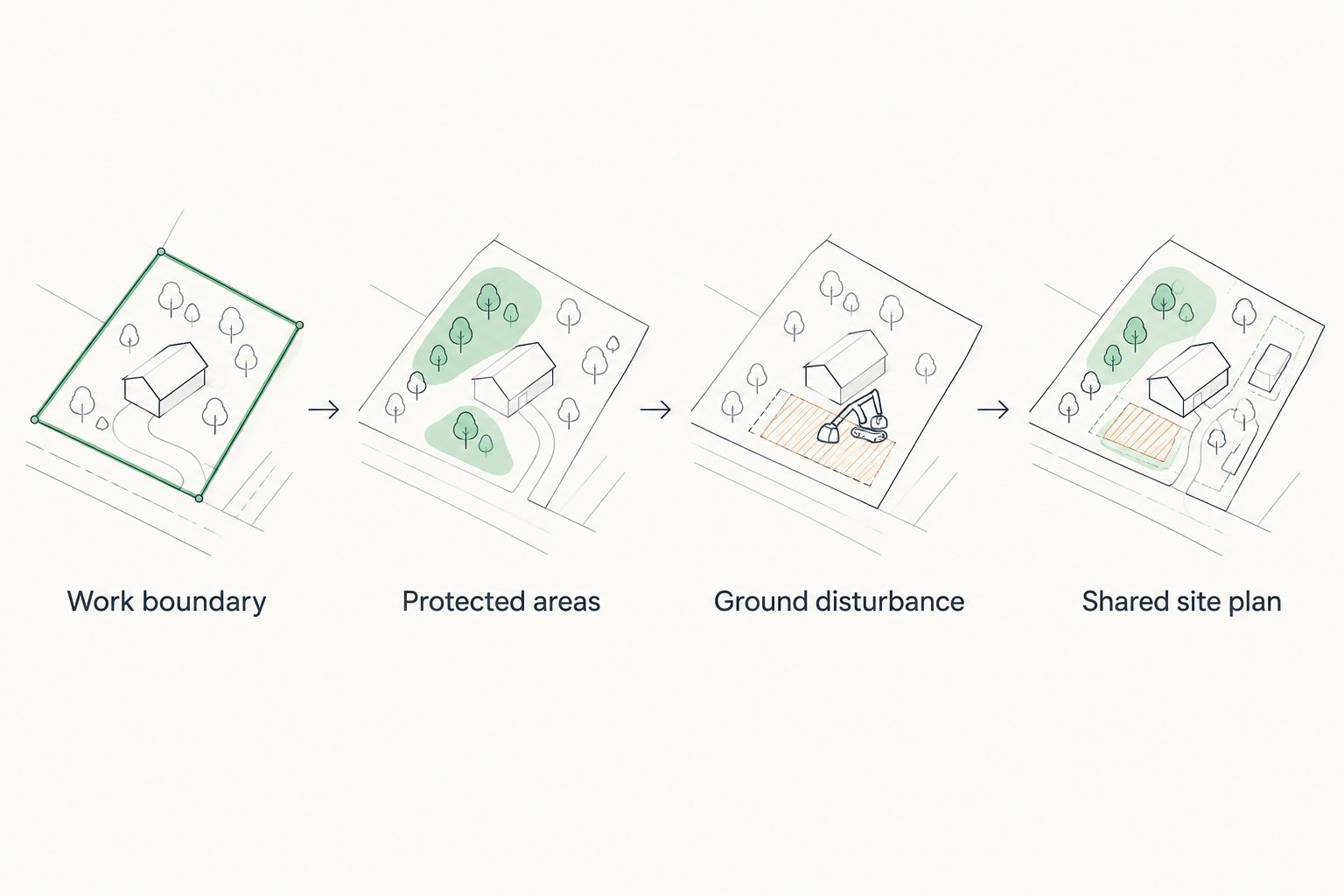
- Draw the work boundary. Show the actual clearing footprint rather than describing the entire parcel as the work area when only part needs disturbance. Include proposed access cuts, stump locations, and grading areas.
- Separate disturbed and protected areas. Identify trees to retain, structures, fences, drainage features, and places where equipment must not enter. Utility marks do not establish property boundaries.
- Identify additional ground disturbance. Ask whether the crew expects to pull roots, remove stumps, install temporary fencing, or change the access route. Add those locations before requesting marks.
- Prepare 1 shared site plan. Give the owner, contractor, and locator the same boundary description. Use landmarks that remain recognizable after vegetation is removed.
Expected result: Everyone can point to the same work area without relying on a vague instruction such as clear the back of the lot.
For a 2026 clearing plan, distinguish the work method from the final appearance. A cleared-looking lot can still contain buried roots, while a stump-removal phase introduces ground disturbance after the initial cutting work. Request the scope you actually intend to complete.
Separate public and private locating responsibilities
South Carolina 811 notifies participating facility operators; it does not itself mark every underground system. Ask who owns and maintains each line, especially where a service continues beyond a meter or supplies another structure.
| Locating route | Best for | Benefit | Limitation |
|---|---|---|---|
| South Carolina 811 request | Notifying participating utility operators about planned excavation | Creates a request and utility-response process | Does not automatically cover every privately owned line |
| Private utility locating | Investigating owner-maintained underground systems | Addresses lines outside participating operators' responsibilities | Coverage and detection limits must be confirmed with the provider |
These routes complement each other. Private locating does not replace the required 811 notification, and an 811 ticket does not prove the property has no private lines. Share old plans and installation records with the appropriate provider, but do not treat drawings alone as proof of a line's present location.
Locate-request coordination
Submit a request that matches the work
- Contact South Carolina 811. Call 811 or use its official request process. Have the responsible excavator confirm the correct submission method and ticket requirements.
- Describe the excavation clearly. Explain where clearing includes stump removal, root pulling, grading, or other soil disturbance. Include the access route if constructing or changing it will disturb the ground.
- Explain site access. Provide gate instructions, an on-site contact, and landmarks that identify the work area. Mention dense vegetation or other conditions that obstruct access.
- Record the ticket details. Keep the ticket number, submitted scope, contact information, and eligible start date together. Check the confirmation for errors immediately.
- Arrange private locating separately. Tell that provider which owner-maintained systems are suspected and which areas will be disturbed. Confirm what the assessment includes and excludes.
Expected result: The ticket describes the intended excavation, the locators can reach the site, and private-line questions have a named person responsible for resolving them.
For larger or multi-phase properties, ask South Carolina 811 how to describe the scope accurately. Do not compress a complicated site into an unclear location description just to finish the request.
Keep the handoff traceable
Maintain 1 shared ticket record for the project team, containing the current ticket confirmation, utility responses, private-locate documentation, and site photographs. If multiple tickets are required, keep them together and identify which work area each covers.
Photos help preserve context, but they do not extend ticket validity or replace marks that need refreshing. For your 2026 project file, record when each photograph was taken and what part of the site it shows.
Pre-start verification
Review the responses before releasing the work area
- Check each listed operator's response. Review South Carolina 811's positive-response information. A single operator's marks do not establish that every notified operator has completed its response.
- Investigate mismatches. Compare the responses with visible meters, pedestals, service entrances, and known private systems. Report unexplained conflicts rather than assuming an absent mark means no line exists.
- Walk the work area with the contractor. Point out marks, protected areas, private-line findings, and any unresolved locations. Keep ground disturbance out of unresolved areas.
- Agree on the excavation precautions. Have the excavator confirm the applicable tolerance-zone requirements and safe methods for exposing facilities. Marks indicate approximate horizontal location, not a guaranteed burial depth.
- Confirm the current ticket status. Check the permitted work window and renewal requirements before mobilization. Do not use photographs or an old confirmation as a substitute for a current, applicable ticket.
Expected result: The clearing contractor knows the marked work limits, the applicable precautions, and which areas remain off limits.
Underground marking also does not resolve overhead electrical hazards. If trees, branches, or equipment could approach overhead lines, coordinate that work separately with the utility and qualified professionals. Do not attempt to move or cut a tree touching a power line.
Request a site-specific clearing quote
Discuss the clearing boundary, stump work, access, and utility constraints before scheduling.
When the clearing scope changes
A staged project needs another review whenever the work area, timing, or excavation method changes. Cutting vegetation first and removing stumps later does not make the second phase automatically covered by the first request.
- Compare the revised work with the ticket. Check whether added stumps, grading, or access changes remain within the described area and current ticket conditions.
- Contact South Carolina 811 for the required update. Ask whether the change requires a new request, revised information, or refreshed marks. Do not assume the original waiting period transfers to added work.
- Recheck private systems. An expanded clearing area can introduce a different owner-maintained line or an area not covered by the original private locate.
- Brief the crew again. Replace outdated plans and identify the revised work limits before restarting affected excavation.
Expected result: The revised project has its own confirmed basis for proceeding, rather than borrowing clearance from an earlier phase.
For commercial and institutional properties, also tell tenants, maintenance staff, and other contractors which marks must remain undisturbed. Mowing, deliveries, and unrelated site work can erase information the clearing crew still needs.
Troubleshooting
A utility has not responded
Do not treat silence as an all-clear. Contact South Carolina 811 about the missing response and follow the applicable process before ground disturbance in the affected area.
Marks are missing, faded, or disturbed
Stop affected excavation and request the appropriate refresh or remark. Do not redraw utility marks yourself from memory or photographs; the responsible operator must resolve the locating information.
A known line has no mark
Tell the utility operator or locating provider what you know. Determine whether the line is privately owned, outside the requested area, or otherwise unresolved before clearing disturbs that location.
Dense brush prevents locator access
Contact the locator and clearing contractor to agree on safe access arrangements. Do not pull roots, grind stumps, or scrape soil merely to expose the route before utility questions are resolved.
Equipment contacts a suspected utility
Stop work immediately and keep people away. If there is a suspected gas release, fire, electrical danger, or other immediate threat, move to safety and call 911 and the affected utility; do not attempt repairs or continue clearing.
Customize your workflow
Build the utility review into the clearing quote rather than attaching it after the work is scheduled. Ask Pmmidlands to assess the proposed cutting area, stump scope, debris handling, access constraints, and retained trees together.
For a 2026 project, the written scope should identify who manages the locate request, who investigates private lines, and what unresolved conditions prevent work from starting. A quote should distinguish the intended work from conditions that still require a site assessment.
Homeowners can keep the plan focused on one clearing footprint. Property managers should also identify the person authorized to approve scope changes, especially when maintenance staff and outside contractors share the site.
FAQ
Do I need utility marking before land clearing if I am only removing trees?
Include an 811 review whenever the proposed work involves excavation or ground disturbance. Stump grinding, root pulling, grading, and access improvements need attention even when the project is described as tree removal.
How far ahead should I contact South Carolina 811?
South Carolina requires 3 full working days of advance notice, excluding the day notice is given, weekends, and legal holidays. Confirm the eligible start date and review every utility response before excavation begins.
Does an 811 request cover private power lines to a shed?
Do not assume an 811 request covers an owner-maintained power line to a shed. Confirm ownership and marking responsibility, then arrange private locating where needed.
Can the clearing contractor use the ticket I requested?
Confirm ticket responsibility with the clearing contractor and South Carolina 811 before relying on an owner-requested ticket. The request must correctly identify the responsible excavator, work area, scope, and timing.
Can stump grinding start as soon as paint marks appear?
Paint marks alone are not enough to release stump grinding. Check the notice period, all operator responses, private-line questions, ticket status, and excavation precautions first.
What should I do if rain or clearing activity removes the marks?
Pause affected ground disturbance and request the appropriate remark or refresh. Photographs help explain the problem but do not replace current locating information.
Does utility marking tell the crew how deep a line is buried?
Utility marks do not guarantee burial depth. The excavator must follow applicable tolerance-zone and facility-exposure requirements rather than assuming a safe cutting depth.
One last thing
Stump work deserves its own line in the clearing scope. A project described as cutting trees can change substantially when someone adds root removal after the crew arrives. Confirm that decision before the locate request, not beside an operating machine.