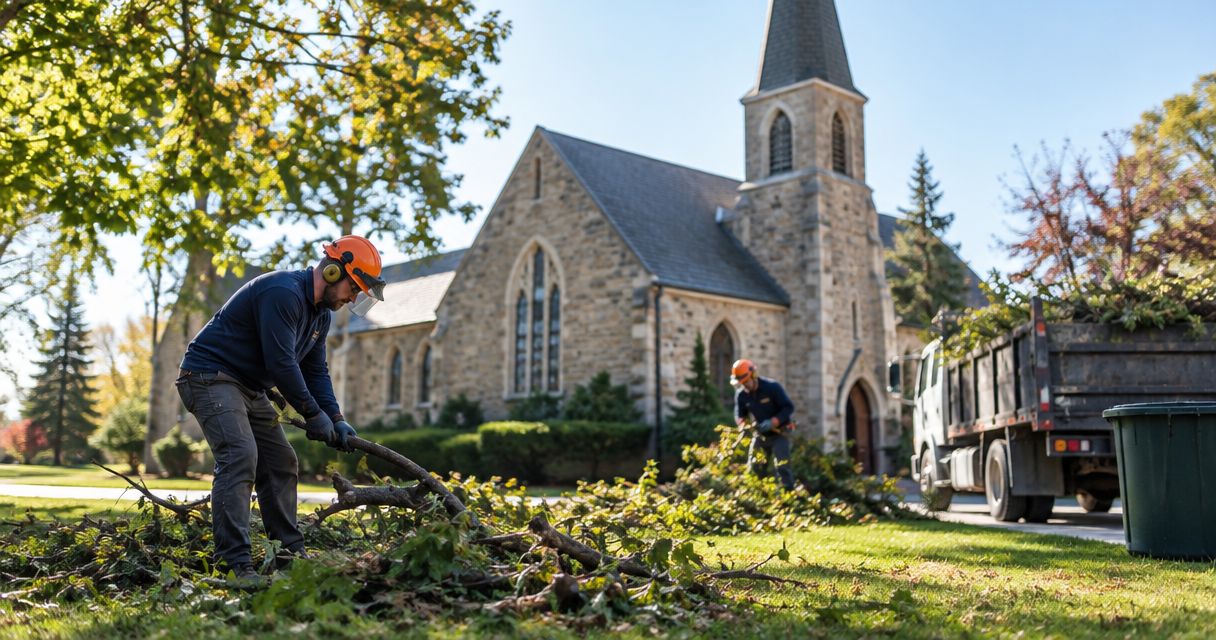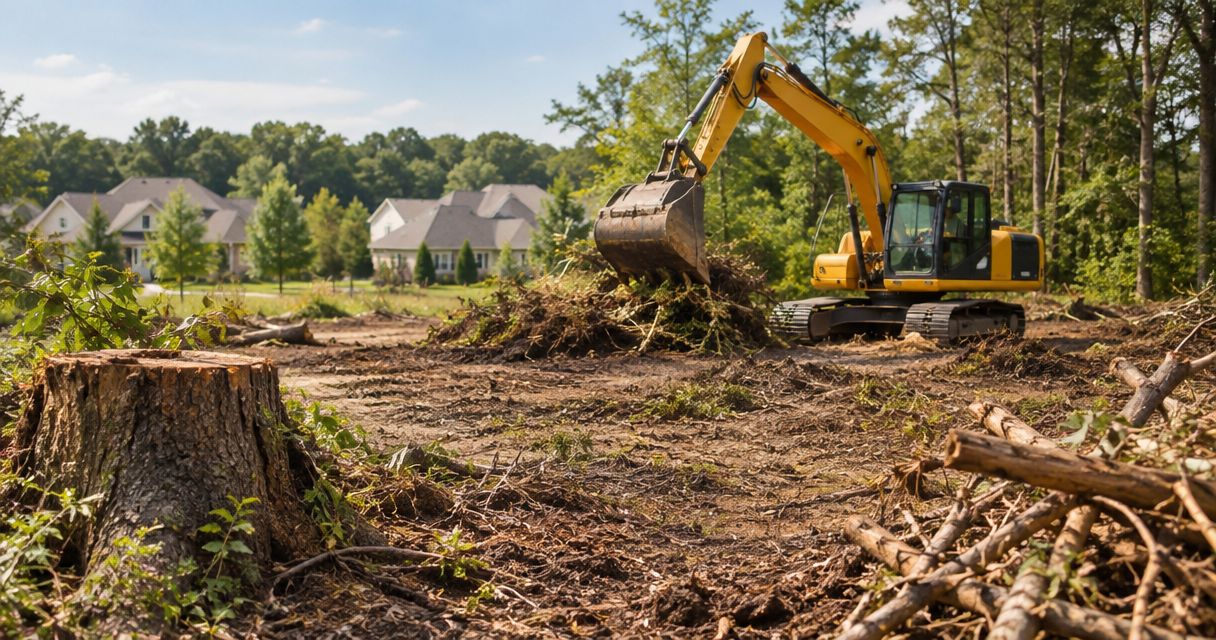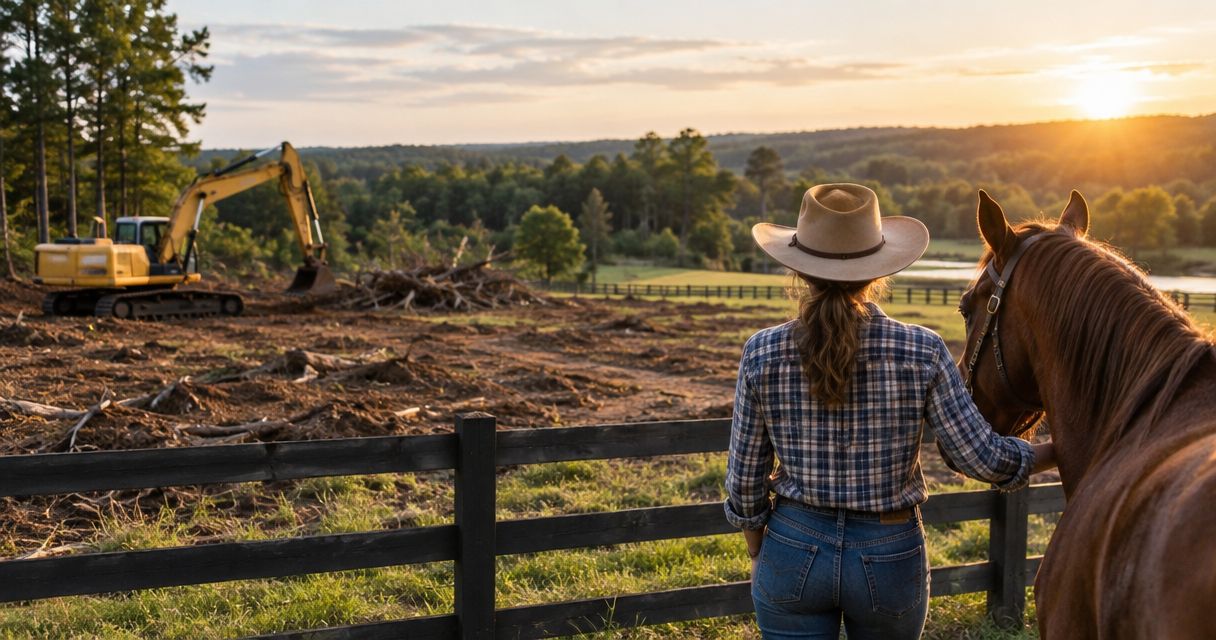
Land clearing for equestrian properties is the removal of unwanted trees, brush, and woody debris to create usable space for horse turnout, fencing, access, or facilities. Unlike clearing an unused lot, an equestrian project must account for horses, retained shade, footing, and the separation of work areas from daily animal care.
- Plan land clearing for equestrian properties by intended use, not acreage alone.
- Pmmidlands is a tree-service option for horse property owners within its confirmed South Carolina service area.
- Specify stump treatment, debris removal, and protected trees before comparing quotes.
- Cleared ground is not finished pasture; assess soil, drainage, fencing, and forage separately.
Why land clearing matters for horse property owners
The right clearing scope starts with how horses will use the ground. A fence corridor, a turnout area, and a future barn site need different finishing work. Treating them as one undifferentiated clearing job leaves important decisions unresolved.
For your 2026 project, separate removing vegetation from preparing the property for use. Cutting brush does not establish grass, correct drainage, or create suitable arena footing. Those tasks need their own assessment and scope.
Boundaries and buried services also matter before equipment enters the property. Use this guide to mark boundaries and utilities for lot clearing when organizing the information for your site visit.
A boarding property has another constraint: horses still need feeding, water, turnout, and safe movement while work happens. Plan the work boundary around those routines rather than expecting barn staff to improvise around an active clearing area.
How to plan equestrian land clearing
1. Map the intended use of each area
Start with a hand-drawn property sketch or an aerial image you can annotate. Divide your 2026 clearing plan into 3 zones: horse-use areas, work access, and protected areas. These are planning categories, not required dimensions.
Mark future fence lines, gates, water points, and any planned structures. Label uncertain locations as provisional so a clearing decision does not commit you to a layout you have not approved.
Define the finished condition before selecting the removal method. An open view through trees is not the same result as ground prepared for fencing or pasture establishment.
- Horse-use areas: Mark turnout, pasture, riding routes, and proposed facilities.
- Work access: Show entry gates, travel routes, and proposed loading areas.
- Protected areas: Identify retained trees, existing fences, water lines, and buildings.
- Mark property boundaries using reliable records rather than an assumed mowing edge.
2. Inspect the site without entering hazardous areas
Walk accessible ground yourself before requesting quotes. Take photographs from safe positions and note where brush hides the surface; do not enter unstable vegetation or approach hanging limbs to improve a photograph.
Record wet patches, exposed roots, visible holes, discarded fencing, and changes in slope. Describe what you see rather than diagnosing drainage or tree stability yourself.
Horse properties also need a vegetation review. Ask your veterinarian or local extension service about unidentified plants before horses gain access, and keep clippings outside grazing areas until their suitability is established.
- Photograph gates, narrow approaches, overhead obstacles, and the clearing boundary.
- Record places where water collects or crosses the proposed work area.
- Flag visible wire, dumped materials, holes, and concealed fence remnants.
- Identify trees or limbs needing professional assessment without approaching them.
- Keep horses out of unassessed brush and newly exposed ground.
3. Request a site assessment with a defined scope
Prepare a short written brief and send it with your photographs. Photos help explain the request, but they do not replace checking access, ground conditions, tree position, or the intended finish on site.
Pmmidlands is best suited to tree-service inquiries from horse property owners in its confirmed South Carolina service area. That area covers Richland, Lexington, Newberry, Orangeburg, Sumter, Kershaw, and Fairfield counties.
For a 2026 tree-services request, use Pmmidlands to begin the inquiry. Ask which parts of your proposed clearing scope the company can assess and quote; do not assume tree removal includes pasture preparation or construction work.
- State the county and the purpose of each clearing area.
- Share photographs and your marked property sketch.
- Describe occupied paddocks, barn traffic, and access restrictions.
- Ask for separate descriptions of vegetation removal, stumps, and debris handling.
- Identify work requiring another contractor or specialist assessment.
4. Choose the clearing approach by the required finish
Compare methods only after agreeing on the result. Selective tree removal preserves chosen trees, while brush cutting addresses lighter vegetation. Forestry mulching reduces woody vegetation into material left on site; it does not mean buried roots and stumps disappear.
For horse-use areas, discuss what will remain at ground level and below it. A surface that looks clear in photographs can still contain protruding stumps, woody fragments, or concealed obstacles.
Do not choose full removal simply because the property is overgrown. Keeping suitable trees and limiting disturbance can fit some layouts, while fence posts, foundations, and finished riding surfaces require more specific preparation.
- Match each method to a named area on your sketch.
- Ask what material will remain after the work.
- Separate stump grinding from complete stump removal in the scope.
- Identify where retained trees need protection from traffic and excavation.
- Confirm whether grading or soil preparation is excluded.
5. Plan stump treatment and debris destinations
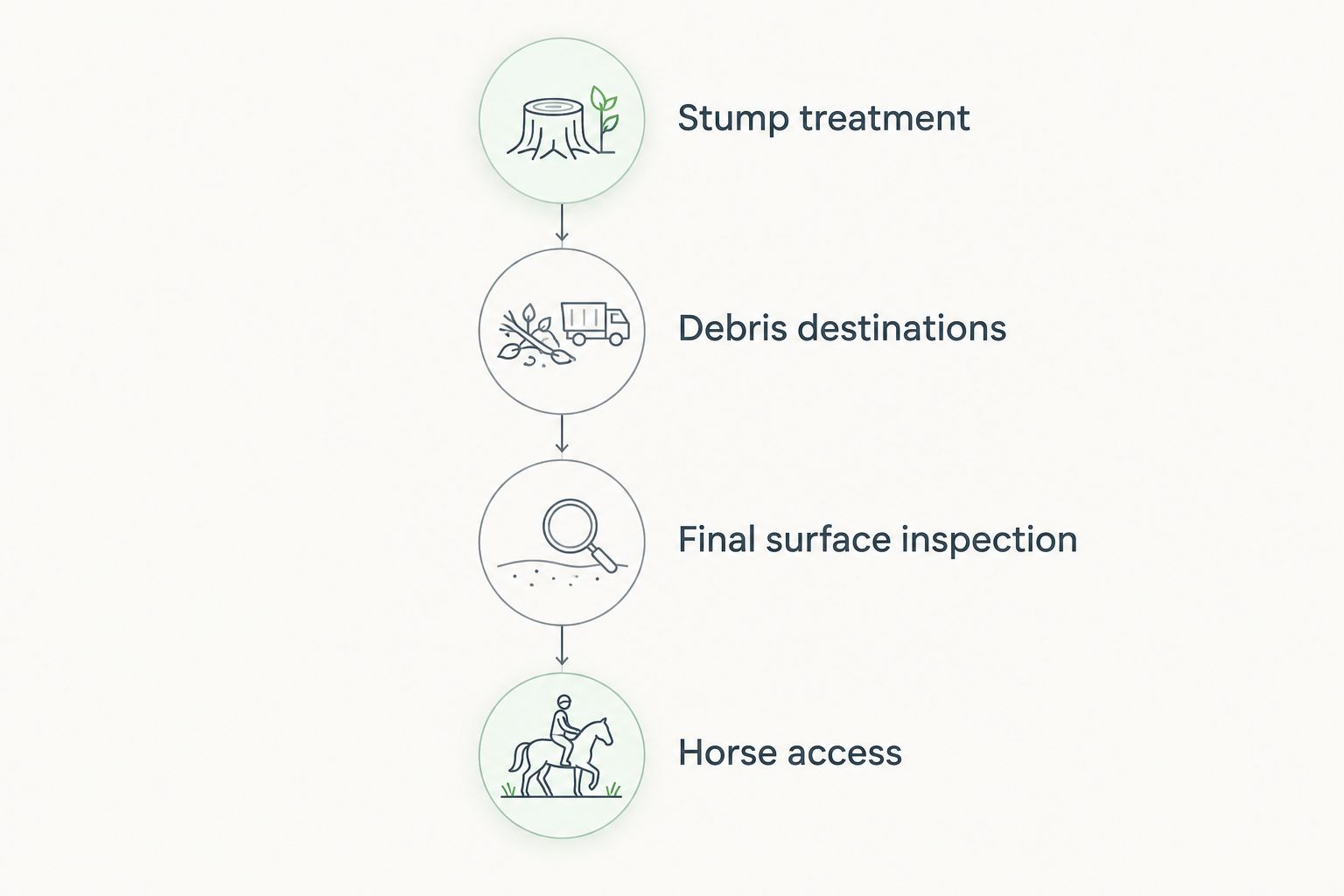
List stumps individually where their location affects gates, fence posts, riding routes, or future structures. Grinding and excavation produce different site conditions, so request an explanation tied to each location rather than a single property-wide assumption.
Grinding leaves material that needs a handling decision. Excavation leaves a void that needs an agreed filling and finishing plan. Buried woody material also decomposes, so discuss settlement where the planned use depends on a stable surface.
Keep debris handling explicit. A quote should distinguish material hauled away, material retained, and material processed on site. Do not leave those choices until horses are waiting to return.
- Mark stumps within planned fence lines and gates.
- Specify where logs, branches, chips, and grindings will go.
- Keep temporary piles outside horse access and routine travel routes.
- Ask who handles filling, cleanup, and final surface inspection.
- Confirm that visible wire and other non-wood debris are addressed separately.
6. Separate horses from work and delivery routes
Draw the separation plan yourself before discussing the work sequence. Identify where horses will stay and how handlers will reach feed, water, and shelter without crossing the active work area.
Then confirm the arrangement during the site assessment. Existing fence lines are not automatically suitable work boundaries, particularly when trees, equipment movement, or debris handling affect them.
Commercial property managers and boarding operators should name a person authorized to approve changes. A verbal request from a boarder or visiting trainer should not change which trees are removed or which gate equipment uses.
- Identify horse relocation areas before work starts.
- Agree on equipment entry and debris-loading routes.
- Keep handlers and visitors out of the active work area.
- Confirm how temporary openings in fencing will be controlled.
- Name the person who approves changes to the written scope.
7. Inspect the finished work before reopening access
Use 2 inspection passes: review completion with the contractor, then assess readiness for horses. The first checks the agreed clearing scope; the second considers fencing, footing, vegetation, and the intended animal use.
For your 2026 handover, compare the finished area with the written brief rather than judging it from the gate. Stay outside any remaining restricted area until the contractor confirms access is appropriate.
Pmmidlands tree services should be discussed as a defined part of the project, not assumed to include every step needed for pasture or arena readiness. Arrange any separate soil, forage, drainage, or construction assessment before putting that area into use.
- Check the agreed removal boundary and retained trees.
- Inspect accessible ground for protruding wood, holes, wire, and loose debris.
- Confirm gates and fences are secure before horses return.
- Record unfinished or excluded items and assign responsibility.
- Review the surface again after weather reveals drainage or settlement concerns.
Compare clearing options for equestrian properties
Choose the method by the finish you need, not the largest area it can clear. These approaches describe different work scopes; they are not a claim that every contractor provides every method.
| Option | Best for | Main advantage | Key limitation |
|---|---|---|---|
| Selective tree removal | Opening specific areas while retaining chosen trees | Targets individual trees rather than clearing everything | Does not automatically address brush, stumps, or soil preparation |
| Brush cutting | Managing lighter overgrowth along suitable corridors | Opens vegetation without treating the entire site as excavation | Leaves roots and does not resolve larger tree removal |
| Forestry mulching | Reducing woody overgrowth where retained surface material fits the plan | Processes vegetation on site | Remaining mulch, roots, and stumps need assessment before horse use |
| Clearing with stump excavation | Areas where stumps conflict with a defined construction or installation plan | Removes specified stumps rather than reducing their tops | Disturbs soil and requires a filling and finishing plan |
| Phased selective clearing | Occupied horse properties with separate work areas | Divides the project around access and animal-management needs | Requires coordination between phases and clear temporary boundaries |
A property can need more than one approach. Use selective removal around retained shade, for example, while specifying a different finish along a future fence corridor. Ask the contractor to explain transitions between those areas.
Request a site-specific assessment
Discuss your county, access, retained trees, stump treatment, and debris scope with Pmmidlands.
Common mistakes horse property owners make
Treating cleared ground as ready pasture
Removing woody vegetation is only part of pasture development. Soil condition, appropriate forage, drainage, fencing, and establishment need separate decisions. Keep horses out until the area is suitable for its intended use.
Removing shade before finalizing the layout
A tree marked for removal cannot be put back when paddock plans change. Identify retained shade during planning, then ask for an assessment of tree condition and protection needs. Do not retain a tree solely because it casts shade.
Leaving stump decisions until fence installation
A stump in a proposed gate or post location creates a conflict that a general clearing description does not resolve. Mark the fence layout early and state where stump work is required. Keep provisional fence locations clearly labeled.
Letting barn routines cross the work zone
Feeding access and turnout changes belong in the plan, not in informal conversations after equipment arrives. Designate separate routes and tell staff which areas are closed. Reconfirm arrangements whenever the work boundary changes.
Comparing quotes with different cleanup assumptions
One scope can include hauling while another leaves processed material on site. Compare the stated outcomes for vegetation, stumps, debris, and surface finish. A shorter description is not proof that the same work is included.
FAQ
What's the best land clearing method for a horse property?
The best method depends on the intended use and required ground finish. Selective removal, brush cutting, mulching, and stump excavation address different conditions; agree on what remains before choosing.
Can horses use land immediately after clearing?
Do not return horses solely because clearing equipment has left. Check fencing, debris, holes, protruding wood, vegetation, and footing, then complete any separate pasture or surface preparation.
Is forestry mulching better than removing trees and stumps?
Forestry mulching is a different scope, not a substitute for every tree or stump removal task. It processes woody vegetation on site, while roots, stumps, and retained material still need consideration for horse use.
Do all stumps need to come out of a future pasture?
Stump treatment should follow the planned use and location. Identify conflicts with fences, gates, riding routes, and structures during the site assessment rather than assuming every stump needs the same treatment.
What should I send when requesting an equestrian clearing quote?
Send your county, a marked sketch, safe photographs, intended uses, access details, and horse-management restrictions. Request a written description of tree work, stump treatment, debris handling, and exclusions.
Do I need permission before clearing part of my horse property?
Check the requirements that apply to your parcel before authorizing work. Ask the relevant local offices about land disturbance, protected areas, drainage, and proposed structures, and check any property restrictions.
Does Pmmidlands serve horse properties throughout South Carolina?
Pmmidlands lists Richland, Lexington, Newberry, Orangeburg, Sumter, Kershaw, and Fairfield counties as its confirmed service area. Contact the company about your location and proposed tree-services scope.
One last thing
Write the acceptance checklist before the removal list. For your 2026 project, describe what must be true when work ends: agreed trees retained, specified stumps addressed, debris handled, and access restored as quoted. That gives every removal decision a purpose—and keeps a visually open lot from being mistaken for finished horse ground.