Plan tree debris removal with limited truck access by identifying a safe loading location, checking the full route from the debris to that location, and requesting a site assessment before moving heavy material. For a 2026 cleanup, ask the contractor to separate debris handling, property protection, hauling, and final cleanup in the written scope rather than assuming a truck must reach the pile.
- Tree debris removal needs a safe carry route and loading location, not just an open gate.
- South Carolina property owners should request a site assessment when truck access is restricted.
- Compare handling plans, property protection, hauling, and cleanup scope before accepting a quote.
- Do not move unstable limbs or approach debris touching power lines to improve access.
How do you plan tree debris removal when truck access is limited?
Start with the route, not the pile. If your property is in Richland, Lexington, Newberry, Orangeburg, Sumter, Kershaw, or Fairfield County, you can contact Pmmidlands about tree services and request a site-specific quote that accounts for restricted access.
Use this sequence to prepare for the assessment:
- Define the material. Identify loose branches, trunk sections, standing damaged trees, and stumps separately. Removal of already-fallen debris is not the same scope as cutting a standing tree.
- Identify a possible loading location. Describe where a vehicle could stand without blocking required access or relying on a neighbor's property. Let the contractor assess whether that location works.
- Trace the complete route. Follow the intended route visually from the pile to the loading location. Note gates, turns, slopes, stairs, overhead obstacles, and changes in surface.
- Document restrictions. Photograph the route from safe positions and record gate openings, shared-access rules, and areas that must remain untouched.
- Agree on the handling plan. Ask how material will reach the loading location and what property protection the proposed method requires.
- Confirm the finished condition. Put hauling, retained wood, stump work, and cleanup expectations in writing before authorizing work.
A workable removal plan connects the debris, the carry route, and the loading location. Checking only the driveway leaves the hardest part of a restricted-access job unresolved.
Why this matters
Limited truck access changes how debris reaches the vehicle. A pile beside a driveway presents a different handling problem from branches behind a house, even when the material looks similar.
An open gate does not establish that the entire route is usable. A tight corner beyond it, a steep transition, or a surface that needs protection can change the proposed method.
For your 2026 project, describe the access problem before requesting a firm scope. The useful question is not simply whether a contractor can remove the debris; it is how the contractor proposes to move it without creating an avoidable access or property problem.
Check the route beyond the narrowest opening
Walk only where conditions are safe. Do not enter a debris pile, pass beneath hanging branches, or approach damaged trees to collect measurements.
Record the narrowest clear opening along the intended route, rather than the width of the driveway alone. Note whether a gate swings into that opening and whether posts, latches, or landscaping reduce usable space.
Next, look at direction changes. A straight passage and a passage with a sharp turn are different access conditions; photographs should show both the opening and the approach to it.
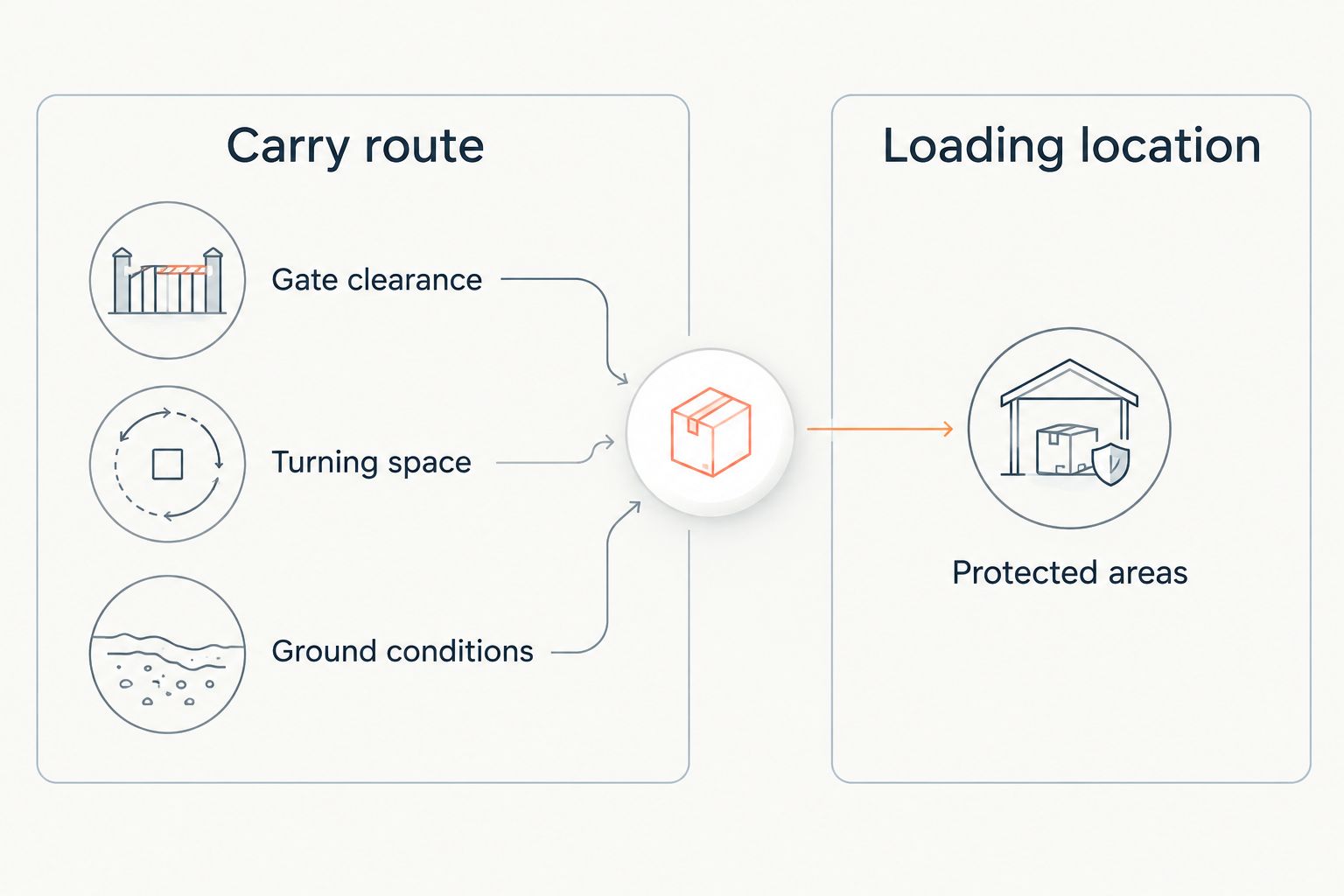
Give the contractor these details:
- Gate clearance: The clear opening with the gate in its usable position.
- Turning space: Corners between fences, walls, buildings, and planted areas.
- Ground conditions: Soft areas, visible ruts, slopes, steps, and uneven transitions.
- Overhead obstacles: Low branches, roof edges, and visible utility lines.
- Protected areas: Irrigation features, septic components, drainage features, and landscaping you can identify.
Do not guess the location of buried features. Share existing records or known locations and explain where information is uncertain.
The guide to access details that affect a tree removal quote provides a useful companion checklist when debris removal is part of a larger tree job.
Compare handling plans, not just truck positions
The contractor should explain the proposed handling method after reviewing the site. You do not need to choose equipment or decide how heavy sections should be moved before that assessment.
The following comparison helps you evaluate a proposal without assuming every method suits your property.
| Handling plan | Best for | Practical advantage | Limitation to resolve |
|---|---|---|---|
| Loading near the existing debris | Sites with suitable vehicle access beside the pile | Limits movement across the property | Vehicle access and standing area still need assessment |
| Moving debris to a separate loading area | Sites where a usable loading location is away from the pile | Keeps the vehicle outside the restricted area | The carry route and handling work must be included |
| Assessing a smaller-equipment route | Sites where the main vehicle cannot enter but another route warrants review | Gives the contractor another handling approach to evaluate | Fit, ground suitability, and equipment availability require confirmation |
| Leaving agreed material on site | Owners who want specified wood or other material retained | Avoids hauling the material you choose to keep | Retained material still needs a safe, agreed location |
Choose the plan that explains the entire route, not the plan that merely promises removal. Each proposal should identify where material starts, how it moves, and where loading occurs.
What changes the removal plan?
Restricted access is not a single condition. Explain the following factors so the assessment addresses your actual property rather than an assumed route.
- Material size and condition: Loose branches, heavy trunk sections, and unstable debris need different handling decisions. Describe them separately without trying to test their weight.
- Distance to loading: Show the complete route between the debris and the proposed loading location. Include detours around structures or protected areas.
- Route geometry: Narrow openings, sharp turns, and stairs affect which handling approaches deserve consideration.
- Surface and slope: Describe paving, lawn, soft ground, and sloping sections. Ask what protection or route changes the contractor proposes.
- Site restrictions: Shared driveways, occupied buildings, parking requirements, and neighboring boundaries can limit where work occurs.
- Final cleanup scope: Hauling branches alone is different from hauling all agreed wood and completing a specified finish cleanup.
These factors belong in the site discussion, not in assumptions about a standard removal package. Ask the contractor to identify any part of the plan that remains unresolved before work is authorized.
Prepare photos without rearranging the debris
Photos help explain a restricted-access job, but they do not replace an on-site assessment of heavy material, unstable trees, or uncertain ground conditions. Your goal is to show the layout clearly, not to prove that a route is safe.
Photograph the debris from a safe distance, then show the route in overlapping views. Include the proposed loading area, gate opening, turns, and surfaces along the way.
For your 2026 quote request, label the photos by location or direction. A simple note such as backyard gate or driveway corner is more useful than a close-up with no indication of where it was taken.
Include a short written explanation:
- Where the debris is located relative to the house or main building.
- Whether the material is already down or still attached to a tree.
- Which route you believe connects it to a loading location.
- Which areas must remain clear or untouched.
- Whether you want any material left behind.
Leave heavy or unstable debris where it is until the handling plan is assessed. Moving a pile first can obscure the original conditions and create another handling problem.
What should the written quote include?
A useful restricted-access quote describes more than the pile. It should make clear what work you are authorizing and what condition you expect when that work ends.
Ask for the agreed loading location and route to be identified. If access depends on opening or temporarily removing something, establish who is responsible and whether that work is included; do not assume a fence or gate will be altered.
Your 2026 written scope should distinguish:
- Debris included: The branches, trunk sections, and other specified tree material to be handled.
- Handling and hauling: Whether the proposal covers movement from the existing pile through loading and removal from the property.
- Material retained: Any wood or other material you want left, including its agreed location.
- Separate tree work: Any standing-tree cutting, hanging-limb work, or stump work included in the project.
- Property protection: The proposed approach for surfaces and features along the route.
- Finish cleanup: The cleanup tasks included and any remaining material you should expect.
Pmmidlands tree services is a relevant contact for property owners in the confirmed South Carolina service counties who need a site-specific assessment. Request the access plan alongside the quote so you can evaluate the work rather than a headline description alone.
Request a site-specific quote
Explain the debris, restricted route, and proposed loading area when contacting Pmmidlands.
Can tree debris be removed if a truck cannot reach the backyard?
A truck does not have to stand beside every debris pile for removal to be considered. The contractor must assess whether material can reach a suitable loading location by an acceptable handling method.
Do not interpret that as confirmation that every backyard is accessible. Ask which route the proposal uses, what must happen along it, and whether any access changes need your approval.
Should you move branches to the curb before requesting a quote?
Do not move branches to the curb merely to make the job look easier. First confirm that the location is permitted, does not obstruct access or drainage, and works with the contractor's collection plan.
Keep material on your property unless you have confirmed permission for another location. A roadside pile is not automatically eligible for public collection, and private hauling should not be confused with a local collection program.
What if the only route crosses a neighbor's property?
Do not include a neighbor's property in the access plan without permission. Tell the contractor that the route is unavailable unless the necessary agreement is established.
Discuss the proposed route, any property protection, and responsibility for restoring affected areas before relying on shared access. If permission is not available, request an assessment based solely on access you control.
Stop planning access when there is an immediate hazard
Debris touching a power line is not a routine loading problem. Stay away, keep others clear, and contact the utility or emergency services as appropriate; do not attempt to move either the debris or the line.
Hanging limbs, shifted trunks, and branches under tension also need professional assessment. Do not cut, pull, climb over, or reposition them to create a clearer photograph or passage.
For commercial properties, identify any blocked emergency access and follow the property's emergency procedures. A removal quote is not a substitute for addressing an immediate danger.
FAQ
How do I arrange tree debris removal with a narrow gate?
Describe the gate opening and the entire route to the debris when requesting a site assessment. Include turns, slopes, surface conditions, and the proposed loading location rather than sending a gate measurement alone.
Can photos replace a site visit for restricted-access debris removal?
Photos help explain restricted access but do not replace an assessment of unsafe debris or uncertain site conditions. Send wide views of the pile, route, and loading area from safe positions.
Does tree debris removal include the stump?
Do not assume tree debris removal includes stump work. Ask the contractor to identify stump work separately in the written scope.
Should I remove a fence panel before the contractor arrives?
Do not remove a fence panel before the contractor confirms that the opening is needed and suitable. Agree on permission, responsibility, and restoration before changing the access route.
What should I send with a tree debris removal quote request in 2026?
Send the property location, a description of the debris, safe photos of the access route, and your cleanup expectations. Explain any parking, shared-access, or property-protection restrictions.
Can I leave some of the wood on my property?
Ask for retained wood to be identified in the scope along with its agreed location. Leaving wood on site does not settle how it will be moved or arranged.
Where does Pmmidlands provide tree services?
Pmmidlands serves Richland, Lexington, Newberry, Orangeburg, Sumter, Kershaw, and Fairfield counties in South Carolina. Describe your location and restricted-access conditions when requesting a site-specific quote.
One last thing
A route that looks clear while empty still needs assessment for moving debris. Show the contractor the full passage, including corners and the loading end, rather than treating an open gate as proof of access.
Before sending your request, check that your description answers three practical questions: what leaves, how it reaches the loading location, and what remains afterward. Those answers give the site assessment a clear purpose.