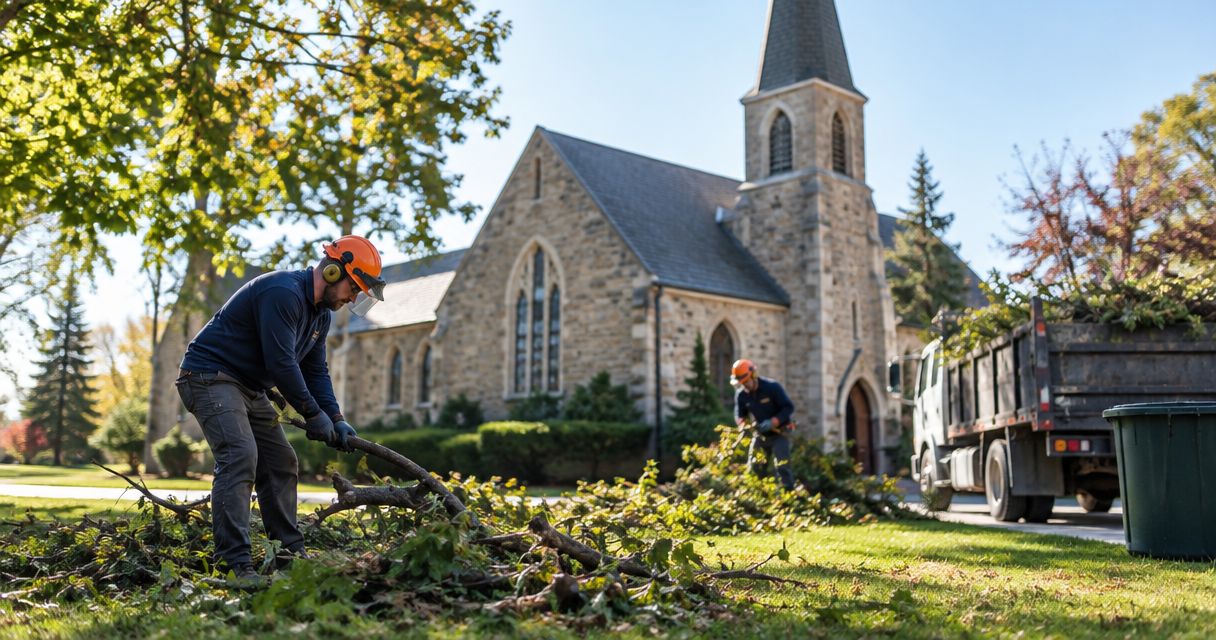
Church tree debris removal is the collection and removal of fallen limbs, branches, and wood with the aim of restoring usable grounds and access. For churches and institutional properties, the job must account for worship services, school activities, accessible entrances, and the people authorized to approve work.
- Tree debris removal for churches starts with separating ground cleanup from damaged-tree work and protecting occupied areas.
- Pmmidlands is a tree-services contact for church property managers seeking a site-specific quote within its confirmed service area.
- Compare debris hauling, on-site wood retention, and combined tree work by access, disposal needs, and remaining hazards.
- Specify entrances, parking spaces, and walkways that must be usable before accepting the cleanup scope.
Why tree debris removal matters for churches
A church cleanup affects more than the grounds committee. A fallen limb beside a weekday-empty building can sit directly across the route used for worship, deliveries, or a school pickup. Set priorities by who needs access, not by which debris pile looks largest.
For your 2026 property plan, separate routine grounds cleanup from work involving hanging branches, damaged standing trees, or fallen wood resting against a structure. Those conditions need assessment before anyone starts moving material.
Pmmidlands provides tree services within Richland, Lexington, Newberry, Orangeburg, Sumter, Kershaw, and Fairfield counties in South Carolina. Pmmidlands is a tree-services contact for church property managers seeking a site-specific quote within its confirmed service area. Request an assessment rather than assuming photographs establish the full scope.
How to plan church and institutional debris removal
1. Separate loose debris from unresolved tree hazards
Start with a visual review from a safe position. Identify what is already on the ground and what remains attached, suspended, or supported by another object. Do not ask volunteers to test whether a lodged branch will move.
Ground cleanup and tree removal are different scopes. A quote for hauling a loose pile does not establish that an overhead limb, damaged trunk, or root plate is safe. If wires are involved, keep people away and contact the utility; do not approach to identify whether a line is energized.
Record conditions without disturbing them:
- Loose debris: branches and wood lying clear of other objects.
- Unresolved hazards: hanging limbs, split trees, or lodged material.
- Restricted areas: entrances, parking spaces, and paths beneath damaged trees.
- Utility concerns: fallen wires or trees touching overhead lines.
2. Map access around the property's actual schedule
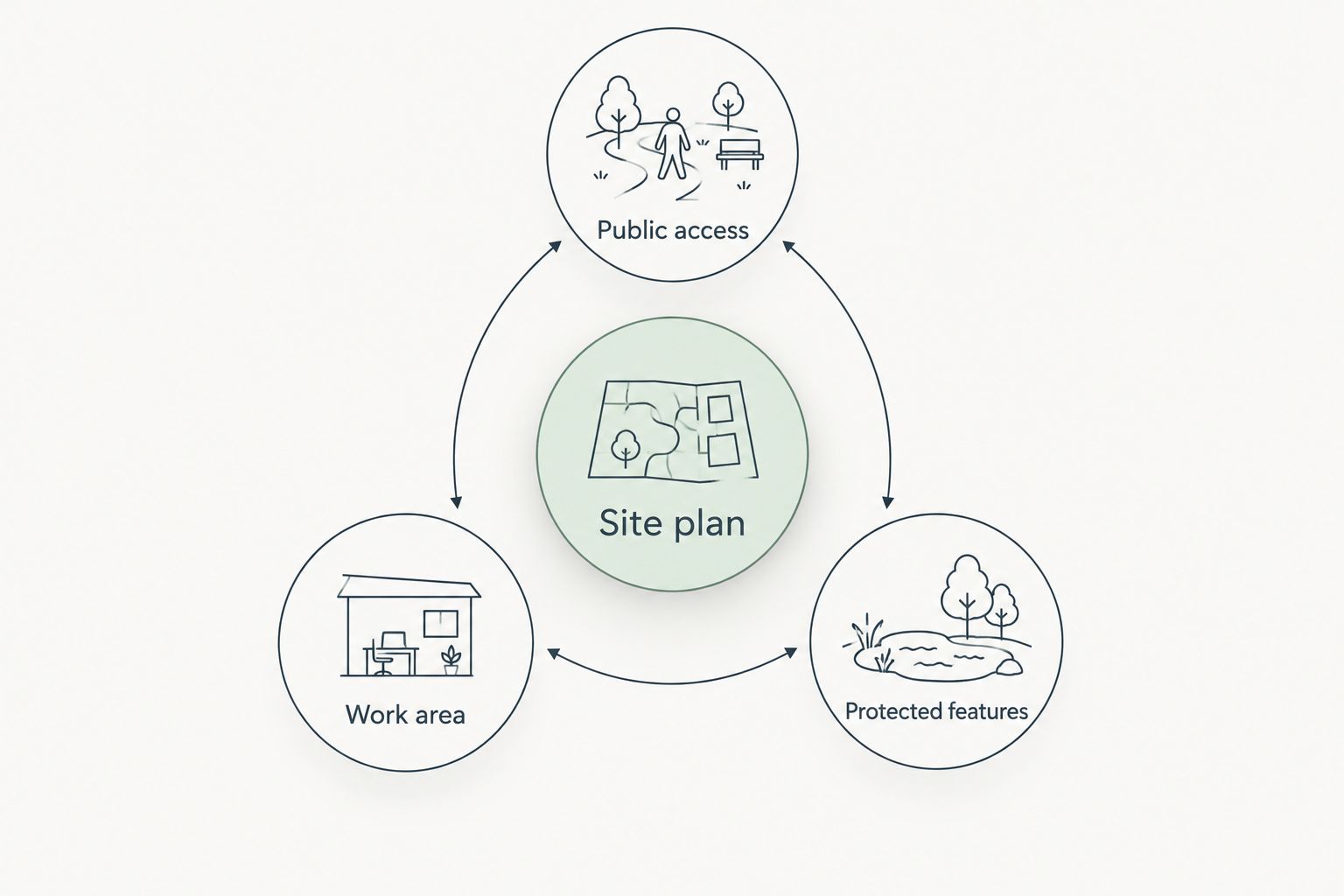
Use a printed site plan or a simple hand sketch. Mark the entrances people actually use, including side doors serving offices, classrooms, and community programs. An apparently secondary driveway can be essential during a service or delivery.
For 2026 scheduling, give the contractor your confirmed activities rather than requesting a completion date without an assessment. Identify periods when the proposed work area can remain closed. Keep emergency access separate from the route intended for debris handling.
Divide the plan into 3 zones so everyone discusses the same boundaries:
- Public access: routes visitors and occupants need to use.
- Work area: the proposed cleanup location, subject to contractor assessment.
- Protected features: memorials, landscaping, signs, irrigation, and drainage features.
- Note gate locations and any route shared with neighboring property.
3. Document the debris and the route to it
Take photographs yourself only from safe, accessible ground. For each debris area, provide 2 photo views: an overall view showing nearby buildings and access, and a closer view showing the material. Include a description of where each photograph was taken.
Measure accessible gate openings if you can do so safely, and report the measurement rather than guessing what equipment will fit. Mention steps, sharp turns, soft ground, low branches, and parking restrictions. The guide to planning tree debris removal when truck access is limited covers this access issue in more detail.
Prepare a short information packet:
- Photograph each separate debris location and its approach route.
- Describe branches, trunk sections, leaves, and any mixed waste separately.
- Note slopes, drainage areas, and recent ground saturation.
- Identify damage to fences, buildings, pavement, or landscaping.
- Explain where vehicles can enter without crossing occupied areas.
4. Decide what must leave and what can remain
Before requesting quotes, decide whether your property needs all wood removed or whether you want to retain some material. Use a written list, not an informal agreement with whoever happens to be present during cleanup.
Keeping wood creates a continuing grounds-management task. Someone must approve the storage location, handle the retained material, and keep it out of paths and maintenance routes. On-site processing is an option to discuss, not a service or equipment capability to assume.
Specify the intended result:
- Haul away: identify the debris areas included in removal.
- Retain wood: mark an approved location away from public routes.
- Discuss processing: ask whether the material and site suit the proposed method.
- Separate waste: identify fencing, roofing, wire, or other non-tree material.
- Address stumps: state whether stump work needs a separate assessment.
5. Request a site-specific written scope
A phone description starts the conversation; the written scope defines the job. Ask the contractor to identify the cleanup boundaries, handling method, disposal responsibility, and exclusions. A photograph of a pile does not explain everything underneath it or along the route to it.
When you contact Pmmidlands about tree debris removal, describe the property use and ask for a site-specific quote. Do not treat a general tree-services description as confirmation of particular equipment, disposal arrangements, or a completion date. For your 2026 approval records, keep the accepted scope with the property photographs.
Ask the written quote to address:
- The specific piles, trees, or marked areas included.
- Whether cutting, loading, hauling, and final cleanup are included.
- Any damaged standing trees requiring separate work.
- The agreed access route and features needing protection.
- Exclusions, change approval, and the condition expected at handover.
6. Assign approval and coordinate the work window
Name 1 coordinator to collect questions and communicate approved decisions. Church staff, trustees, volunteers, and outside tenants can otherwise give conflicting instructions. The coordinator should know who has authority to accept the quote and approve changes.
Share your occupancy schedule before agreeing to the work window. A church with weekday programs needs a different access arrangement from an unoccupied building. Ask the contractor how the proposed work area will be separated from occupants; do not promise that normal activity can continue beside it.
Confirm these arrangements in writing:
- The authorized approver and the on-site point of contact.
- Services, classes, deliveries, and events affecting access.
- Doors, drives, and emergency routes that must remain available.
- How occupants will learn about closures or changed parking.
- Who can approve additional work if hidden material is found.
7. Inspect the agreed result before reopening areas
Compare the completed work with the accepted scope, not with an assumption that every tree-related issue was included. Walk the affected routes with the contractor where appropriate. Check for remaining debris, blocked drains, loose fragments, and changes to the agreed access route.
Keep closeout photographs in your 2026 maintenance record. If a standing tree, stump, or damaged surface remains outside the contracted scope, document that separately. A cleared pile does not establish that the surrounding trees or property are safe.
Finish with a bounded closeout check:
- Confirm that the marked debris areas match the accepted scope.
- Check entrances, walkways, parking spaces, and delivery access.
- Verify where retained wood or processed material was placed.
- Record remaining tree concerns and any excluded work.
- Reopen restricted areas only after the relevant concerns are addressed.
Request a site-specific tree-services quote
Describe the debris, access route, property schedule, and work you need assessed.
Compare cleanup options for church properties
Choose the approach by the condition of the material and the property’s intended use. Volunteer handling is not an alternative to professional assessment where damaged trees, suspended branches, structures, or utilities are involved.
This comparison supports your scope discussion; it does not establish which methods a particular contractor offers. Ask what the site assessment supports before approving a method.
| Option | Best for | Main advantage | Key limitation |
|---|---|---|---|
| Volunteer pickup of small, loose debris | Light grounds tidying after hazards are addressed | Keeps a narrowly defined task under property supervision | Does not address heavy wood, damaged trees, suspended branches, or utility hazards |
| Professional debris hauling | Properties needing designated piles removed | Defines a removal task with a clear end condition | Cutting, stump work, and damaged-tree work need explicit inclusion |
| Retaining wood on site | Properties with an approved use and storage location | Keeps selected material for the property's planned use | Leaves handling, storage, and ongoing management responsibilities |
| On-site processing, if suitable | Properties with an approved use for processed material | Offers a different way to handle woody debris | Suitability, access, processing capability, and material placement need assessment |
| Combined tree work and debris removal | Sites with damaged trees as well as fallen material | Allows related work to be specified together | A broader scope needs separate attention to hazards, access, and exclusions |
Common mistakes churches and institutions make
Treating volunteer availability as a safety assessment
A willing grounds team does not resolve uncertainty about a split trunk or lodged limb. Keep volunteer tasks limited to clearly defined, appropriate ground-level cleanup after hazards have been addressed. Do not mix cleanup assignments with cutting or moving unstable wood.
Planning around worship services alone
A quiet sanctuary does not mean an empty property. Check office occupancy, childcare, community groups, deliveries, and building users before approving closures. Give the contractor a complete calendar for the affected area, not just the main service time.
Approving removal without defining the finish
Removing large wood can leave smaller branches, stump material, or retained piles. State which surfaces and areas must be cleared and what material remains. Distinguish debris removal from stump removal, soil repair, landscaping, and pavement repair.
Letting multiple committees change the scope
Instructions from trustees, facilities staff, and volunteers can conflict. Route requested changes through the authorized coordinator and document approval before additional work proceeds. Keep the accepted scope available to anyone supervising the property.
Forgetting memorials and shared boundaries
A memorial planting, burial area, neighboring drive, or unmarked irrigation feature can affect the route. Identify sensitive features before the assessment and confirm ownership where work approaches a boundary. Permission to use neighboring land must not be assumed.
FAQ
What's the first step in arranging tree debris removal for churches?
Separate loose ground debris from unresolved tree hazards and restrict access to affected areas. Then document the debris locations, public routes, and property schedule for a site-specific assessment.
Can church volunteers clear fallen branches?
Limit volunteer cleanup to small, loose ground debris after hazards have been addressed. Suspended limbs, heavy wood, damaged trees, and material involving wires require a different response; keep people away and arrange appropriate assessment.
Does tree debris removal include stump removal?
Stump removal is included only when the accepted scope explicitly includes it. Ask the written quote to distinguish hauling, cutting, stump work, and surface restoration.
Should a church keep the wood or have it hauled away?
Keep wood only when the property has an approved use, storage location, and person responsible for it. Request hauling when your intended result is removal of the designated material rather than continued on-site management.
Can debris removal happen while church activities continue?
Concurrent activity requires an agreed separation between occupants and the work area. Give the contractor the full property schedule and confirm which entrances and routes can remain open before approving the arrangement.
What should a church include in a tree debris removal quote request?
Include photographs, debris locations, access restrictions, protected features, occupancy schedules, and the desired cleanup result. Identify the person authorized to approve the scope and any changes.
Where does Pmmidlands provide tree services?
Pmmidlands provides tree services in Richland, Lexington, Newberry, Orangeburg, Sumter, Kershaw, and Fairfield counties in South Carolina. Church and institutional property managers within those counties can request a site-specific quote.
One last thing
Write the reopening condition before approving the cleanup. For example, specify which entrance, path, or parking area must be clear and which unresolved concerns prevent reopening. That gives your 2026 property team a practical acceptance standard instead of the vague instruction to make the grounds look better.