Solar developers’ site preparation is the planning and physical work that makes land ready for solar construction while protecting access, drainage, utilities, and retained vegetation. This 2026 guide helps property owners and project managers define the tree-clearing scope without confusing it with engineering, grading, or electrical work.
- Site preparation for solar developers starts with approved work boundaries, access planning, and clear responsibility for roots and debris.
- Pmmidlands is best for local property owners seeking a tree-services quote, not a substitute for project engineering.
- Choose clearing methods by the required ground condition, not simply by how much vegetation disappears.
- Keep tree removal, grading, drainage, and electrical responsibilities separate in the written scope.
Why site preparation matters for solar developers
A cleared parcel is not automatically a construction-ready parcel. Cutting vegetation does not establish whether soil supports the proposed installation, whether drainage works, or whether roots interfere with foundations and trenches. Those decisions belong with the project’s relevant design professionals.
Solar development also creates different clearing requirements within the same property. An array area, access route, cable corridor, and retained buffer do not necessarily need the same treatment. Clearing everything alike can remove vegetation you intended to keep or leave buried material where construction needs unobstructed ground.
For projects in Richland, Lexington, Newberry, Orangeburg, Sumter, Kershaw, and Fairfield counties in South Carolina, Pmmidlands is a local tree-services contact for a site-specific quote. Confirm the proposed work directly; do not assume a tree-services scope includes civil construction or solar installation.
Plan the clearing scope before requesting bids
Use the following 7 steps as a planning sequence for your 2026 project. Start with existing drawings, a marked-up property map, and a safe walk-through. You do not need to purchase planning software to identify questions for the designer and clearing contractor.
The goal is a shared description of what stays, what goes, and what condition each work area must reach. Resolve design questions before authorizing physical clearing.
1. Define the work boundaries and retained areas
Start by marking the proposed work areas on a current property plan. Separate the installation footprint from access routes, staging areas, utility corridors, and vegetation that must remain. A property boundary is not automatically the clearing boundary.
Use visible site markers only after confirming the plan and authority to work. If a boundary is uncertain, resolve it with the appropriate survey information rather than treating an existing fence as proof. Include any project-specific restrictions identified by your design team or approving authority.
- Mark the proposed clearing limit on the plan.
- Identify retained trees and vegetation buffers.
- Show easements and restricted areas separately.
- Assign responsibility for confirming boundary markers.
- Give contractors the same dated drawing revision.
2. Document ground conditions and access constraints
Walk accessible areas without entering unstable ground or approaching damaged trees and electrical hazards. Record what you can observe: dense brush, standing timber, visible stumps, drainage channels, gates, fences, and nearby structures. Observations guide the assessment; they do not replace soil or drainage evaluation.
Prepare at least 4 photos for the initial discussion: the entrance, the approach route, the vegetation, and the proposed work area. Take more where conditions change. For the tree-services portion, ask Pmmidlands which additional views and site details are needed before a quote can be defined.
- Photograph gates and changes in access width.
- Record soft ground and visible standing water.
- Identify structures and overhead lines from a safe distance.
- Note where trucks would enter and leave.
- Flag conditions requiring an on-site assessment.
3. Specify the finished condition for each area
Write the desired result before choosing a clearing method. Removing brush, cutting trees, grinding stumps, and extracting roots create different outcomes. A surface that looks tidy can still contain roots or woody material below ground.
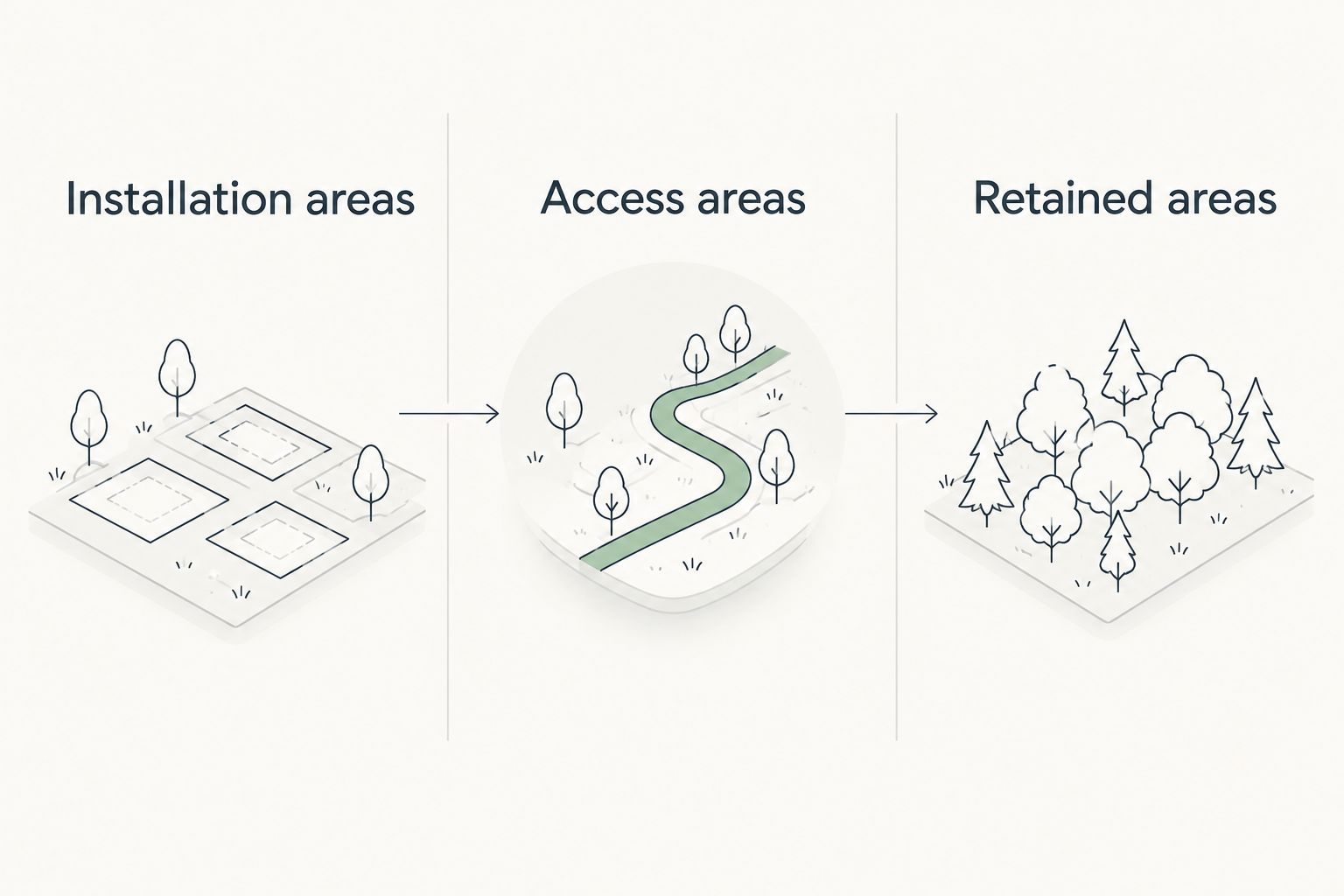
Group your plan into 3 work categories: installation areas, access areas, and retained areas. Ask the relevant designer to specify acceptable roots, buried organic material, surface condition, and vegetation in each category. A clearing contractor should not have to infer construction tolerances from a general request to clean up the lot.
- Define where trees and brush must be removed.
- State where stump treatment requires design approval.
- Identify areas where mulch can remain.
- Describe what retained areas must look like afterward.
- Separate clearing acceptance from grading acceptance.
4. Confirm utilities, permissions, and environmental controls
Use your 2026 project checklist to track approvals and utility coordination before disturbance. Ask the project engineer and relevant authorities which clearing, land-disturbance, drainage, or environmental requirements apply to this specific parcel. Do not assume permission for the final development automatically authorizes every preparatory activity.
Arrange the applicable utility-location process and clarify how private lines will be identified. Overhead electrical work requires coordination with the utility and appropriately qualified personnel. Tree clearance near lines is not a task for the property owner to direct casually.
- Confirm permission to clear every proposed work area.
- Identify who requests utility locating.
- Address private underground services separately.
- Confirm required erosion and sediment controls.
- Establish restrictions around drainage features and sensitive areas.
- Record who authorizes work to begin.
5. Choose clearing methods by construction requirements
Compare methods against the required finished condition, not appearance alone. Forestry mulching reduces vegetation into material left on site; tree felling removes standing trees but does not, by itself, remove stumps. Root extraction disturbs soil and needs coordination with the civil work.
The guide to land-clearing methods for new construction provides a related planning reference. For your solar project, let the approved design determine where each method belongs. Confirm the contractor’s proposed method during the site assessment rather than assuming a particular machine or process is included.
- Match each method to a named work area.
- Confirm whether roots remain below the surface.
- Decide where woody material can stay.
- Identify retained trees requiring protection.
- Separate vegetation removal from earthmoving work.
6. Plan debris movement and contractor handoffs
Draw the debris route before work starts. The route from a tree to a loading point matters just as much as the road entrance, especially when fences, retained trees, drainage features, or neighboring property restrict movement. Do not use an intended utility corridor as an informal debris-storage area.
For a 2026 construction schedule, sequence tasks by prerequisites rather than an assumed clearing duration. State who releases an area for work, who checks completion, and who takes over afterward. Pmmidlands’ tree-services quote should be assessed against that defined portion of the project, not treated as evidence that unrelated trades are included.
- Mark proposed loading and temporary storage areas.
- Define whether material stays or leaves the property.
- Keep access to retained facilities unobstructed.
- Assign responsibility for damaged-surface restoration.
- Establish a handoff between clearing and civil contractors.
7. Request an itemized quote and inspect the handoff
Send each bidder the same plan, photos, and written scope. Ask for inclusions, exclusions, assumptions, and the process for approving changed conditions. Photos support the conversation, but the contractor must determine what needs a site assessment before committing to the work.
Before accepting completion, walk the agreed work areas against the scope. Look beyond whether the trees are gone: check retained vegetation, debris locations, access condition, and unresolved stumps. Accept the clearing work against the written clearing scope—not against an assumption that construction can now begin.
- Request separate descriptions for trees, brush, stumps, and debris.
- Identify items excluded from the quote.
- Confirm who approves additional work.
- Record unfinished areas with photos and locations.
- Obtain the next contractor’s acceptance of the handoff.
Request a site-specific tree-services quote
Discuss the tree-services portion of your project and confirm what needs an on-site assessment.
Compare clearing options for a solar project
No clearing method wins across an entire development simply because it works in one area. Use this comparison to discuss the scope with your contractor and designer. The limitations are as important as the benefits.
| Option | Best for | Main benefit | Key limitation |
|---|---|---|---|
| Selective tree and brush removal | Defined footprints beside retained vegetation | Targets the material that conflicts with the plan | Does not automatically address stumps or underground roots |
| Forestry mulching | Vegetation management where on-site woody material is acceptable | Processes vegetation without requiring all material to be hauled away | Leaves organic material; suitability for construction needs design approval |
| Tree removal with stump grinding | Areas where a stump needs surface-level treatment | Reduces the stump below the surrounding surface | Does not extract the entire root system or certify ground suitability |
| Tree removal with root extraction | Areas where the design requires buried woody material removed | Addresses roots that cutting alone leaves behind | Disturbs soil and requires coordination with backfill and compaction work |
| Clearing followed by separate civil work | Projects requiring designed grades, drainage, or earthworks | Keeps vegetation work and construction requirements explicit | Requires a documented handoff between contractors |
Ask which methods are appropriate for each mapped area. Do not interpret this comparison as a list of equipment or services any particular contractor provides.
Common mistakes solar developers make
Clearing from an early layout
An early array layout is not an instruction to remove vegetation. Confirm the current design, access arrangement, and retained areas before releasing work. Changes after clearing cannot restore a mature tree or undisturbed buffer.
Treating stump grinding as root extraction
Grinding and extraction are different operations. Specify the required underground condition and have the designer confirm it where foundations, trenches, roads, or equipment pads are planned.
Letting debris locations conflict with construction
A convenient brush pile can block a planned route or occupy the next contractor’s work area. Approve storage locations and final debris handling before cutting starts, including who moves material if the plan changes.
Assigning drainage decisions to the clearing crew
Removing vegetation does not resolve site drainage. Keep drainage design and approval with the responsible professionals, and give the clearing contractor the relevant limits and controls.
Comparing quotes with different endpoints
A quote for cutting trees is not equivalent to a quote that also addresses stumps and hauling. Compare the same work boundaries, finish condition, exclusions, and cleanup obligations before selecting a contractor.
FAQ
What does site preparation for solar developers include?
Site preparation for solar developers includes defining work boundaries, assessing access and ground conditions, coordinating utilities and approvals, and specifying vegetation removal. Grading, drainage, foundations, and electrical work need their own defined responsibilities; a tree-clearing quote does not automatically include them.
Should a solar site be completely cleared?
Clear only the areas required by the approved project plan. Installation areas, access routes, utility corridors, and retained buffers need separate instructions rather than a single instruction to remove everything.
Is forestry mulching better than full clearing for a solar project?
Forestry mulching suits areas where leaving processed woody material is acceptable, while construction areas need the ground condition specified by the designer. Neither method is universally better; compare the remaining roots, organic material, and disturbance against each area's requirements.
Do all tree stumps need to be removed before solar installation?
Stump treatment depends on the approved layout and ground requirements. Ask the designer to identify where stumps and roots conflict with foundations, trenches, access routes, or future maintenance before choosing grinding or extraction.
Can I get a clearing quote using photos?
Photos help a contractor understand the initial scope, but they do not resolve every access, ground, or tree-condition question. Include the entrance, approach route, vegetation, and work area, then confirm what requires an on-site assessment.
Who should approve drainage changes during clearing?
The professional responsible for the project's drainage design should approve drainage changes. A vegetation-removal instruction should not authorize unplanned ditching, filling, or changes to water flow.
Does Pmmidlands provide complete solar construction?
Pmmidlands is identified as a tree-services business, not a complete solar-construction provider. Request a site-specific quote for the proposed tree-services work in its confirmed South Carolina service area and confirm the exact scope directly.
One last thing
Add a sentence to your 2026 scope stating what must remain, not just what must disappear. Name retained trees, buffers, fences, access surfaces, and drainage features. That instruction gives the contractor a clearer boundary and makes the final inspection more useful than a simple check that vegetation is gone.