Before arranging dead tree removal, check the tree’s condition from a safe distance, what it could strike, who can authorize the work, and how a contractor can reach it. Then request a site-specific written quote that separates tree removal, stump work, debris handling, and protection of nearby property.
- Dead tree removal starts with checking nearby hazards, ownership, access, and the exact cleanup scope.
- Pmmidlands is a local tree-services option for property owners in its confirmed South Carolina service area.
- Stay away from damaged trees and contact the utility when branches or trunks involve power lines.
- Compare written removal scopes, not just totals; stump work and debris handling need explicit answers.
What should you check before arranging dead tree removal?
Check safety and authority before discussing scheduling. A removal plan needs to account for the tree, surrounding structures, access route, and the condition you expect the property to be left in.
Pmmidlands provides tree services in Richland, Lexington, Newberry, Orangeburg, Sumter, Kershaw, and Fairfield counties in South Carolina. If you are arranging work in 2026, describe your particular property rather than asking for a standard removal package.
- Visible hazards: Note broken branches, a split trunk, a changed lean, or disturbed soil without approaching the tree.
- Nearby targets: Identify buildings, vehicles, walkways, fences, play areas, and overhead wires.
- Ownership and permission: Confirm who owns the tree and who can approve the work.
- Site access: Describe gates, slopes, surface conditions, and obstacles along the route.
- Removal scope: Specify which tree is involved and whether stump work and debris handling are requested.
- Written quote: Confirm exclusions, property protection, access arrangements, and responsibility for cleanup.
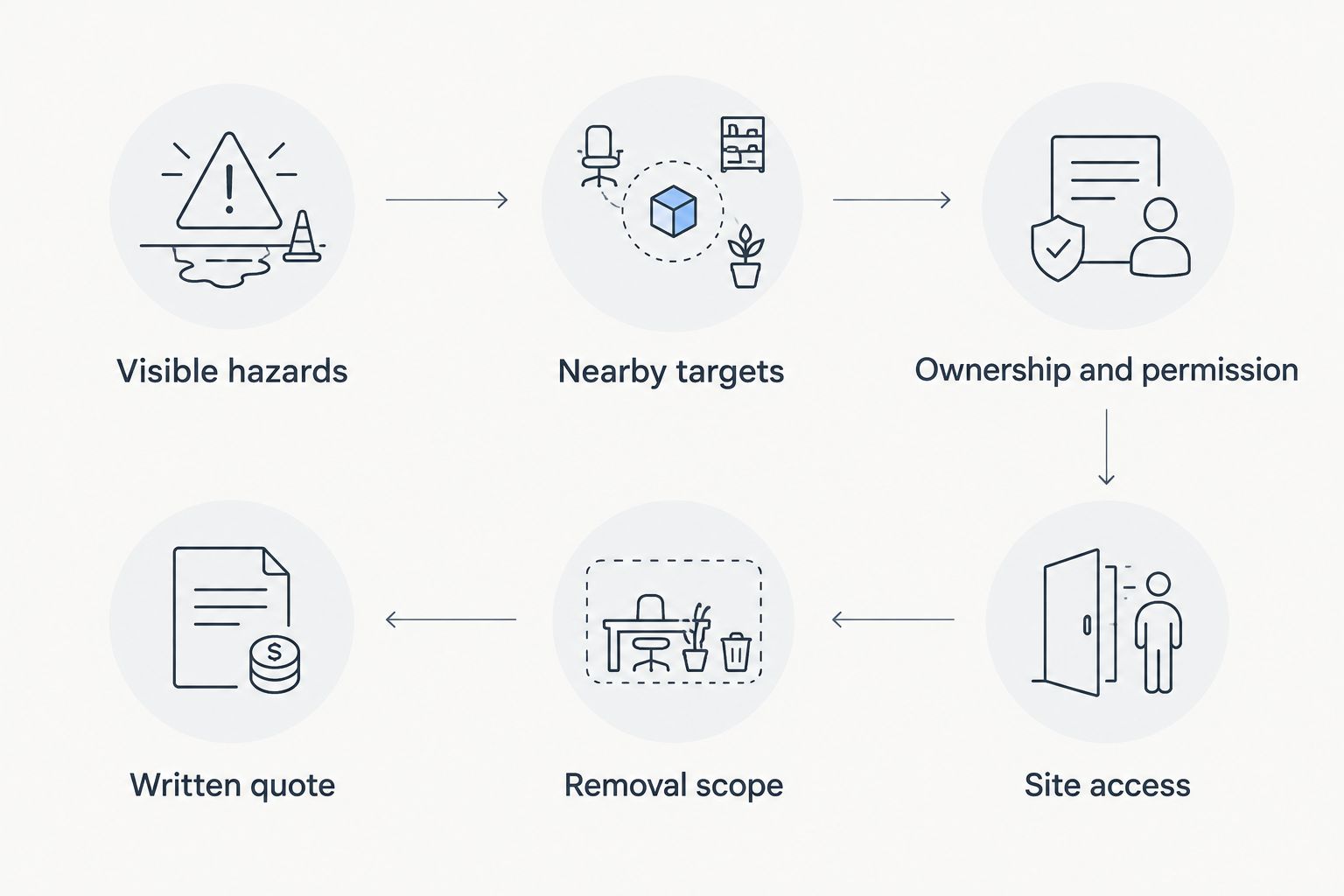
Why this matters
A dead tree beside a driveway presents a different job from a dead tree behind a house with a narrow gate. The difference is not simply the tree’s size: nearby property and access affect how the work must be planned.
Your goal is a clear agreement about the job, not a diagnosis made from the lawn. Report what you can see safely; leave close inspection and the removal method to the contractor’s assessment.
Check visible hazards without approaching the tree
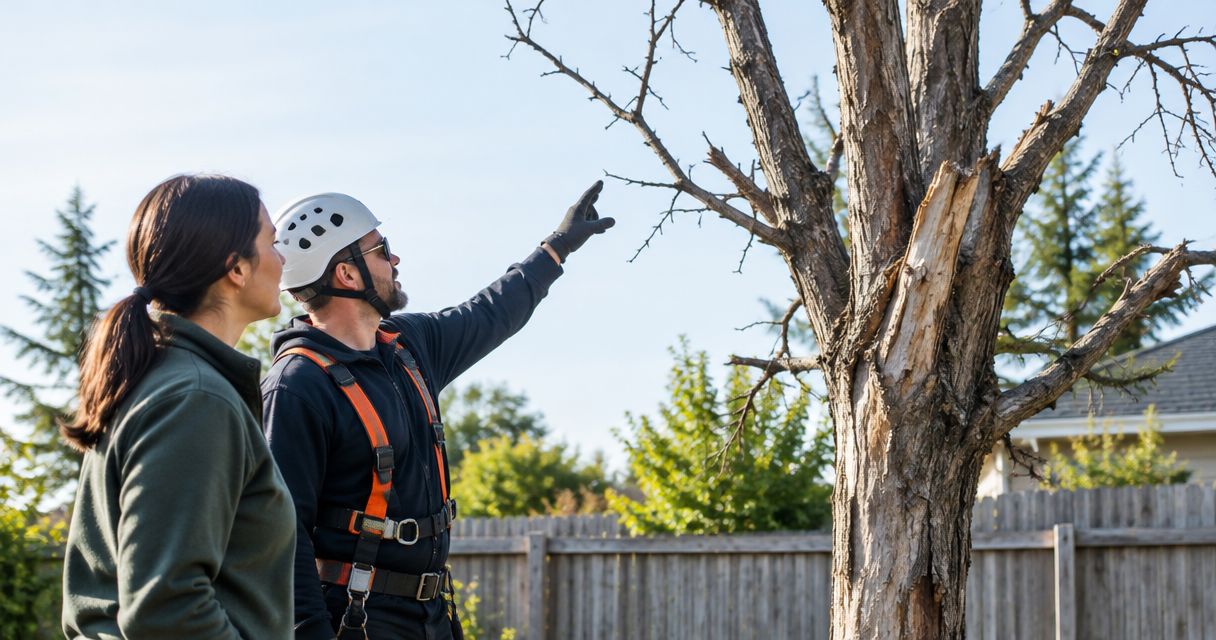
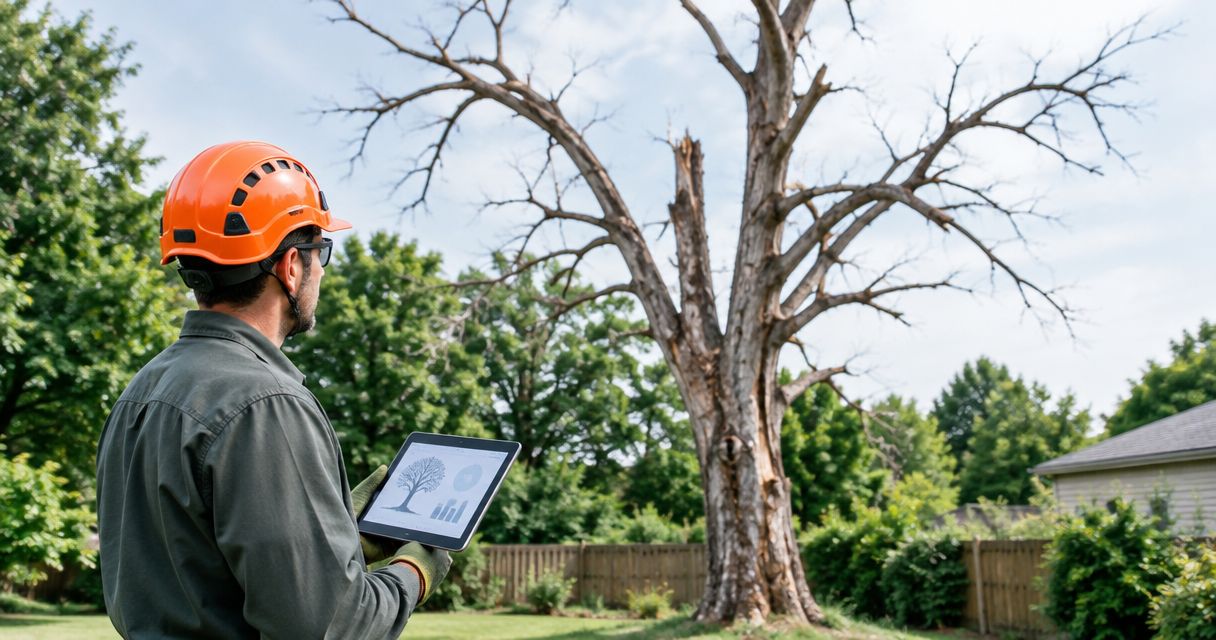
Look from a safe location for hanging limbs, broken branches caught in the crown, cracks, and changes around the base. Treat those observations as information to report, not an invitation to investigate more closely.
Dead branches can break, and a damaged tree can behave unpredictably. Do not climb the tree, shake it, pull a hanging branch, or stand beneath the crown to get a clearer photograph.
- Keep people and pets away from the affected area.
- Describe any recent change, such as a new lean or a branch that broke during a storm.
- Tell the contractor if the tree affects a route people regularly use.
- Photograph only from a position that does not require entering the hazard area.
If a tree or branch touches a power line, stay away and contact the utility. Do not touch the tree, wire, or anything in contact with them; contact emergency services when there is immediate danger to people.
Confirm ownership and permission before authorizing work
Check that you have authority to remove the tree. A tree near a fence is not proof that the fence marks the property boundary, and a neighbor’s verbal assumption is not a substitute for resolving a disputed location.
If you rent, manage a shared property, or act for a commercial owner, establish who must approve the work. Identify the person who can authorize changes if the site assessment reveals a different scope.
For a 2026 project, check current requirements with the relevant local authority and any applicable property association. Do not assume that a dead tree is automatically exempt from every permission requirement.
Keep approvals with the quote and site photographs. Resolve a boundary dispute before authorizing removal, rather than asking the contractor to settle ownership during the job.
Identify what the tree could strike
Tell the contractor about the house, garage, neighboring buildings, fences, parked vehicles, and outdoor fixtures around the tree. Include features behind or beneath the tree that are difficult to see in a close-up photograph.
A useful description explains both the obstacle and how the space is used. For example, identify a shared driveway as a shared driveway, not simply as pavement beside the trunk.
Commercial property managers should flag entrances, loading areas, pedestrian routes, and parking spaces that must be considered in the work plan. Homeowners should identify regularly used doors, paths, and play areas.
For a tree close to a building, use the guide to arranging dead tree removal near a house to organize the details for your quote request. Do not move closer to a hazardous tree just to document the building clearance.
Describe access before asking for a quote
Explain how the contractor would reach the tree from the road or parking area. Mention locked gates, steps, steep ground, narrow passages, and surfaces you want protected.
Measurements help only when you can take them safely. Record a gate opening from an unaffected area, but do not enter the tree’s potential fall area to measure the trunk or estimate its height.
Also identify septic components, irrigation, drainage features, and other known underground installations along the proposed access route. Do not assume that a lawn or paved surface can support every work method.
For your 2026 quote request, include:
- The property address and county.
- A wide view showing the tree and its surroundings.
- A description of the access route and any locked entry.
- Known obstacles above and below ground.
- Any limits on parking or use of shared areas.
Ask the contractor to confirm the access plan after assessing the site. A photograph of the gate does not establish that the full route is suitable.
Separate tree removal, stump work, and debris handling
Do not treat the phrase tree removal as a complete description of the finished job. Ask what happens to the trunk, branches, stump, and material produced by any stump work.
These are scope choices, not interchangeable services. The table below shows what to clarify; it does not describe a standard package or promise what any contractor includes.
| Requested scope | Best for | Main benefit | Limitation to clarify |
|---|---|---|---|
| Tree removal without stump work | Owners addressing the standing tree first | Keeps the immediate task clearly defined | The stump remains unless separately addressed |
| Tree removal with stump work | Owners planning to reuse the area | Addresses both the standing tree and the stump | Ask about remaining roots, material, and final ground condition |
| Removal with debris hauled away | Owners who do not want wood left onsite | Establishes an offsite debris requirement | Confirm which material is included |
| Removal with selected wood retained | Owners with a defined use for the wood | Keeps agreed material on the property | Requires a safe placement area and a clear agreement |
If you want wood retained, specify where it should go and what preparation you expect. Do not assume that retained wood will be split, stacked, or prepared for burning.
If you plan to plant, pave, or build afterward, describe that next use. Removing a stump does not by itself define excavation, backfilling, grading, or surface restoration.
Why dead tree removal plans vary
A site assessment connects the tree’s condition with the constraints around it. These factors explain why a description or photograph alone does not settle the final work plan:
- Tree condition: Broken limbs, cracks, and instability affect how the contractor approaches the tree.
- Nearby targets: Buildings, fences, overhead wires, and public routes require specific consideration.
- Access restrictions: Gates, slopes, narrow passages, and surface conditions limit the available approach.
- Debris instructions: Hauling material away and retaining selected wood create different handling requirements.
- Stump and restoration scope: Stump work, material removal, backfilling, and surface repair need separate clarification.
- Property use: Shared access, tenants, visitors, and business activity affect coordination around the work area.
Do not select a cutting method yourself based on an online example. Describe the outcome you need and ask the contractor to explain the proposed approach after inspection.
What should a written removal quote include?
A useful written quote identifies the tree, the agreed work, the exclusions, and what will remain afterward. If several trees look similar, use photographs or a clearly described location to prevent confusion.
Before accepting a 2026 quote, check that the document answers these questions:
- Which tree is being removed, and which nearby trees must remain untouched?
- Is stump work included, excluded, or listed separately?
- Will branches, trunk sections, and other debris leave the property?
- Where will any retained material be placed?
- What property protection and access arrangements are agreed?
- What ground condition and cleanup are included?
- Who approves additional work or a change in scope?
Ask for evidence of applicable insurance and verify it with the insurer when needed. Also ask who will perform the work and who your onsite contact will be; do not infer either from the name on the quote.
Pmmidlands is a local tree-services option for property owners in its confirmed South Carolina service area. Request a site-specific scope rather than assuming that stump work, hauling, or restoration comes with removal.
Request a site-specific tree quote
Describe the tree, nearby structures, access route, and the cleanup you want included.
Can you arrange dead tree removal using photos alone?
Photos help explain the job, but they do not replace a site assessment of condition, access, and nearby hazards. Send a wide view and a description of what is outside the frame rather than relying on a close-up of the trunk.
Ask whether the written scope is final or subject to inspection. Do not authorize work on the assumption that an initial photo-based discussion has resolved every site constraint.
Does dead tree removal automatically include the stump?
Dead tree removal does not establish that stump work is included; the written agreement must say so. Ask separately about the stump, remaining material, and the condition of the ground afterward.
If your next project depends on a clear planting or construction area, explain that before accepting the scope. A request to remove the standing tree is not the same as a request to prepare the ground for a new use.
FAQ
What should I check first before booking dead tree removal?
Check for immediate hazards from a safe distance, especially damaged limbs, nearby people, buildings, and power lines. Keep away from the tree and report what you can see without approaching it.
Who should I call if a dead tree is touching power lines?
Contact the utility and stay away from the tree and wires. Contact emergency services if there is immediate danger to people, and do not attempt to move branches yourself.
Do I need permission to remove a dead tree in South Carolina?
Check current local requirements and any applicable property restrictions before authorizing removal. Confirm ownership and approval authority rather than assuming a dead tree is exempt.
Can I compare tree removal quotes by the total alone?
Compare the written scopes before comparing totals. Stump work, debris hauling, retained wood, access arrangements, and restoration must be clear for the quotes to describe the same job.
What should I tell a tree contractor about backyard access?
Describe gates, narrow passages, slopes, steps, surface conditions, and known underground installations. Let the contractor assess the full route rather than assuming a gate measurement proves access is suitable.
Can I leave the wood on my property after removal?
Request retained wood explicitly and agree on its placement and preparation. Do not assume the contractor will split, stack, or move it to a particular location unless the agreement includes that work.
Which counties does Pmmidlands serve for tree services?
Pmmidlands serves Richland, Lexington, Newberry, Orangeburg, Sumter, Kershaw, and Fairfield counties in South Carolina. Provide your property location when requesting a site-specific quote.
One last thing
Describe the finished property, not just the tree you want gone. For your 2026 project, write down whether you expect an area ready for mowing, space for planting, retained wood, or further ground preparation.
That final-use description gives the contractor something concrete to assess. It also exposes the gap between removing a tree and completing everything you need afterward.