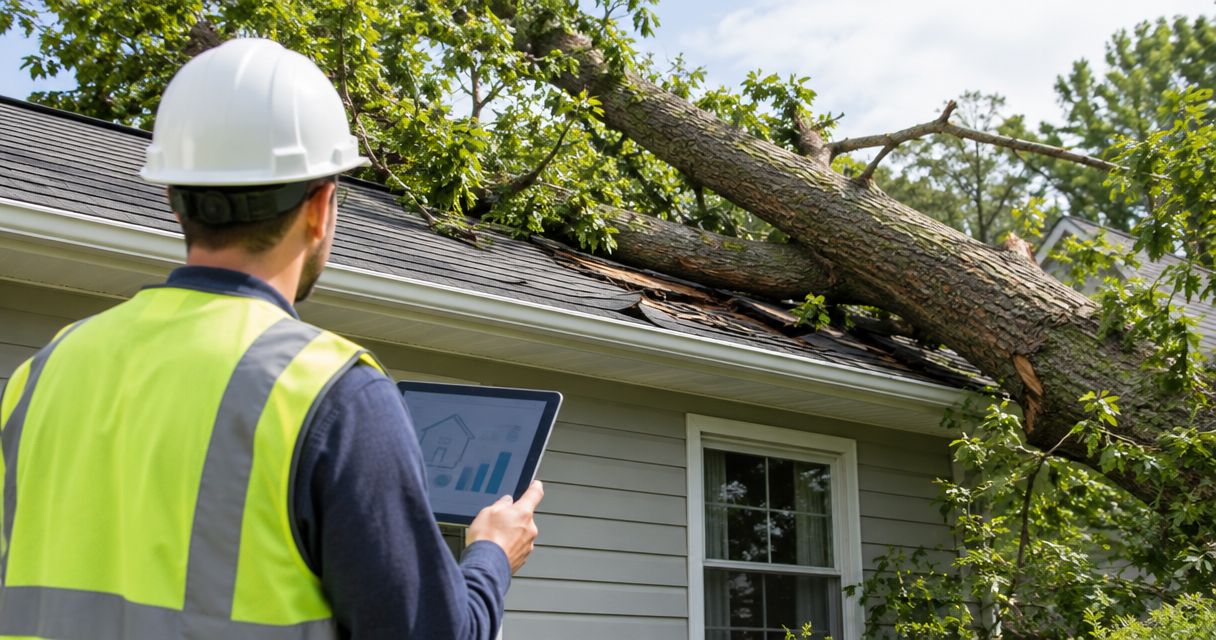
For fallen tree removal from a roof, contact a professional tree service to assess and plan the removal; contact emergency services first if anyone is injured, trapped, or in immediate danger. If the tree touches power lines, stay away and notify the electric utility. A roofer handles roof protection and repairs, while your insurer explains the claim process and documentation requirements.
- Fallen tree removal from a roof needs a professional tree-service assessment, not homeowner cutting or pulling.
- Call 911 for immediate danger; contact the electric utility when wires are involved.
- A tree service removes the tree; a roofer assesses roof protection and repairs.
- Pmmidlands handles tree-service inquiries within its confirmed South Carolina service area; request a site-specific assessment.
Who should you contact for fallen tree removal from a roof?
Contact a tree service for removal, but let the immediate hazard determine your first call. A tree resting on a roof creates a different problem from a fallen branch lying flat in the yard. Cutting, lifting, or shifting it changes how its weight bears on the building.
Before arranging work, review what to do before fallen tree removal. Keep everyone away from the affected area while you make calls.
| Contact | Best for | Main role | Important limitation |
|---|---|---|---|
| Emergency services | Injuries, entrapment, or immediate danger | Emergency response and scene safety | Not a substitute for arranging tree removal or roof repairs |
| Electric utility | A tree touching wires or damaged electrical equipment | Assessing and addressing electrical hazards | Electrical clearance does not establish that the roof is safe |
| Professional tree service | Planning and carrying out tree removal | Assessing tree position, access, and removal requirements | Tree removal does not automatically include roof repairs |
| Roofing contractor | Roof openings and roof damage | Assessing roof protection and repair needs | Roof work is separate from releasing the tree's weight |
| Insurance company | Claim reporting and coverage questions | Explaining documentation and claim requirements | Coverage guidance is not a physical safety assessment |
These contacts serve different purposes. You might need several of them, but an insurance call must not delay a response to immediate danger.
Why this matters
A tree on a roof is both a tree-removal job and a potential building-safety problem. The visible branches do not tell you how much weight the roof carries, whether a trunk is under tension, or what will move when a cut is made.
Do not climb onto the roof, cut supporting branches, or pull the tree with a vehicle. Stay out of rooms beneath visible damage until the relevant emergency responder or qualified building professional has assessed the danger. Do not enter a damaged area to retrieve possessions or take better photographs.
For a 2026 incident, start a simple record of what happened, whom you contacted, and what instructions you received. Documentation helps organize the job; it does not make entering an unsafe area necessary.
What should you do before the tree service arrives?
Use this sequence to organize your response. The safety decisions come before photographs, quote comparisons, or cleanup.
- Keep clear. Move people and pets away from the damaged building section, the fallen tree, and hanging branches. Do not walk underneath the tree to inspect the impact point.
- Report danger. Call 911 for injuries, entrapment, or immediate danger. If wires are involved, notify the electric utility and keep away from the tree, wires, and anything touching them.
- Request assessment. Tell the tree service that the tree is resting on a roof, not simply lying in the yard. Describe any visible wires, blocked access, or additional hanging limbs without approaching them.
- Document safely. Take photographs only from a safe position. Record the date, visible damage, and the location of the tree relative to the building.
- Coordinate repairs. Notify your insurer and arrange a roofing assessment. Ask the contractors how removal and roof protection need to be sequenced.
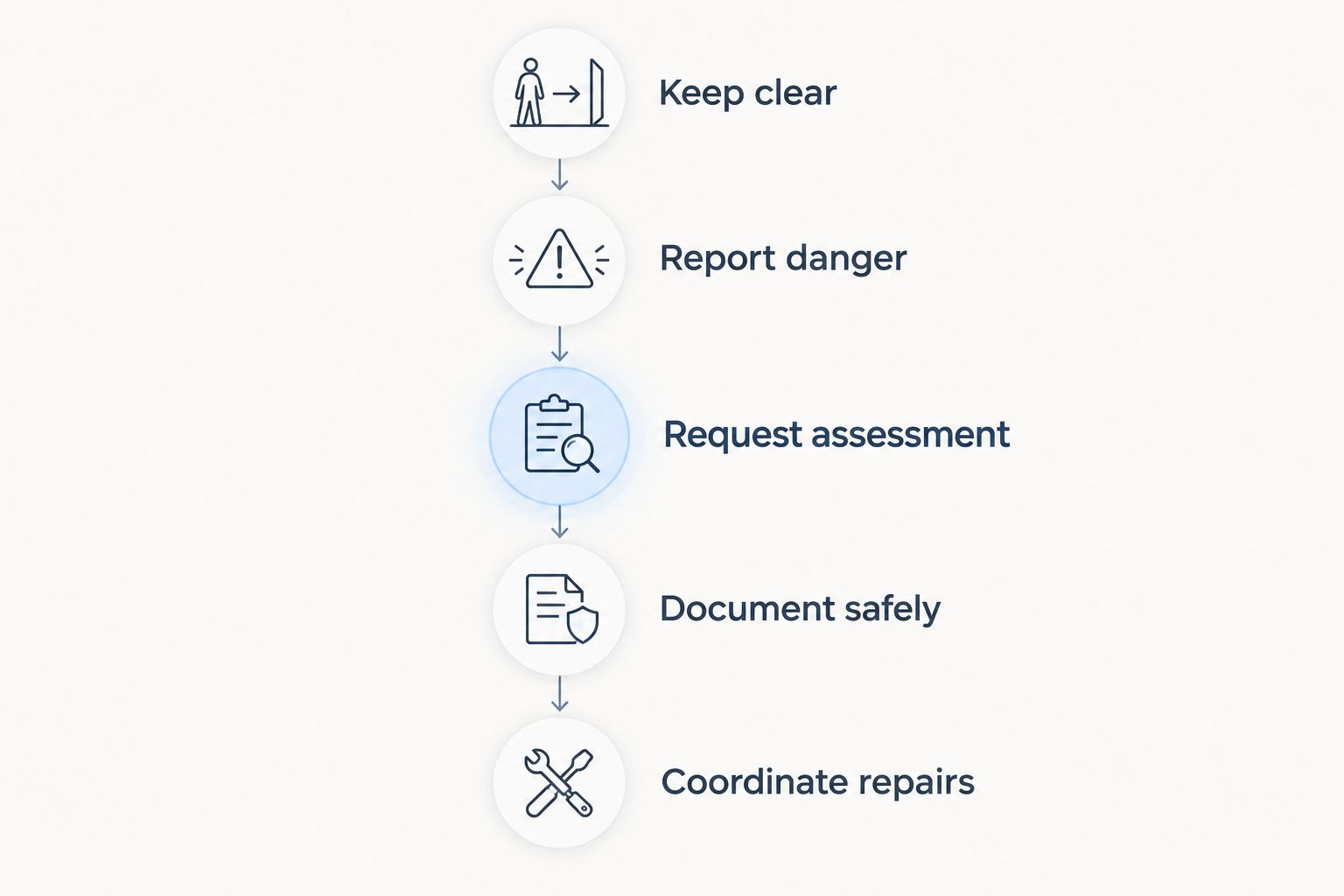
You do not need to diagnose the tree's stability before calling. Describe what you can see from safety, then let the site assessment establish the removal plan.
Why fallen tree removal plans vary
A useful removal plan addresses the tree, the building, and the route workers can use. A photograph helps explain the situation, but it does not replace inspection of the site.
- Roof contact: A trunk resting across a roof presents different support and movement questions from branches resting against an eave.
- Tree condition: Splits, hanging limbs, and an attached or uprooted root system affect what needs assessment before cutting.
- Electrical involvement: Wires and damaged electrical equipment require utility involvement rather than assumptions about whether power is off.
- Site access: Gates, fences, driveways, slopes, and nearby structures affect how the removal can be approached.
- Building condition: Visible sagging, openings, and damaged walls require attention beyond tree removal alone.
- Cleanup scope: Removing the tree from the roof, hauling wood away, and addressing the remaining stump are separate scope questions.
Ask for a plan based on your property, not a promise based only on the tree's apparent size. Do not move a fence, vehicle, or other obstacle if reaching it takes you into the hazard area.
What should you tell the tree service when you call?
Lead with the roof involvement and the property location. Then explain whether anyone is in danger and whether power lines are involved. Clear information helps the person taking your call understand the assessment you need.
Have these details ready for a 2026 service request:
- The property address and county.
- Whether the building is a house, rental property, or commercial building.
- Where the trunk and branches appear to touch the roof.
- Whether the tree is still attached to its stump or root system.
- Any visible roof opening, sagging, or damaged wall.
- The usable driveway, gate, or other access route.
- Whether emergency services or the electric utility have already attended.
- Photographs taken without entering the affected area.
State observations rather than conclusions. For example, report that a branch touches a wire rather than declaring the wire safe, and describe visible roof sagging rather than deciding the building is structurally sound.
For commercial properties, identify the person authorized to approve work. Explain any occupied areas, shared entrances, or access restrictions that contractors need to consider.
What should a roof-related tree-removal quote explain?
A useful quote separates removing the tree from repairing the building. Before approving work, confirm what is included and which tasks belong to another contractor.
Ask how the proposed work addresses the portion on the roof, the remaining tree, and the debris. Confirm whether hauling, stump work, and cleanup are included or excluded. A cleared roof does not necessarily mean the entire property will be cleared of wood.
The written scope should also identify access arrangements and any prerequisites, such as utility involvement. Ask who will coordinate with the roofer and how changes discovered during work will be discussed before additional work proceeds.
Use the guide to comparing a tree-removal quote in South Carolina to check scope rather than comparing totals alone. Keep the accepted 2026 quote, photographs, correspondence, and invoices together so you can distinguish agreed work from later changes.
Do not accept an unsafe shortcut simply because it sounds simpler. Pulling a tree off a roof without an assessment is not equivalent to a removal plan.
Who can you contact in the confirmed South Carolina service area?
Pmmidlands is best for local tree-service inquiries within its confirmed South Carolina service area. That area covers Richland, Lexington, Newberry, Orangeburg, Sumter, Kershaw, and Fairfield counties.
When contacting Pmmidlands about tree services, explain that the tree is on a roof and request a site-specific assessment. Confirm whether the particular job can be accepted, what the proposed scope includes, and what coordination is needed with your utility, insurer, or roofer.
A local inquiry is a starting point, not confirmation of a removal method or completion date. The condition of the tree and building must guide those decisions.
Request a site-specific tree assessment
Describe the roof contact, property location, access, and any known electrical hazards.
Should you call your insurer before removing the tree?
Contact your insurer promptly, but do not delay emergency help to obtain claim instructions. Ask what documentation is needed, how to report urgent protective work, and whether an adjuster needs to inspect before nonemergency work begins.
For a 2026 claim, keep the incident date and each contractor's scope clearly recorded. Save photographs taken safely, written estimates, invoices, and messages concerning authorization.
Do not assume that tree removal, roof repair, debris hauling, and stump work receive identical treatment under your policy. Your insurer must explain the applicable coverage, deductible, and claim requirements. A contractor's willingness to do the work does not establish insurance coverage.
If the tree originated on neighboring property, record that fact without entering the neighbor's property or deciding responsibility yourself. Share the information with your insurer and discuss access with the property owner when it is safe to do so.
Does removing the tree make the roof safe?
Removing the tree does not establish that the roof is safe or watertight. A roofing contractor should assess visible roof damage and determine what protection or repairs are appropriate. Suspected structural damage also needs assessment by a qualified building professional.
Coordinate the handoff before removal begins where circumstances allow. Ask who will inspect the exposed area, who will address openings, and how the work area will remain restricted until it is safe.
Do not climb up to inspect the roof after the tree is gone. Damage beneath roofing materials or within the supporting structure is not something a ground-level photograph can rule out.
Can you remove branches yourself to help the crew?
Do not cut branches attached to a tree resting on a roof. Branches can be supporting other parts of the tree, and cutting them changes the load. A small-looking piece is not automatically safe to remove.
Leave ropes, ladders, chainsaws, and vehicles out of the removal attempt. Help instead by sharing safe access information, identifying the person authorized to approve work, and keeping occupants away from the affected area.
Once the site is assessed, ask which unrelated areas you can use safely. Do not interpret the absence of visible movement as permission to start cleanup.
FAQ
Who should I call first when a tree falls on my roof?
Call 911 first if anyone is injured, trapped, or in immediate danger. Otherwise, contact a professional tree service for assessment, notify the electric utility if wires are involved, and arrange roofing and insurance follow-up.
Should I call a roofer or a tree service for fallen tree removal?
Contact a tree service for fallen tree removal and a roofer for roof protection and repairs. Coordinate the work because removing the tree and repairing the building are separate tasks.
Can I stay inside after a tree falls on my roof?
Do not use the area beneath visible damage or enter an area that appears unsafe. Follow emergency responders' instructions and obtain a qualified assessment rather than deciding safety from appearances.
What should I do if the fallen tree touches a power line?
Stay away and notify the electric utility if the fallen tree touches a power line. Do not touch the tree, wire, or nearby objects in contact with them, and do not assume a quiet or fallen wire is de-energized.
Will homeowners insurance cover removing a tree from my roof?
Your insurer must determine coverage under your policy and the circumstances of the loss. Ask separately about tree removal, roof repairs, debris hauling, documentation, and authorization requirements.
What information helps when requesting a roof-related tree-removal quote?
Provide the property location, roof-contact description, known electrical hazards, access details, and photographs taken safely. Explain any emergency-service or utility involvement and request a site-specific assessment.
Does fallen tree removal include the stump and all debris?
Stump removal and debris hauling must be confirmed in the written scope. Do not assume that removing the tree from the roof includes every remaining piece of wood or the stump.
One last thing
Decide who takes responsibility for the next stage before the tree leaves the roof. Removal exposes the area the roofer needs to inspect, but it does not complete the repair. Ask the tree service and roofing contractor to clarify that handoff rather than leaving it until the site is being packed up.
If you contact Pmmidlands for a 2026 tree-service inquiry, start with your county, the roof involvement, and any known hazards. Request an assessment and a written scope; keep emergency decisions separate from routine quote requests.